State Key Laboratory of Quantum Optics and Quantum Optics Devices, Institute of Laser Spectroscopy, Shanxi University, Taiyuan 030006, China.
Collaborative Innovation Center of Extreme Optics, Shanxi University, Taiyuan 030006, China.
Nat Commun. 2017 May 31;8:15331. doi: 10.1038/ncomms15331.
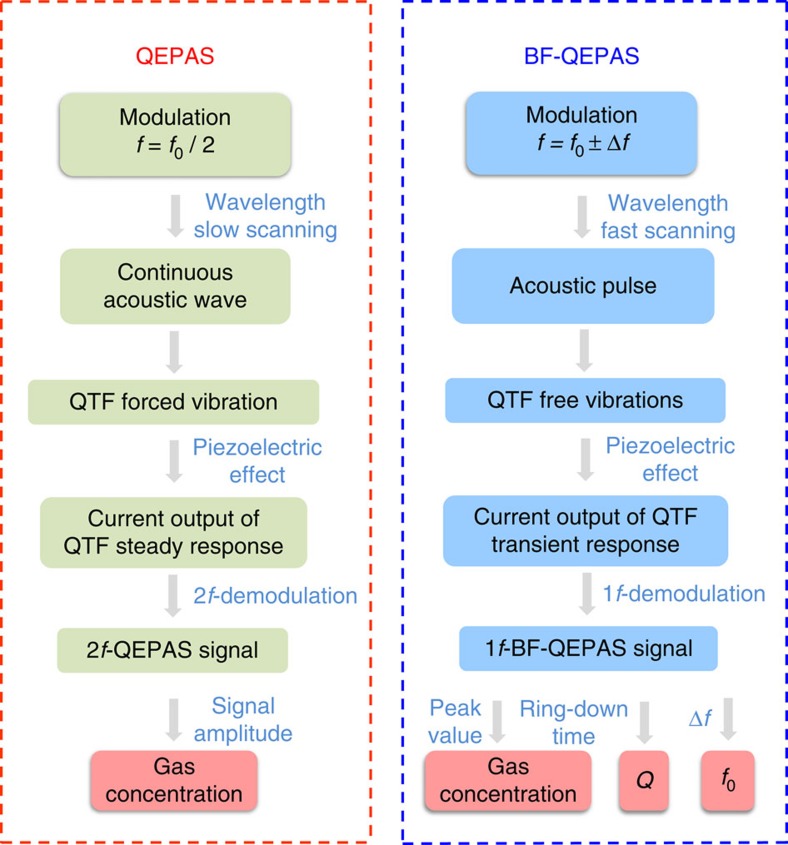
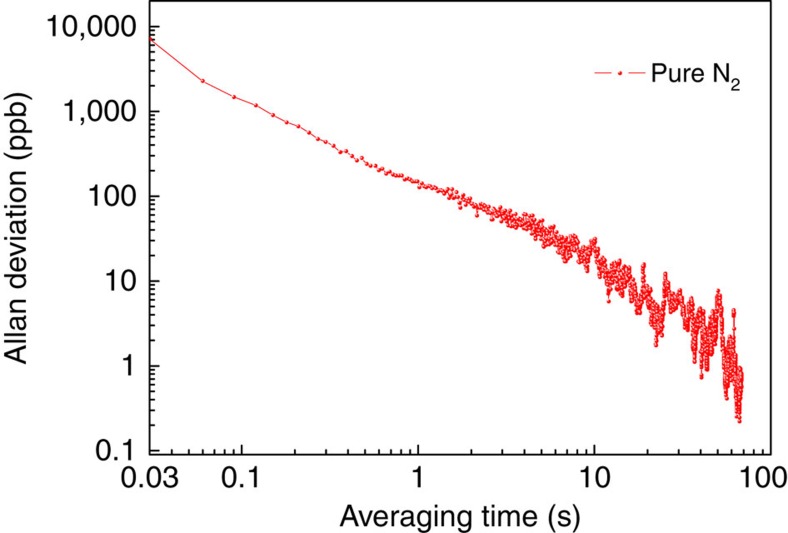
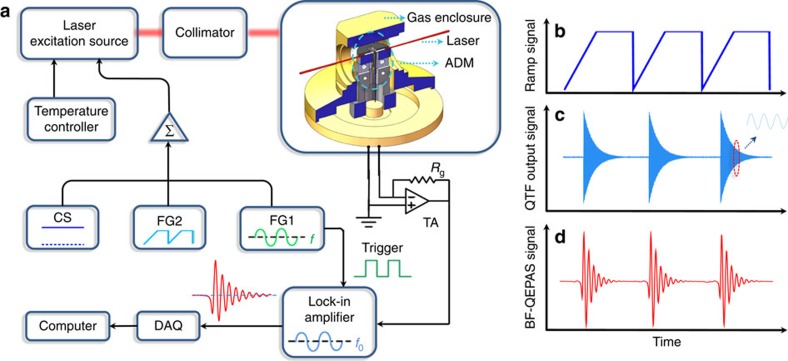
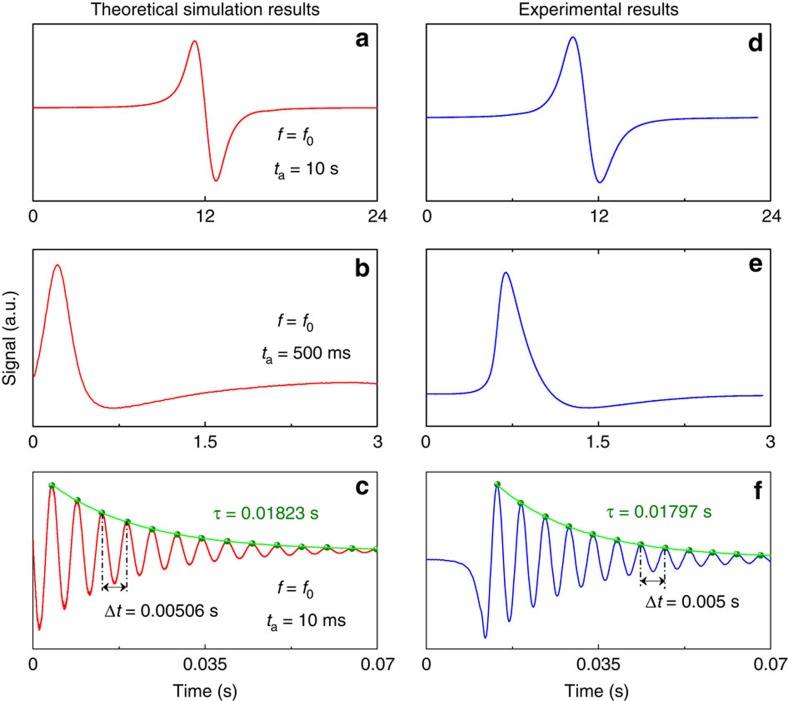
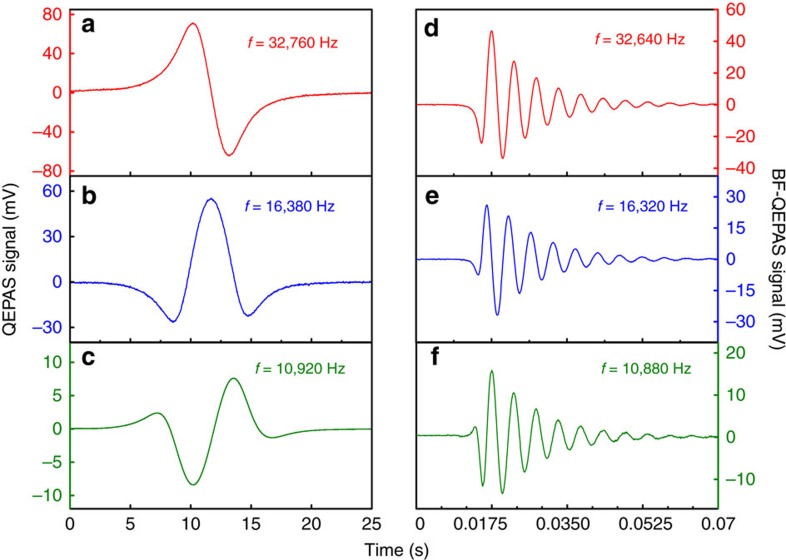
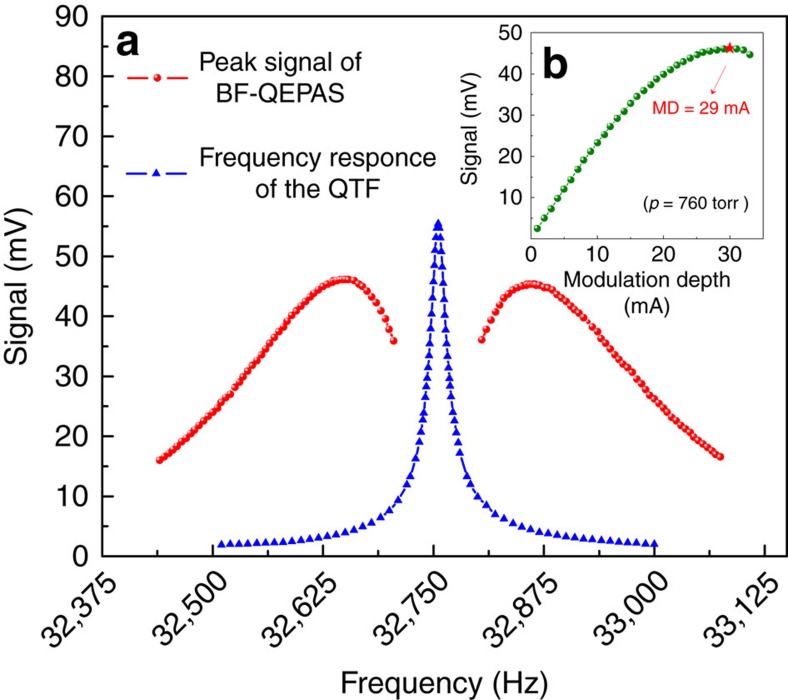
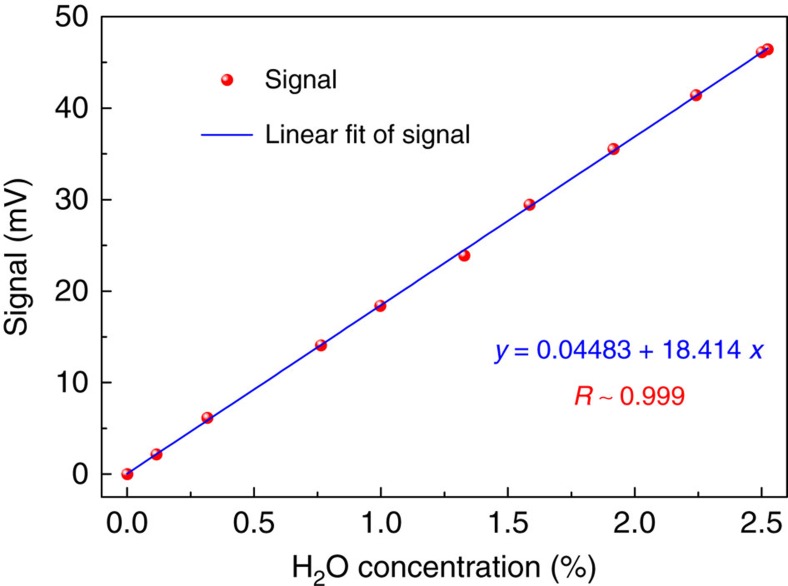
Quartz-enhanced photoacoustic spectroscopy (QEPAS) is a sensitive gas detection technique which requires frequent calibration and has a long response time. Here we report beat frequency (BF) QEPAS that can be used for ultra-sensitive calibration-free trace-gas detection and fast spectral scan applications. The resonance frequency and Q-factor of the quartz tuning fork (QTF) as well as the trace-gas concentration can be obtained simultaneously by detecting the beat frequency signal generated when the transient response signal of the QTF is demodulated at its non-resonance frequency. Hence, BF-QEPAS avoids a calibration process and permits continuous monitoring of a targeted trace gas. Three semiconductor lasers were selected as the excitation source to verify the performance of the BF-QEPAS technique. The BF-QEPAS method is capable of measuring lower trace-gas concentration levels with shorter averaging times as compared to conventional PAS and QEPAS techniques and determines the electrical QTF parameters precisely.
石英增强光声光谱学(QEPAS)是一种灵敏的气体检测技术,需要频繁的校准且响应时间长。我们在此报告拍频(BF)QEPAS,它可用于超灵敏的无校准痕量气体检测和快速光谱扫描应用。通过检测石英音叉(QTF)瞬态响应信号在非共振频率下解调时产生的拍频信号,可以同时获得 QTF 的共振频率和 Q 因子以及痕量气体浓度。因此,BF-QEPAS 避免了校准过程,并允许对目标痕量气体进行连续监测。选择了三个半导体激光器作为激励源来验证 BF-QEPAS 技术的性能。与传统的 PAS 和 QEPAS 技术相比,BF-QEPAS 方法能够以更短的平均时间测量更低的痕量气体浓度水平,并能精确地确定 QTF 的电学参数。