Lu Yang, Huang Jing, Geng Shuang, Chen Hao, Song Cheng, Zhu Shan, Zhao Su, Yuan Mingli, Li Xueying, Hu Hongling
Department of Respiratory Medicine, Key Laboratory for Molecular Diagnosis of Hubei Province, Central Hospital of Wuhan, Tongji Medical College, Huazhong University of Science and Technology, Wuhan, Hubei 430017, P.R. China.
Exp Ther Med. 2017 May;13(5):1697-1701. doi: 10.3892/etm.2017.4161. Epub 2017 Feb 23.
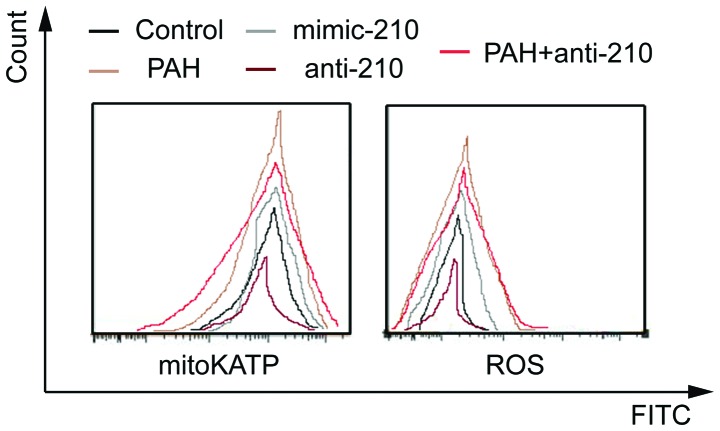
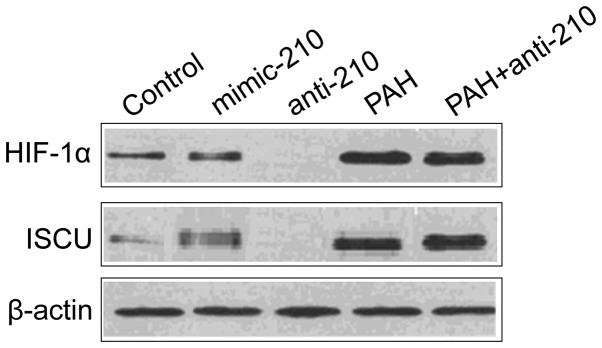
In the present study, we studied the mechanism of mitochondrial ATP-sensitive potassium (mitoKATP) channels regulating hypoxia-inducible factor (HIF)-1α/microRNA (miR)-210/mitochondrial iron-sulfur protein integrin (ISCU) signaling axis and forming a positive feedback loop in chronic hypoxia-induced pulmonary arterial hypertension (PAH) by using animal model. Two hundred healthy adult SPF Sprague-Dawley rats were randomly divided into five groups: Control, a mimic miR-210 agent (mimic-210) intervention, a miR-210 inhibitor (anti-210) intervention, a chronic PAH and an anti-210 intervention PAH groups, with 40 rats in each group. After the chronic PAH rat model was successfully established, the rats were intervened with mimic-210 and anti-210. The pulmonary artery smooth muscle cells (PASMCs) of rats in each group were acutely isolated and the activity of mitoKATP and mitochondria-derived oxygen free radicals reactive oxygen species (ROS) was detected. RT-qPCR was used to detect the gene of HIF-1α/miR-210/ISCU and western blot analysis was used to detect the protein of HIF-1α and ISCU. The gene and protein expression were detected again after mitoKATP-specific opener diazoxide and blocker 5-HD was given via tail vein and took effect on each group of rats, respectively. Additionally, the indicators were detected again after ISCU recombinant protein was given via tail vein and ISCU small interfering RNA (siRNA) via nasal feeding and took effect on each group of rats, respectively. It was found that the activity of mitoKATP and ROS and the gene and protein levels of HIF-1α/miR-210/ISCU of the mimic-210 group were significantly higher than those of the control group while that of the anti-210 group was significantly reduced (P<0.05). The indicators in the chronic PAH group were significantly higher than those of the control group while those of the anti-210 intervention PAH group were significantly reduced (P<0.05). The indicators of all the groups were increased after being given mitoKATP specific opener diazoxide. The indicators of all the groups were significantly reduced after receiving blocker 5-HD (P<0.05). The indicators of all the groups were significantly reduced after given ISCU recombinant protein. The indicators of all the groups increased following ISCU siRNA, and there was a statistically significant difference (P<0.05). In conclusion, the mechanism of mitoKATP regulating the HIF-1α/miR-210/ISCU signaling axis and formation of a positive feedback loop exists in the PAH rat model.
在本研究中,我们通过动物模型研究了线粒体ATP敏感性钾通道(mitoKATP)调节缺氧诱导因子(HIF)-1α/微小RNA(miR)-210/线粒体铁硫蛋白整合素(ISCU)信号轴并在慢性缺氧诱导的肺动脉高压(PAH)中形成正反馈环的机制。将200只健康成年SPF级Sprague-Dawley大鼠随机分为五组:对照组、模拟miR-210剂(模拟-210)干预组、miR-210抑制剂(抗-210)干预组、慢性PAH组和抗-210干预PAH组,每组40只大鼠。成功建立慢性PAH大鼠模型后,对大鼠进行模拟-210和抗-210干预。急性分离每组大鼠的肺动脉平滑肌细胞(PASMCs),检测mitoKATP活性和线粒体衍生的氧自由基活性氧(ROS)。采用RT-qPCR检测HIF-1α/miR-210/ISCU基因,采用蛋白质免疫印迹分析检测HIF-1α和ISCU蛋白。经尾静脉分别给予mitoKATP特异性开放剂二氮嗪和阻滞剂5-HD并对每组大鼠起效后,再次检测基因和蛋白表达。此外,经尾静脉给予ISCU重组蛋白和经鼻饲给予ISCU小干扰RNA(siRNA)并对每组大鼠起效后,再次检测各项指标。结果发现,模拟-210组的mitoKATP和ROS活性以及HIF-1α/miR-210/ISCU的基因和蛋白水平均显著高于对照组,而抗-210组则显著降低(P<0.05)。慢性PAH组的各项指标显著高于对照组,而抗-210干预PAH组则显著降低(P<0.05)。给予mitoKATP特异性开放剂二氮嗪后,所有组的指标均升高。给予阻滞剂5-HD后,所有组的指标均显著降低(P<0.05)。给予ISCU重组蛋白后,所有组的指标均显著降低。给予ISCU siRNA后,所有组的指标均升高,且差异具有统计学意义(P<0.05)。综上所述,PAH大鼠模型中存在mitoKATP调节HIF-1α/miR-210/ISCU信号轴并形成正反馈环的机制。