Xu Wei-Long, Liu Su, Li Nan, Ye Li-Fang, Zha Min, Li Chang-Yin, Zhao Yue, Pu Qiang, Bao Jin-Jing, Chen Xing-Jie, Yu Jiang-Yi, Pei Ying-Hao
Department of Endocrinology, Jiangsu Province Hospital of Chinese Medicine, Affiliated Hospital of Nanjing University of Traditional Medicine, Nanjing, China.
Department of Clinical Pharmacology, Jiangsu Province Hospital of Chinese Medicine, Affiliated Hospital of Nanjing University of Traditional Medicine, Nanjing, China.
Front Med (Lausanne). 2021 Mar 4;8:656086. doi: 10.3389/fmed.2021.656086. eCollection 2021.
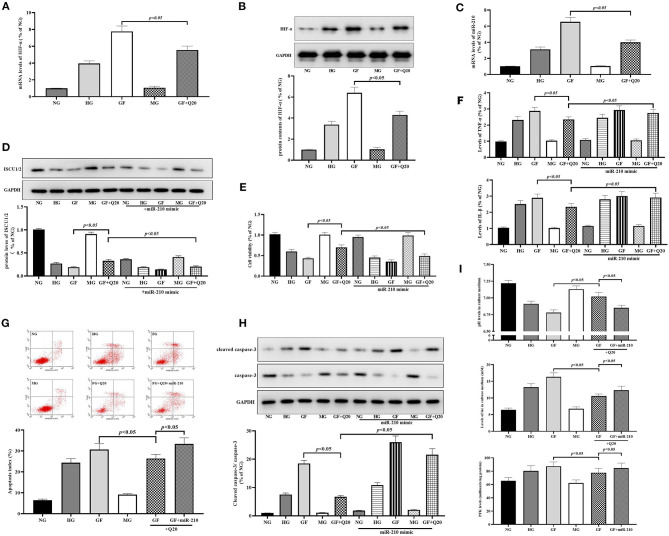
Glucose fluctuation (GF) has been reported to induce renal injury and diabetic nephropathy (DN). However, the mechanism still remains ambiguous. Mitochondrial energy metabolism, especially aerobic glycolysis, has been a hotspot of DN research for decades. The activation of HIF-1α/miR210/ISCU/FeS axis has provided a new explanation for aerobic glycolysis. Our previous studies indicated quercetin as a potential therapeutic drug for DN. This study aims to evaluate levels of aerobic glycolysis and repressive effect of quercetin via HIF-1α/miR210/ISCU/FeS axis in a cell model of GF. The mouse glomerular mesangial cells (MCs) were exposed in high or oscillating glucose with or without quercetin treatment. Cell viability was measured by CCK8 assay. Aerobic glycolysis flux was evaluated by lactate acid, pH activity of PFK. Apoptosis level was confirmed by Annexin V-APC/7-AAD double staining and activity of caspase-3. TNF-α and IL-1β were used to evaluate inflammation levels. GF deteriorated inflammation damage and apoptosis injury in MCs, while quercetin could alleviate this GF-triggered cytotoxicity. GF intensified aerobic glycolysis in MCs and quercetin could inhibit this intensification in a dose-dependent manner. Quercetin prevented activities of two FeS-dependent metabolic enzymes, aconitase, and complex I, under GF injury in MCs. The mRNA expression and protein contents of HIF-1α were increased after GF exposure, and these could be alleviated by quercetin treatment. Knockdown of ISCU by siRNA and Up-regulating of miR-210 by mimic could weaken the effects of quercetin that maintained protein levels of ISCU1/2, improved cell viability, relieved inflammation injury, decreased apoptosis, and reduced aerobic glycolysis switch in MCs. Quercetin antagonizes GF-induced renal injury by suppressing aerobic glycolysis via HIF-1α/miR-210/ISCU/FeS pathway in MCs cell model. Our findings contribute to a new insight into understanding the mechanism of GF-induced renal injury and protective effects of quercetin.
据报道,葡萄糖波动(GF)可诱发肾损伤和糖尿病肾病(DN)。然而,其机制仍不明确。几十年来,线粒体能量代谢,尤其是有氧糖酵解,一直是DN研究的热点。HIF-1α/miR210/ISCU/FeS轴的激活为有氧糖酵解提供了新的解释。我们之前的研究表明槲皮素是一种治疗DN的潜在药物。本研究旨在评估在GF细胞模型中,槲皮素通过HIF-1α/miR210/ISCU/FeS轴对有氧糖酵解水平的影响及其抑制作用。将小鼠肾小球系膜细胞(MCs)暴露于高糖或波动葡萄糖环境中,并给予或不给予槲皮素处理。通过CCK8法检测细胞活力。通过乳酸、磷酸果糖激酶(PFK)的pH活性评估有氧糖酵解通量。通过Annexin V-APC/7-AAD双染和半胱天冬酶-3活性确认细胞凋亡水平。使用肿瘤坏死因子-α(TNF-α)和白细胞介素-1β(IL-1β)评估炎症水平。GF会加重MCs中的炎症损伤和凋亡损伤,而槲皮素可以减轻这种由GF引发的细胞毒性。GF会增强MCs中的有氧糖酵解,而槲皮素可以剂量依赖性地抑制这种增强作用。在MCs受到GF损伤时,槲皮素可抑制两种依赖铁硫簇(FeS)的代谢酶即乌头酸酶和复合体I的活性。GF暴露后,HIF-1α的mRNA表达和蛋白含量增加,而槲皮素处理可使其减轻。通过小干扰RNA(siRNA)敲低ISCU以及通过模拟物上调miR-210可削弱槲皮素维持ISCU1/2蛋白水平、提高细胞活力、减轻炎症损伤、降低细胞凋亡以及减少有氧糖酵解转换的作用。在MCs细胞模型中,槲皮素通过HIF-1α/miR-210/ISCU/FeS途径抑制有氧糖酵解,从而拮抗GF诱导的肾损伤。我们的研究结果有助于深入了解GF诱导肾损伤的机制以及槲皮素的保护作用。