Simblett Sara K, Yates Matthew, Wagner Adam P, Watson Peter, Gracey Fergus, Ring Howard, Bateman Andrew
Institute of Psychiatry, Psychology and Neuroscience, Department of Psychology, King's College London, London, United Kingdom.
Department of Psychiatry, University of Cambridge, Cambridge, United Kingdom.
JMIR Ment Health. 2017 May 31;4(2):e16. doi: 10.2196/mental.6022.
Depression and anxiety are common complications following stroke. Symptoms could be treatable with psychological therapy, but there is little research on its efficacy.
The aim of this study was to investigate (1) the acceptability and feasibility of computerized cognitive behavioral therapy (cCBT) to treat symptoms of depression and anxiety and (2) a trial design for comparing the efficacy of cCBT compared with an active comparator.
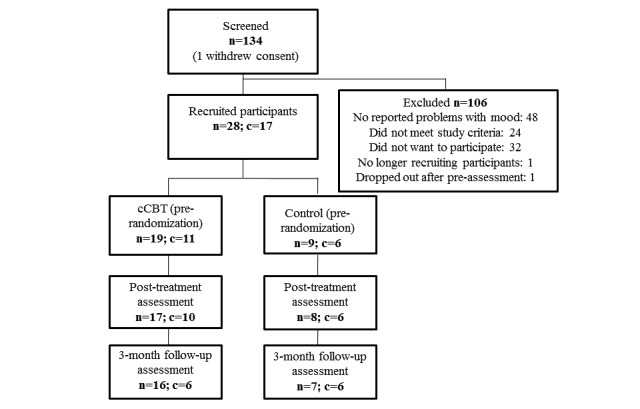
Of the total 134 people screened for symptoms of depression and anxiety following stroke, 28 were cluster randomized in blocks with an allocation ratio 2:1 to cCBT (n=19) or an active comparator of computerized cognitive remediation therapy (cCRT, n=9). Qualitative and quantitative feedback was sought on the acceptability and feasibility of both interventions, alongside measuring levels of depression, anxiety, and activities of daily living before, immediately after, and 3 months post treatment.
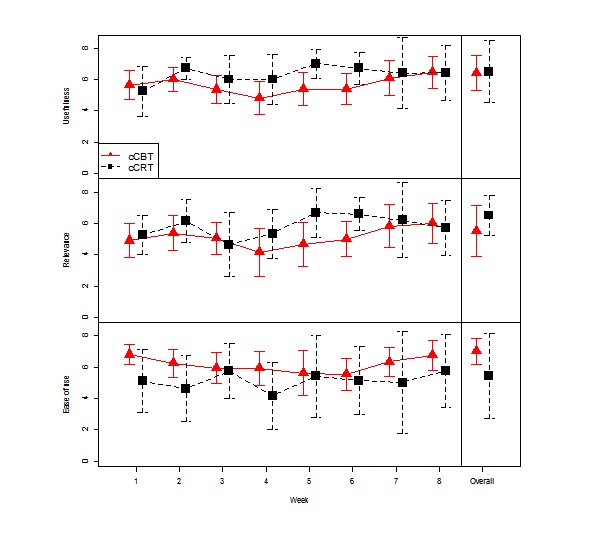
Both cCBT and cCRT groups were rated as near equally useful (mean = 6.4 vs 6.5, d=0.05), while cCBT was somewhat less relevant (mean = 5.5 vs 6.5, d=0.45) but somewhat easier to use (mean = 7.0 vs 6.3, d=0.31). Participants tolerated randomization and dropout rates were comparable with similar trials, with only 3 participants discontinuing due to potential adverse effects; however, dropout was higher from the cCBT arm (7/19, 37% vs 1/9, 11% for cCRT). The trial design required small alterations and highlighted that future-related studies should control for participants receiving antidepressant medication, which significantly differed between groups (P=.05). Descriptive statistics of the proposed outcome measures and qualitative feedback about the cCBT intervention are reported.
A pragmatic approach is required to deliver computerized interventions to accommodate individual needs. We report a preliminary investigation to inform the development of a full randomized controlled trial for testing the efficacy of computerized interventions for people with long-term neurological conditions such as stroke and conclude that this is a potentially promising way of improving accessibility of psychological support.
抑郁和焦虑是中风后的常见并发症。症状可以通过心理治疗来缓解,但关于其疗效的研究较少。
本研究旨在调查(1)计算机化认知行为疗法(cCBT)治疗抑郁和焦虑症状的可接受性和可行性,以及(2)比较cCBT与积极对照疗法疗效的试验设计。
在总共134名因中风后出现抑郁和焦虑症状而接受筛查的人中,28人被按2:1的分配比例整群随机分组,分别接受cCBT(n = 19)或计算机化认知康复疗法(cCRT,n = 9)这一积极对照疗法。在寻求关于两种干预措施可接受性和可行性的定性和定量反馈的同时,还测量了治疗前、治疗后即刻以及治疗后3个月时的抑郁、焦虑水平和日常生活活动能力。
cCBT组和cCRT组的有用性评分相近(均值分别为6.4和6.5,d = 0.05),而cCBT的相关性稍低(均值分别为5.5和6.5,d = 0.45),但使用起来稍容易一些(均值分别为7.0和6.3,d = 0.31)。参与者能够接受随机分组,脱落率与类似试验相当,仅有3名参与者因潜在不良反应而退出;然而,cCBT组的脱落率更高(7/19,37%,而cCRT组为1/9,11%)。试验设计需要进行一些小的调整,并强调未来相关研究应控制接受抗抑郁药物治疗的参与者,两组之间这一情况存在显著差异(P = 0.05)。报告了拟采用的结局指标的描述性统计结果以及关于cCBT干预措施的定性反馈。
需要采取务实的方法来提供计算机化干预措施,以满足个体需求。我们报告了一项初步调查,为开展一项全面的随机对照试验提供信息,该试验旨在测试针对如中风等长期神经疾病患者的计算机化干预措施的疗效,并得出结论认为,这是一种潜在的、有望提高心理支持可及性的方法。