Sundram Frederick, Hawken Susan J, Stasiak Karolina, Lucassen Mathijs Fg, Fleming Theresa, Shepherd Matthew, Greenwood Andrea, Osborne Raechel, Merry Sally N
Department of Psychological Medicine, Faculty of Medical and Health Sciences, The University of Auckland, Auckland, New Zealand.
Department of General Practice and Primary Health Care, The University of Auckland, Auckland, New Zealand.
JMIR Ment Health. 2017 Jan 11;4(1):e3. doi: 10.2196/mental.5878.
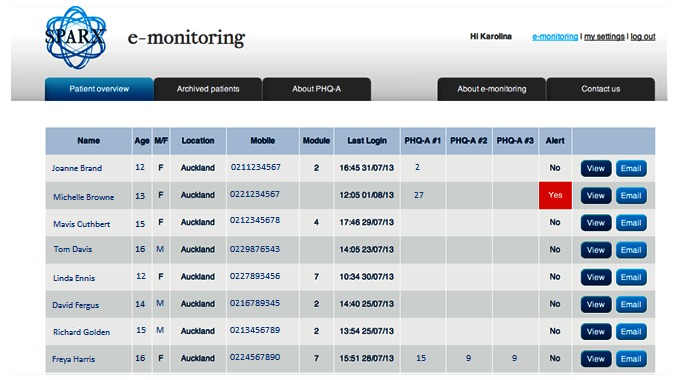
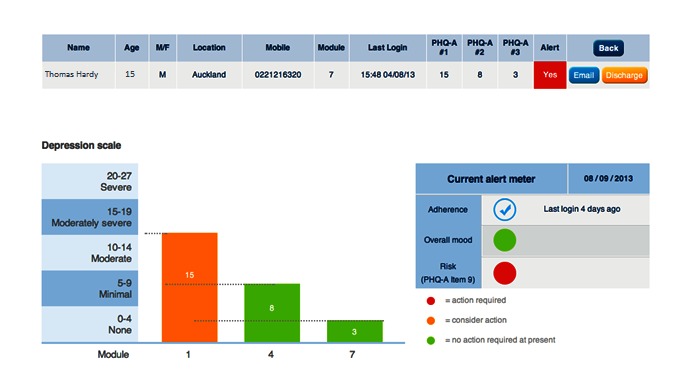
Computerized cognitive behavioral therapy (cCBT) is an acceptable and promising treatment modality for adolescents with mild-to-moderate depression. Many cCBT programs are standalone packages with no way for clinicians to monitor progress or outcomes. We sought to develop an electronic monitoring (e-monitoring) tool in consultation with clinicians and adolescents to allow clinicians to monitor mood, risk, and treatment adherence of adolescents completing a cCBT program called SPARX (Smart, Positive, Active, Realistic, X-factor thoughts).
The objectives of our study were as follows: (1) assess clinicians' and adolescents' views on using an e-monitoring tool and to use this information to help shape the development of the tool and (2) assess clinician experiences with a fully developed version of the tool that was implemented in their clinical service.
A descriptive qualitative study using semistructured focus groups was conducted in New Zealand. In total, 7 focus groups included clinicians (n=50) who worked in primary care, and 3 separate groups included adolescents (n=29). Clinicians were general practitioners (GPs), school guidance counselors, clinical psychologists, youth workers, and nurses. Adolescents were recruited from health services and a high school. Focus groups were run to enable feedback at 3 phases that corresponded to the consultation, development, and postimplementation stages. Thematic analysis was applied to transcribed responses.
Focus groups during the consultation and development phases revealed the need for a simple e-monitoring registration process with guides for end users. Common concerns were raised in relation to clinical burden, monitoring risk (and effects on the therapeutic relationship), alongside confidentiality or privacy and technical considerations. Adolescents did not want to use their social media login credentials for e-monitoring, as they valued their privacy. However, adolescents did want information on seeking help and personalized monitoring and communication arrangements. Postimplementation, clinicians who had used the tool in practice revealed no adverse impact on the therapeutic relationship, and adolescents were not concerned about being e-monitored. Clinicians did need additional time to monitor adolescents, and the e-monitoring tool was used in a different way than was originally anticipated. Also, it was suggested that the registration process could be further streamlined and integrated with existing clinical data management systems, and the use of clinician alerts could be expanded beyond the scope of simply flagging adolescents of concern.
An e-monitoring tool was developed in consultation with clinicians and adolescents. However, the study revealed the complexity of implementing the tool in clinical practice. Of salience were privacy, parallel monitoring systems, integration with existing electronic medical record systems, customization of the e-monitor, and preagreed monitoring arrangements between clinicians and adolescents.
计算机化认知行为疗法(cCBT)是治疗轻度至中度抑郁症青少年的一种可接受且有前景的治疗方式。许多cCBT项目是独立的软件包,临床医生无法监测进展或结果。我们寻求与临床医生和青少年协商开发一种电子监测(e监测)工具,以便临床医生监测完成名为SPARX(明智、积极、主动、现实、X因素思维)的cCBT项目的青少年的情绪、风险和治疗依从性。
我们研究的目的如下:(1)评估临床医生和青少年对使用e监测工具的看法,并利用这些信息帮助塑造该工具的开发;(2)评估临床医生对在其临床服务中实施的该工具完整版本的使用体验。
在新西兰进行了一项使用半结构化焦点小组的描述性定性研究。总共7个焦点小组包括在初级保健机构工作的临床医生(n = 50),3个单独的小组包括青少年(n = 29)。临床医生包括全科医生(GP)、学校指导顾问、临床心理学家、青年工作者和护士。青少年从卫生服务机构和一所高中招募。焦点小组在与咨询、开发和实施后阶段相对应的3个阶段进行,以获取反馈。对转录的回复进行主题分析。
咨询和开发阶段的焦点小组表明,需要一个简单的e监测注册流程以及针对最终用户的指南。人们对临床负担、监测风险(以及对治疗关系的影响)、保密性或隐私以及技术方面的考虑提出了共同关注的问题。青少年不想使用他们的社交媒体登录凭证进行e监测,因为他们重视自己的隐私。然而,青少年确实希望获得有关寻求帮助以及个性化监测和沟通安排的信息。实施后,在实践中使用该工具的临床医生表示对治疗关系没有负面影响,青少年也不担心被电子监测。临床医生确实需要额外的时间来监测青少年,并且e监测工具的使用方式与最初预期的不同。此外,有人建议可以进一步简化注册流程并将其与现有的临床数据管理系统集成,并且临床医生警报的使用范围可以扩大到不仅仅是标记有问题的青少年。
与临床医生和青少年协商开发了一种e监测工具。然而,该研究揭示了在临床实践中实施该工具的复杂性。重要的是隐私、并行监测系统、与现有电子病历系统的集成、e监测器的定制以及临床医生和青少年之间预先商定的监测安排。