Department of Evolutionary Biology and Environmental Studies, University of Zurich, Winterthurrerstrasse 190, CH-8057, Zurich, Switzerland.
Department of Biological and Environmental Sciences, University of Gothenburg, PO Box 461, SE-405 30, Gothenburg, Sweden.
Sci Rep. 2017 May 31;7(1):2571. doi: 10.1038/s41598-017-02595-2.
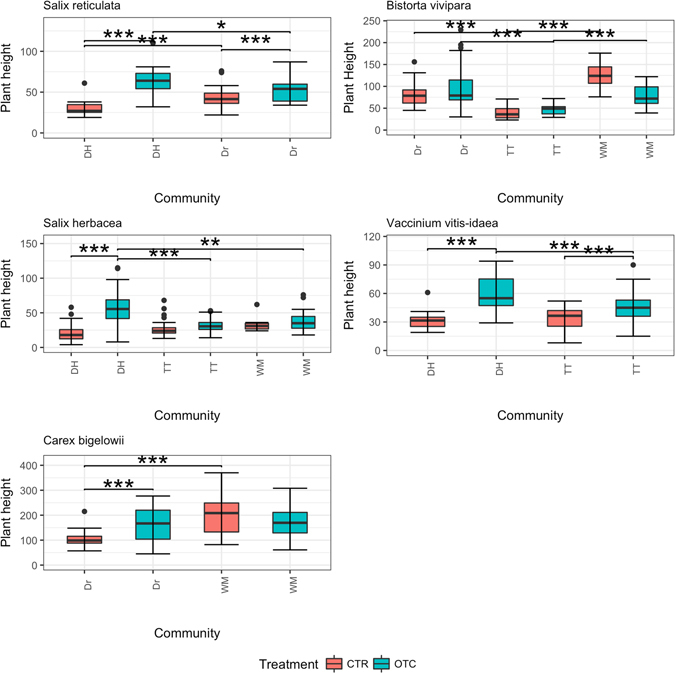
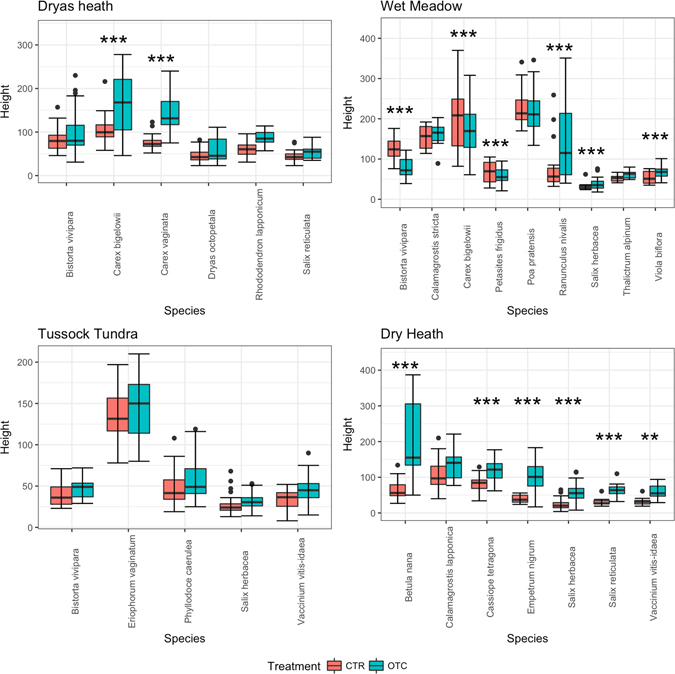
To improve understanding of how global warming may affect competitive interactions among plants, information on the responses of plant functional traits across species to long-term warming is needed. Here we report the effect of 23 years of experimental warming on plant traits across four different alpine subarctic plant communities: tussock tundra, Dryas heath, dry heath and wet meadow. Open-top chambers (OTCs) were used to passively warm the vegetation by 1.5-3 °C. Changes in leaf width, leaf length and plant height of 22 vascular plant species were measured. Long-term warming significantly affected all plant traits. Overall, plant species were taller, with longer and wider leaves, compared with control plots, indicating an increase in biomass in warmed plots, with 13 species having significant increases in at least one trait and only three species having negative responses. The response varied among species and plant community in which the species was sampled, indicating community-warming interactions. Thus, plant trait responses are both species- and community-specific. Importantly, we show that there is likely to be great variation between plant species in their ability to maintain positive growth responses over the longer term, which might cause shifts in their relative competitive ability.
为了更好地了解全球变暖如何影响植物间的竞争相互作用,我们需要了解物种间植物功能性状对长期变暖的响应信息。在这里,我们报告了 23 年的实验性变暖对四个不同高山亚北极植物群落(丛生苔原、干燥石南灌丛、干燥石南荒地和湿地草地)中植物性状的影响。开顶式气室(OTCs)通过 1.5-3°C 的被动方式对植被进行加热。我们测量了 22 种维管植物物种的叶片宽度、叶片长度和植物高度的变化。长期变暖显著影响了所有植物性状。总体而言,与对照相比,植物物种的叶片更长、更宽,植株更高,表明变暖的植株中生物量增加,其中 13 个物种至少有一个性状显著增加,只有 3 个物种有负响应。这种响应在物种和采样的植物群落之间存在差异,表明存在群落变暖的相互作用。因此,植物性状的响应既具有物种特异性,也具有群落特异性。重要的是,我们表明,植物物种在长期内保持积极生长响应的能力可能存在很大差异,这可能导致它们相对竞争能力的变化。