Jonasson Stina B, Nilsson Maria H, Lexell Jan
Department of Health Sciences, Lund University, Box 157, 221 00, Lund, Sweden.
Department of Neurology and Rehabilitation, Skåne University Hospital, Lund, Sweden.
Health Qual Life Outcomes. 2017 May 31;15(1):116. doi: 10.1186/s12955-017-0689-6.
Fear of falling is common in people with Parkinson's disease (PD) and is associated with an increased risk for future falls, activity limitations and a reduced quality of life. The Falls Efficacy Scale-International (FES-I) assesses fear of falling conceptualized as concerns about falling. The original FES-I has good psychometric properties in people with PD, but whether this applies also for the short version of FES-I remains to be shown. The aim of the present study was to evaluate the psychometric properties of the short FES-I and to compare these with the original FES-I in the same sample of people with PD. The investigated psychometric properties included known groups validity, data completeness, scaling assumptions, targeting and reliability.
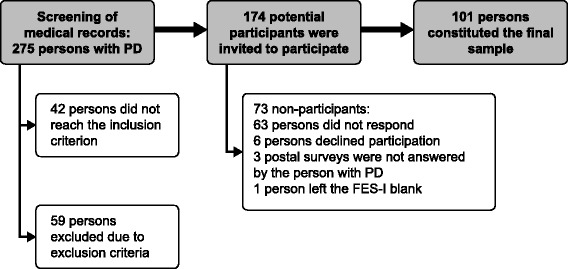
A postal survey, which included the original, full-length FES-I, was distributed to 174 people with PD. Responders received a second survey after two weeks. From these data, short FES-I total scores were calculated by extracting the items that are included in the short version of the scale.
Median age and PD duration of the 101 responders (43% women) were 73 and 5 years, respectively. The original as well as the short FES-I scores were able to discriminate (p < 0.001) between groups with and without fear of falling, activity avoidance, falls, near falls, and with various self-rated PD severity, respectively. Both versions of FES-I had a high level of data completeness (0.7 to 0.9% missing item responses). Scaling assumptions were acceptable for the original as well as the short FES-I. While the short FES-I had 19% floor effect, the original version was better targeted. Both versions were reliable and obtained high values for internal consistency (Cronbach's alpha >0.8) and test-retest reliability (Intraclass Correlation Coefficient > 0.9).
Both the original and short FES-I revealed generally good psychometric properties in people with PD, although the original scale was better targeted. Due to the higher floor effect in the short FES-I, the present findings favors using the original, full-length FES-I in longitudinal follow-ups, intervention studies and clinical practice when addressing concerns about falling.
帕金森病(PD)患者中害怕跌倒的情况很常见,且与未来跌倒风险增加、活动受限及生活质量下降相关。国际跌倒效能量表(FES-I)评估的害怕跌倒被概念化为对跌倒的担忧。原始的FES-I在PD患者中具有良好的心理测量特性,但这是否也适用于FES-I的简短版本仍有待证明。本研究的目的是评估简短FES-I的心理测量特性,并在同一PD患者样本中将其与原始FES-I进行比较。所研究的心理测量特性包括已知群体效度、数据完整性、量表假设、针对性和信度。
向174名PD患者发放了一份包含原始完整版FES-I的邮寄调查问卷。两周后,应答者收到第二份调查问卷。从这些数据中,通过提取量表简短版本中包含的项目来计算简短FES-I的总分。
101名应答者(43%为女性)的年龄中位数和PD病程分别为73岁和5年。原始FES-I以及简短FES-I的得分分别能够区分有或没有害怕跌倒、避免活动、跌倒、险些跌倒以及不同自我评定的PD严重程度的组(p < 0.001)。两个版本的FES-I数据完整性水平都很高(缺失项目回答为0.7%至0.9%)。原始FES-I以及简短FES-I的量表假设都是可接受的。虽然简短FES-I有19%的地板效应,但原始版本的针对性更好。两个版本都具有可靠性,并且在内部一致性(Cronbach's α>0.8)和重测信度(组内相关系数>0.9)方面获得了较高的值。
原始FES-I和简短FES-I在PD患者中总体上都显示出良好的心理测量特性,尽管原始量表的针对性更好。由于简短FES-I中地板效应较高,本研究结果支持在纵向随访、干预研究和临床实践中,当涉及对跌倒的担忧时使用原始的完整版FES-I。