Kong Xiang-Quan, Dong Ya-Ping, Wu Jun-Xin, He Jun-Yan, Le Yu-Yin, Du Kai-Xin, Peng Qing-Qin, Li Jin-Luan
Department of Radiation Oncology, Fujian Medical University Cancer Hospital, Fujian Cancer Hospital, 420 Fuma Rd, Jinan District, Fuzhou, 350014, China.
Radiat Oncol. 2017 May 31;12(1):92. doi: 10.1186/s13014-017-0831-y.
This study aimed to highlight the type of tumor thrombus and identify the prognostic factors influencing the long-term survival outcomes in patients with hepatocellular carcinoma (HCC) having a tumor thrombus. A tumor thrombus in HCC is associated with poor prognosis.
Eighty patients diagnosed with HCC having a tumor thrombus between May 2006 and April 2014 were enrolled in this study. Age, gender, clinical characteristics, laboratory findings, Child-Pugh classification, performance status (ECOG), types of tumor thrombi, radiotherapy method, biologically effective dose (BED), and primary treatment method were analyzed to identify the prognostic factors associated with the overall survival (OS) rates. Statistical analyses were performed using SPSS version 19.0.
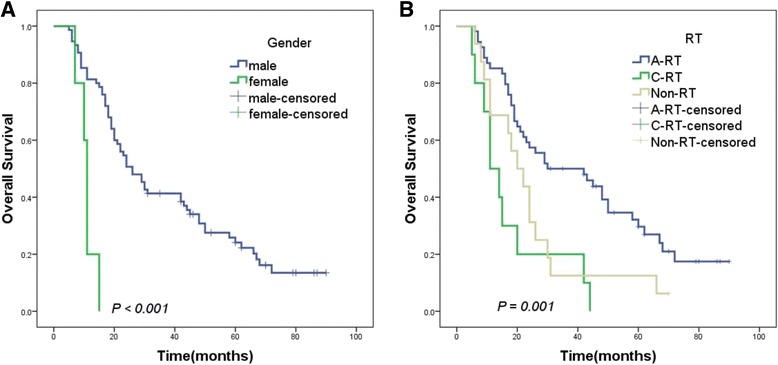
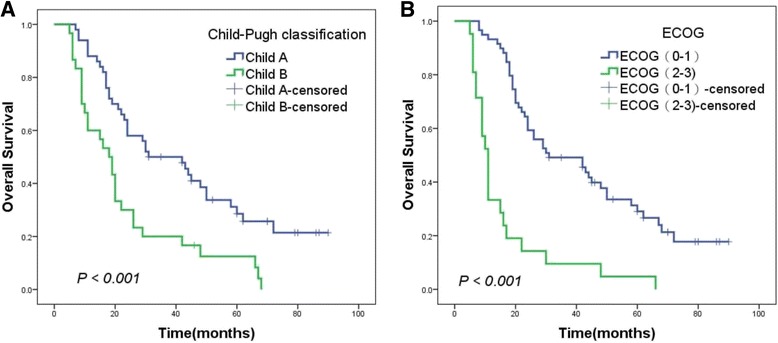
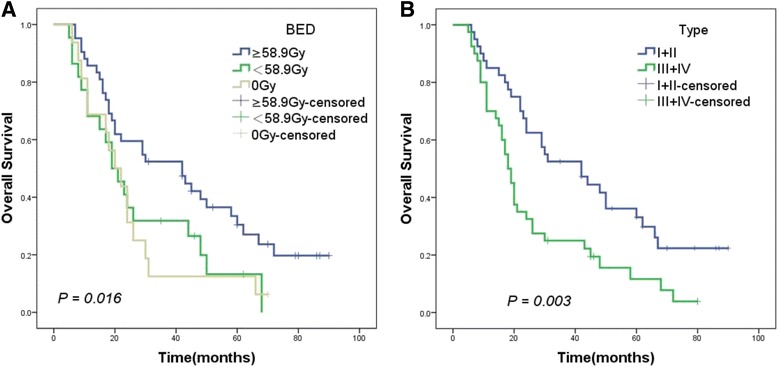
The median follow-up duration was 24 months (range 6-90). The 1-, 3-, and 5-year OS rates of the patients were 77.6%, 37.6%, and 18.8%, respectively. On univariate analysis, gender, radiotherapy method, BED, types of tumor thrombi, Child-Pugh classification, ECOG, and total bilirubin were associated with OS (P < 0.001, P = 0.001, P = 0.016, P = 0.003, P < 0.001, P < 0.001, P = 0.039, respectively). The prognostic factors for OS in multi-variate analyses were gender (P < 0.001), BED (P = 0.044), Child Pugh classification (P = 0.020), performance status (ECOG) (P = 0.004), and types of tumor thrombi (P = 0.001). The median OS for the high-BED group was better than that for the low-BED groups (42 months vs. 19 months, P = 0.016).
Gender, BED, performance status (ECOG), Child-Pugh classification, and types of tumor thrombi seemed to affect OS, and a stepwise decrease in survival was observed with the types of tumor thrombi ranging from I to IV. High-BED palliative radiotherapy might improve the long-term outcomes for patients with HCC having a tumor thrombus.
本研究旨在明确肿瘤血栓的类型,并确定影响伴有肿瘤血栓的肝细胞癌(HCC)患者长期生存结局的预后因素。HCC中的肿瘤血栓与预后不良相关。
本研究纳入了2006年5月至2014年4月期间诊断为伴有肿瘤血栓的80例HCC患者。分析患者的年龄、性别、临床特征、实验室检查结果、Child-Pugh分级、体能状态(ECOG)、肿瘤血栓类型、放疗方法、生物等效剂量(BED)及初始治疗方法,以确定与总生存率(OS)相关的预后因素。使用SPSS 19.0版进行统计分析。
中位随访时间为24个月(范围6 - 90个月)。患者的1年、3年和5年OS率分别为77.6%、37.6%和18.8%。单因素分析显示,性别、放疗方法、BED、肿瘤血栓类型、Child-Pugh分级、ECOG及总胆红素与OS相关(P分别<0.001、=0.001、=0.016、=0.003、<0.001、<0.001、=0.039)。多因素分析中OS的预后因素为性别(P<0.001)、BED(P = 0.044)、Child-Pugh分级(P = 0.020)、体能状态(ECOG)(P = 0.004)及肿瘤血栓类型(P = 0.001)。高BED组的中位OS优于低BED组(42个月对19个月,P = 0.016)。
性别、BED、体能状态(ECOG)、Child-Pugh分级及肿瘤血栓类型似乎影响OS,且随着肿瘤血栓类型从I型到IV型,生存率呈逐步下降。高BED姑息性放疗可能改善伴有肿瘤血栓的HCC患者的长期结局。