Wang Haiyan, Zhang Longxian, Ren Qinge, Yu Fuchang, Yang Yurong
College of Animal Science and Veterinary Medicine, Henan Agricultural University, Zhengzhou, 450002, Henan, People's Republic of China.
Department of Animal Science, Henan Vocational College of Agriculture, Zhongmu, 451450, Henan, People's Republic of China.
BMC Vet Res. 2017 May 31;13(1):152. doi: 10.1186/s12917-017-1079-3.
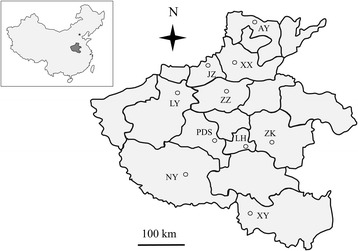
Toxoplasma gondii, a widely prevalent protozoan parasite, causes serious toxoplasmosis infections in humans and other animals. Among livestock, pigs are susceptible to T. gondii infection. Despite Henan being one of the biggest pig-raising provinces in China, little information exists on the epidemiology of toxoplasmosis in this location. Therefore, we molecularly characterized DNA samples from pigs in Henan. A total of 1647 samples, including 952 from dead piglets, 478 from seriously sick fattening pigs and 217 from abortion sows, were collected from different animal hospitals or pig farms from 10 different cities in Henan (2006-2008). Each pig corresponded to a separate pig farm. DNA was extracted from 3 to 5 g of the most severely affected pig tissue (liver, spleen, lung, hilar lymph nodes and amniotic fluid) after postmortem examination. The presence of the T. gondii B1 gene was detected using nested polymerase chain reactions (PCR). Genotyping was performed directly on DNA from the PCR-positive tissue samples using 11 PCR restriction fragment length polymorphism markers (SAG1, 5'- and 3'-SAG2, alternative SAG2, SAG3, BTUB, GRA6, L358, PK1, c22-8, c29-2, and Apico).
Of all samples, thirty-four were positive for the T. gondii B1 gene (2.06%, 95% CI: 1.86%-2.26%) from four cities, including 31 from NanYang city, one (PgXY 1) from Xinyang City, one (PgZZ 1) from Zhengzhou City and one (PgZK1) from Zhoukou City. The prevalence was found to be highest in piglets than in fattening pigs and sows. And the difference was statistically significant (P<0.01). The following 32 samples were genotyped with complete data: 13 hilar lymph node tissue samples, seven liver tissue samples, seven lung tissue samples, four spleen tissue samples, and one amniotic fluid sample. Only one genotype, belonging to ToxoDB Genotype #9, was identified.
This is the first large-scale survey molecularly characterizing T. gondii from pigs in Henan. The results of the present study revealed that T. gondii infection is present in swine in Henan and is a potential source of foodborne toxoplasmosis in the investigated areas. Implementation of effective control measures for T. gondii to reduce the chance of zoonotic toxoplasmosis spreading from pig farms may be warranted. The results show that the ToxoDB #9 genotype may be the dominant T. gondii lineage in mainland China. These findings strengthen the limited Chinese T. gondii epidemiology database.
刚地弓形虫是一种广泛流行的原生动物寄生虫,可导致人类和其他动物发生严重的弓形虫病感染。在家畜中,猪易感染刚地弓形虫。尽管河南是中国最大的养猪省份之一,但关于该地区弓形虫病流行病学的信息却很少。因此,我们对河南猪的DNA样本进行了分子特征分析。2006年至2008年期间,从河南10个不同城市的不同动物医院或养猪场收集了总共1647份样本,其中包括952份死仔猪样本、478份重病育肥猪样本和217份流产母猪样本。每头猪对应一个单独的养猪场。死后检查后,从3至5克受影响最严重的猪组织(肝脏、脾脏、肺、肺门淋巴结和羊水)中提取DNA。使用巢式聚合酶链反应(PCR)检测刚地弓形虫B1基因的存在。使用11种PCR限制性片段长度多态性标记(SAG1、5'-和3'-SAG2、替代SAG2、SAG3、BTUB、GRA6、L358、PK1、c22-8、c29-2和Apico)对PCR阳性组织样本的DNA直接进行基因分型。
在所有样本中,来自四个城市的34份样本刚地弓形虫B1基因呈阳性(2.06%,95%可信区间:1.86%-2.26%),其中31份来自南阳市,1份(PgXY 1)来自信阳市,1份(PgZZ 1)来自郑州市,1份(PgZK1)来自周口市。发现仔猪中的患病率高于育肥猪和母猪。差异具有统计学意义(P<0.01)。对以下32份样本进行了基因分型,数据完整:13份肺门淋巴结组织样本、7份肝脏组织样本、7份肺组织样本、4份脾脏组织样本和1份羊水样本。仅鉴定出一种基因型,属于ToxoDB基因型#9。
这是首次对河南猪的刚地弓形虫进行大规模分子特征分析的调查。本研究结果表明,河南猪存在刚地弓形虫感染,是调查地区食源性弓形虫病的潜在来源。可能有必要实施有效的刚地弓形虫控制措施,以减少人畜共患弓形虫病从养猪场传播的机会。结果表明,ToxoDB #9基因型可能是中国大陆刚地弓形虫的主要谱系。这些发现加强了中国有限的刚地弓形虫流行病学数据库。