Bouhnik Anne-Deborah, N'Diaye Khadim, Evans D Gareth, Harris Hilary, Tibben Aad, van Asperen Christi, Schmidtke Joerg, Nippert Irmgard, Mancini Julien, Julian-Reynier Claire
Aix Marseille Univ, INSERM, IRD, SESSTIM, Sciences Economiques & Sociales de la Santé & Traitement de l'Information Médicale, Marseille, France.
Department of Genomic Medicine, The University of Manchester, Manchester, United Kingdom.
PLoS One. 2017 Jun 1;12(6):e0178447. doi: 10.1371/journal.pone.0178447. eCollection 2017.
To develop a generic scale for assessing attitudes towards genetic testing and to psychometrically assess these attitudes in the context of BRCA1/2 among a sample of French general practitioners, breast specialists and gyneco-obstetricians.
Nested within the questionnaire developed for the European InCRisC (International Cancer Risk Communication Study) project were 14 items assessing expected benefits (8 items) and drawbacks (6 items) of the process of breast/ovarian genetic cancer testing (BRCA1/2). Another item assessed agreement with the statement that, overall, the expected health benefits of BRCA1/2 testing exceeded its drawbacks, thereby justifying its prescription. The questionnaire was mailed to a sample of 1,852 French doctors. Of these, 182 breast specialists, 275 general practitioners and 294 gyneco-obstetricians completed and returned the questionnaire to the research team. Principal Component Analysis, Cronbach's α coefficient, and Pearson's correlation coefficients were used in the statistical analyses of collected data.
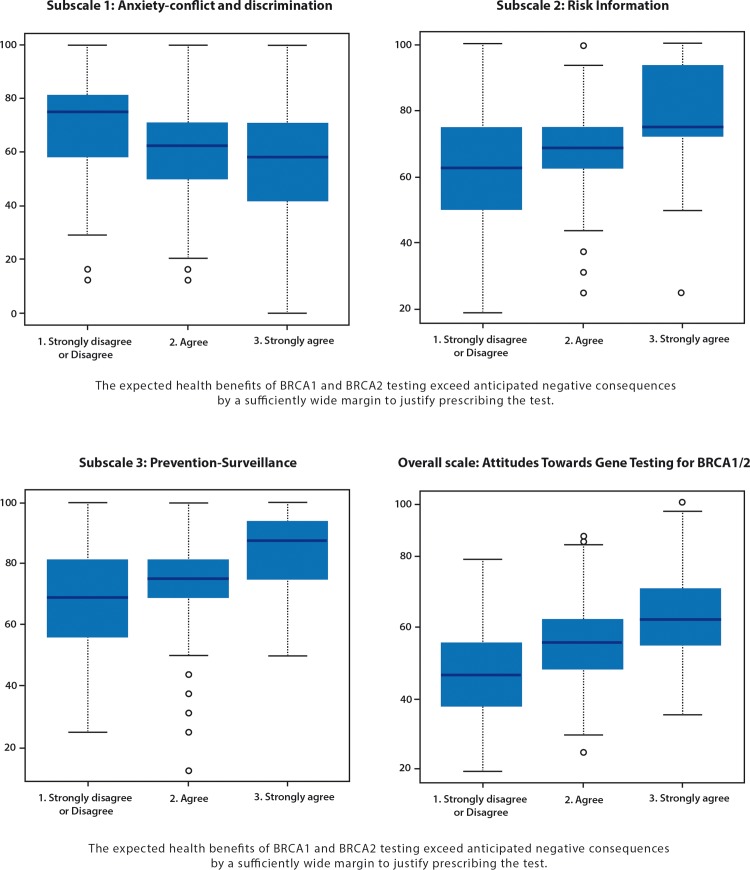
Three dimensions emerged from the respondents' responses, and were classified under the headings: "Anxiety, Conflict and Discrimination", "Risk Information", and "Prevention and Surveillance". Cronbach's α coefficient for the 3 dimensions was 0.79, 0.76 and 0.62, respectively, and each dimension exhibited strong correlation with the overall indicator of agreement (criterion validity).
The validation process of the 15 items regarding BRCA1/2 testing revealed satisfactory psychometric properties for the creation of a new scale entitled the Attitudes Towards Genetic Testing for BRCA1/2 (ATGT-BRCA1/2) Scale. Further testing is required to confirm the validity of this tool which could be used generically in other genetic contexts.
开发一种用于评估对基因检测态度的通用量表,并在法国全科医生、乳腺专科医生和妇产科医生样本中,对BRCA1/2背景下的这些态度进行心理测量评估。
为欧洲InCRisC(国际癌症风险沟通研究)项目开发的问卷中,有14个项目评估乳腺/卵巢遗传性癌症检测(BRCA1/2)过程的预期益处(8项)和弊端(6项)。另一个项目评估对以下陈述的认同度:总体而言,BRCA1/2检测的预期健康益处超过其弊端,因此证明其开具是合理的。问卷被邮寄给1852名法国医生的样本。其中,182名乳腺专科医生、275名全科医生和294名妇产科医生完成并将问卷返还给研究团队。收集的数据统计分析使用主成分分析、克朗巴哈α系数和皮尔逊相关系数。
从受访者的回答中出现了三个维度,并归类在以下标题下:“焦虑、冲突和歧视”、“风险信息”以及“预防和监测”。这三个维度的克朗巴哈α系数分别为0.79、0.76和0.62,并且每个维度与总体认同指标都表现出强相关性(效标效度)。
关于BRCA1/2检测的15个项目的验证过程显示,创建一个名为BRCA1/2基因检测态度(ATGT - BRCA1/2)量表的新量表具有令人满意的心理测量特性。需要进一步测试以确认该工具的有效性,该工具可在其他基因背景下通用。