
平均跨主动脉压力梯度对重度主动脉瓣狭窄且左心室射血分数保留患者长期预后的影响
Impact of Mean Transaortic Pressure Gradient on Long-Term Outcome in Patients With Severe Aortic Stenosis and Preserved Left Ventricular Ejection Fraction.
作者信息
Bohbot Yohann, Kowalski Cedric, Rusinaru Dan, Ringle Anne, Marechaux Sylvestre, Tribouilloy Christophe
机构信息
Department of Cardiology, Amiens University Hospital, Amiens, France.
INSERM U-1088, Jules Verne University of Picardie, Amiens, France.
出版信息
J Am Heart Assoc. 2017 Jun 1;6(6):e005850. doi: 10.1161/JAHA.117.005850.
BACKGROUND
Mean transaortic pressure gradient (MTPG) has never been validated as a predictor of mortality in patients with severe aortic stenosis. We sought to determine the value of MTPG to predict mortality in a large prospective cohort of severe aortic stenosis patients with preserved left ventricular ejection fraction and to investigate the cutoff of 60 mm Hg, proposed in American guidelines.
METHODS AND RESULTS
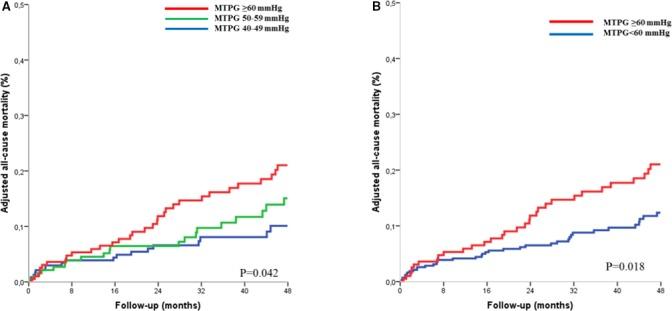
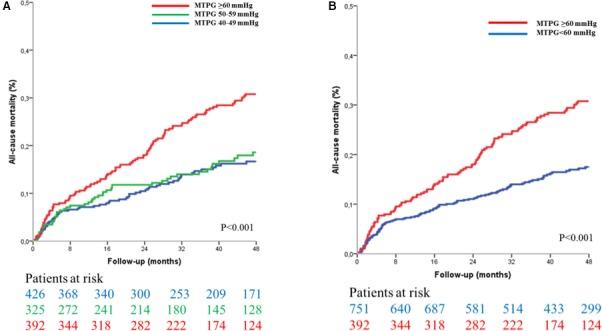
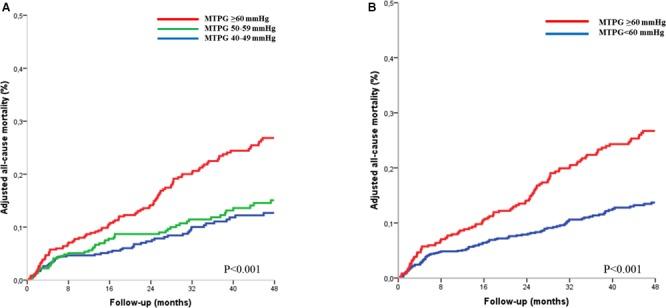
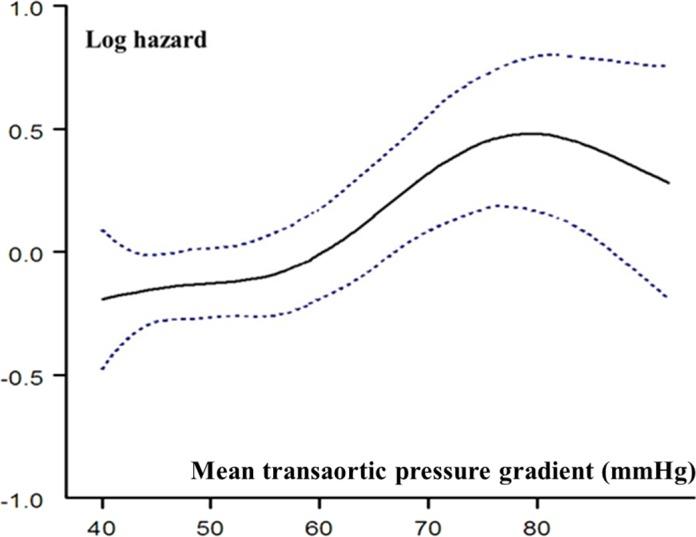
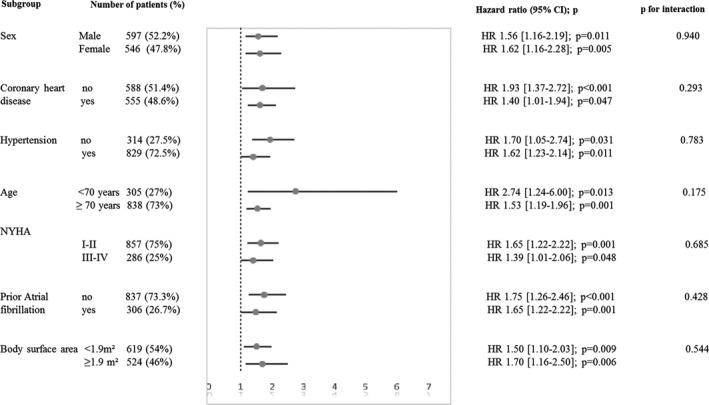
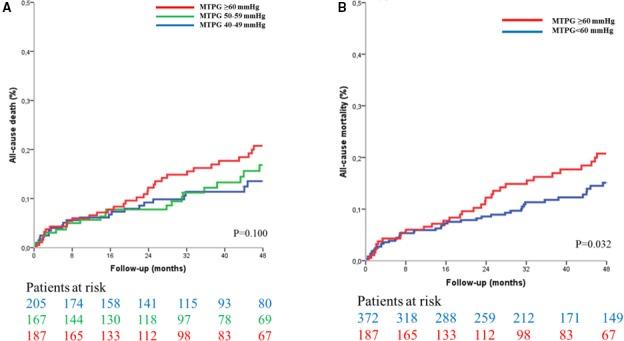
A total of 1143 patients with severe aortic stenosis defined by aortic valve area ≤1 cm and MTPG ≥40 mm Hg were included. The population was divided into 3 groups according to MTPG: between 40 and 49 mm Hg, between 50 and 59 mm Hg, and ≥60 mm Hg. The end point was all-cause mortality. MTPG was ≥60 mm Hg in 392 patients. Patients with MTPG ≥60 mm Hg had a significantly increase risk of mortality compared with patients with MTPG <60 mm Hg (hazard ratio [HR]=1.62 [1.27-2.05] <0.001), even for the subgroup of asymptomatic or minimally symptomatic patients (HR=1.56 [1.04-2.34] =0.032). After adjustment for established outcome predictors, patients with MTPG ≥60 mm Hg had a significantly higher risk of mortality than patients with MTPG <60 mm Hg (HR=1.71 [1.33-2.20] <0.001), even after adjusting for surgery as a time-dependent variable (HR=1.71 [1.43-2.11] <0.001). Similar results were observed for the subgroup of asymptomatic or minimally symptomatic patients (HR=1.70 [1.10-2.32] =0.018 and HR=1.68 [1.20-2.36] =0.003, respectively).
CONCLUSIONS
This study shows the negative prognostic impact of high MTPG (≥60 mm Hg), on long-term outcome of patients with severe aortic stenosis with preserved left ventricular ejection fraction, irrespective of symptoms.
背景
平均跨主动脉压力阶差(MTPG)从未被证实可作为重度主动脉瓣狭窄患者死亡率的预测指标。我们试图确定MTPG在一大组左心室射血分数保留的重度主动脉瓣狭窄患者中预测死亡率的价值,并研究美国指南中提出的60mmHg的临界值。
方法与结果
共纳入1143例主动脉瓣面积≤1cm²且MTPG≥40mmHg定义的重度主动脉瓣狭窄患者。根据MTPG将人群分为3组:40至49mmHg、50至59mmHg和≥60mmHg。终点为全因死亡率。392例患者的MTPG≥60mmHg。与MTPG<60mmHg的患者相比,MTPG≥60mmHg的患者死亡率风险显著增加(风险比[HR]=1.62[1.27 - 2.05]<0.001),即使是无症状或症状轻微的亚组患者(HR=1.56[1.04 - 2.34]=0.032)。在对既定的结局预测因素进行调整后,MTPG≥60mmHg的患者死亡率风险显著高于MTPG<60mmHg的患者(HR=1.71[1.33 - 2.20]<0.001),即使将手术作为时间依赖性变量进行调整后(HR=1.71[1.43 - 2.11]<0.001)。无症状或症状轻微的亚组患者也观察到类似结果(分别为HR=1.70[1.10 - 2.32]=0.018和HR=1.68[1.20 - 2.36]=0.003)。
结论
本研究表明,高MTPG(≥60mmHg)对左心室射血分数保留的重度主动脉瓣狭窄患者的长期结局具有负面预后影响,无论症状如何。
 Zotero 插件