Moon Jong-Sik, Kim Won-Geun, Shin Dong-Myeong, Lee So-Young, Kim Chuntae, Lee Yujin, Han Jiye, Kim Kyujung, Yoo So Young, Oh Jin-Woo
BK21 PLUS Nanoconvergence Technology Division , Pusan National University (PNU) , Busan , 46241 , Republic of Korea . Email:
Department of Nano Fusion Technology , Pusan National University (PNU) , Busan , 46241 , Republic of Korea.
Chem Sci. 2017 Feb 1;8(2):921-927. doi: 10.1039/c6sc02021f. Epub 2016 Nov 14.
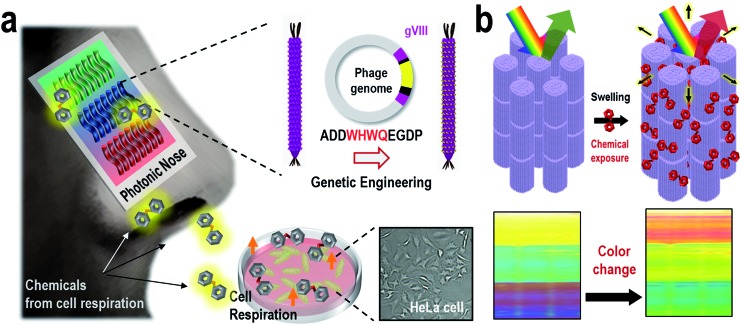
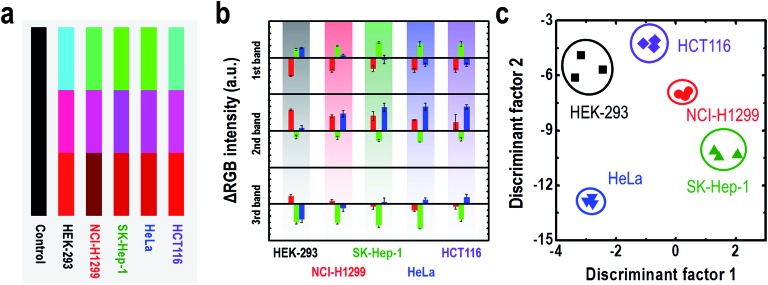
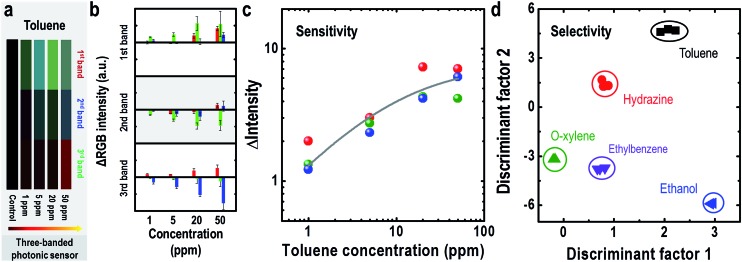
A bioinspired M-13 bacteriophage-based photonic nose was developed for differential cell recognition. The M-13 bacteriophage-based photonic nose exhibits characteristic color patterns when phage bundle nanostructures, which were genetically modified to selectively capture vapor phase molecules, are structurally deformed. We characterized the color patterns of the phage bundle nanostructure in response to cell proliferation several biomarkers differentially produced by cells, including hydrazine, -xylene, ethylbenzene, ethanol and toluene. A specific color enables the successful identification of different types of molecular and cellular species. Our sensing technique utilized the versatile M-13 bacteriophage as a building block for fabricating bioinspired photonic crystals, which enables ease of fabrication and tunable selectivity through genetic engineering. Our simple and versatile bioinspired photonic nose could have possible applications in sensors for human health and national security, food discrimination, environmental monitoring, and portable and wearable sensors.
为实现细胞差异识别,研发了一种受生物启发的基于M-13噬菌体的光子鼻。当经过基因改造以选择性捕获气相分子的噬菌体束纳米结构发生结构变形时,基于M-13噬菌体的光子鼻会呈现出特征性的颜色模式。我们对噬菌体束纳米结构响应细胞增殖的颜色模式进行了表征,细胞会差异产生几种生物标志物,包括肼、二甲苯、乙苯、乙醇和甲苯。特定的颜色能够成功识别不同类型的分子和细胞种类。我们的传感技术利用通用的M-13噬菌体作为构建受生物启发的光子晶体的基础材料,通过基因工程实现了易于制造和可调谐的选择性。我们这种简单且通用的受生物启发的光子鼻可能在人类健康和国家安全传感器、食品鉴别、环境监测以及便携式和可穿戴传感器等方面有应用前景。