Mücksch Frauke, Laketa Vibor, Müller Barbara, Schultz Carsten, Kräusslich Hans-Georg
Department of Infectious Diseases, Virology, University Hospital Heidelberg, Heidelberg, Germany.
German Center for Infectious Disease Research, Partner site Heidelberg, Braunschweig, Germany.
Elife. 2017 Jun 2;6:e25287. doi: 10.7554/eLife.25287.
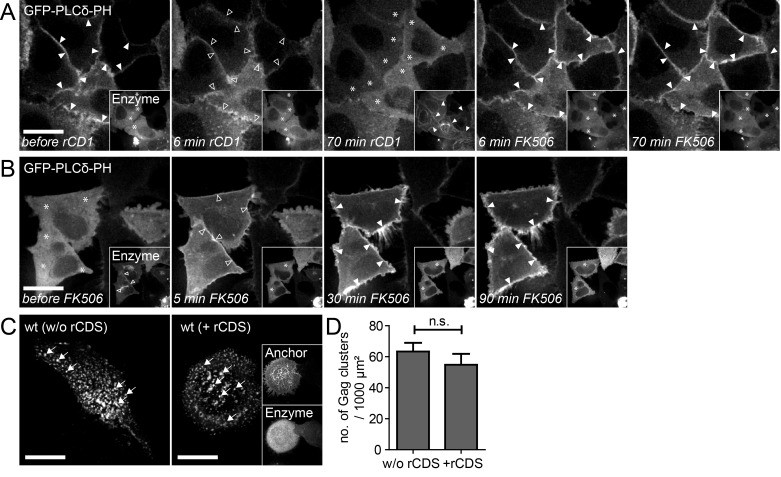
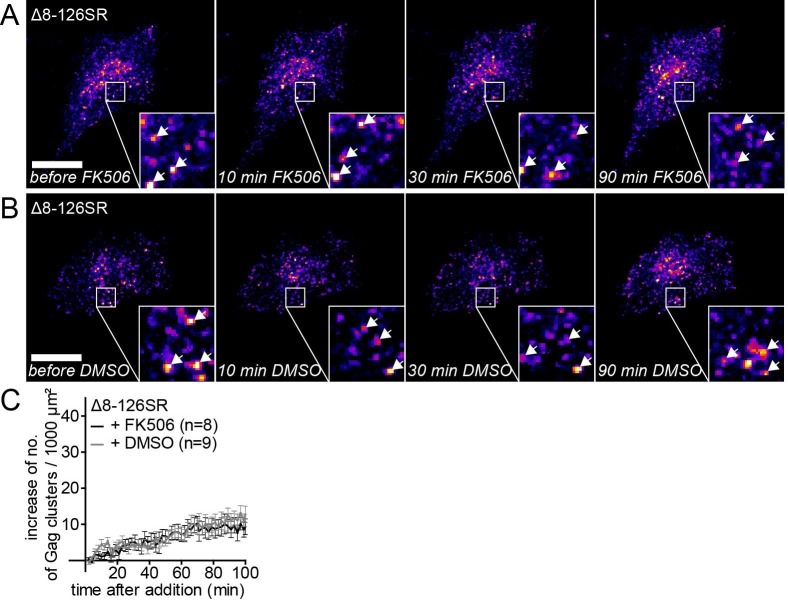
HIV-1 assembles at the plasma membrane (PM) of infected cells. PM association of the main structural protein Gag depends on its myristoylated MA domain and PM PI(4,5)P. Using a novel chemical biology tool that allows rapidly tunable manipulation of PI(4,5)P levels in living cells, we show that depletion of PI(4,5)P completely prevents Gag PM targeting and assembly site formation. Unexpectedly, PI(4,5)P depletion also caused loss of pre-assembled Gag lattices from the PM. Subsequent restoration of PM PI(4,5)P reinduced assembly site formation even in the absence of new protein synthesis, indicating that the dissociated Gag molecules remained assembly competent. These results reveal an important role of PI(4,5)P for HIV-1 morphogenesis beyond Gag recruitment to the PM and suggest a dynamic equilibrium of Gag-lipid interactions. Furthermore, they establish an experimental system that permits synchronized induction of HIV-1 assembly leading to induced production of infectious virions by targeted modulation of Gag PM targeting.
HIV-1在受感染细胞的质膜(PM)处组装。主要结构蛋白Gag与质膜的结合依赖于其肉豆蔻酰化的基质(MA)结构域和质膜上的磷脂酰肌醇-4,5-二磷酸(PI(4,5)P)。我们使用一种新型化学生物学工具,能够快速且可调节地操控活细胞中PI(4,5)P的水平,结果表明PI(4,5)P的耗竭完全阻止了Gag靶向质膜以及组装位点的形成。出乎意料的是,PI(4,5)P的耗竭还导致预先组装好的Gag晶格从质膜上消失。随后质膜PI(4,5)P的恢复即使在没有新蛋白质合成的情况下也能重新诱导组装位点的形成,这表明解离的Gag分子仍具有组装能力。这些结果揭示了PI(4,5)P在HIV-1形态发生中除了将Gag募集到质膜之外的重要作用,并提示了Gag-脂质相互作用的动态平衡。此外,它们建立了一个实验系统,该系统允许通过靶向调节Gag靶向质膜来同步诱导HIV-1组装,从而诱导产生有感染性的病毒粒子。