Bailey Cavan P, Budak-Alpdogan Tulin, Sauter Christopher T, Panis Michelle M, Buyukgoz Cihangir, Jeng Emily K, Wong Hing C, Flomenberg Neal, Alpdogan Onder
Department of Medical Oncology, Kimmel Cancer Center, Thomas Jefferson University, Philadelphia, PA, USA.
Department of Hematology and Oncology, MD Anderson Cancer Center at Cooper, Camden, NJ, USA.
Oncotarget. 2017 Jul 4;8(27):44366-44378. doi: 10.18632/oncotarget.17875.
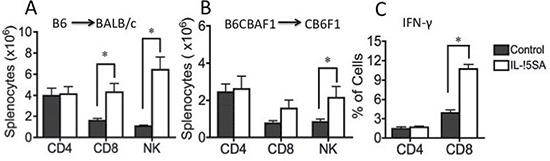
Interleukin-15 (IL-15) is a potent cytokine that increases CD8+ T and NK cell numbers and function in experimental models. However, obstacles remain in using IL-15 therapeutically, specifically its low potency and short in vivo half-life. To help overcome this, a new IL-15 superagonist complex comprised of an IL-15N72D mutation and IL-15RαSu/Fc fusion (IL-15SA, also known as ALT-803) was developed. IL-15SA exhibits a significantly longer serum half-life and increased in vivo activity against various tumors. Herein, we evaluated the effects of IL-15SA in recipients of allogeneic hematopoietic stem cell transplantation. Weekly administration of IL-15SA to transplant recipients significantly increased the number of CD8+ T cells (specifically CD44+ memory/activated phenotype) and NK cells. Intracellular IFN-γ and TNF-α secretion by CD8+ T cells increased in the IL-15SA-treated group. IL-15SA also upregulated NKG2D expression on CD8+ T cells. Moreover, IL-15SA enhanced proliferation and cytokine secretion of adoptively transferred CFSE-labeled T cells in syngeneic and allogeneic models by specifically stimulating the slowly proliferative and nonproliferative cells into actively proliferating cells.We then evaluated IL-15SA's effects on anti-tumor activity against murine mastocytoma (P815) and murine B cell lymphoma (A20). IL-15SA enhanced graft-versus-tumor (GVT) activity in these tumors following T cell infusion. Interestingly, IL-15 SA administration provided GVT activity against A20 lymphoma cells in the murine donor leukocyte infusion (DLI) model without increasing graft versus host disease. In conclusion, IL-15SA could be a highly potent T- cell lymphoid growth factor and novel immunotherapeutic agent to complement stem cell transplantation and adoptive immunotherapy.
白细胞介素-15(IL-15)是一种强效细胞因子,在实验模型中可增加CD8+T细胞和自然杀伤(NK)细胞的数量并增强其功能。然而,在将IL-15用于治疗方面仍存在障碍,尤其是其效力较低以及体内半衰期较短。为了帮助克服这一问题,一种由IL-15N72D突变体和IL-15RαSu/Fc融合体组成的新型IL-15超激动剂复合物(IL-15SA,也称为ALT-803)被研发出来。IL-15SA具有显著更长的血清半衰期,并增强了对各种肿瘤的体内活性。在此,我们评估了IL-15SA在异基因造血干细胞移植受者中的作用。每周给移植受者施用IL-15SA可显著增加CD8+T细胞(特别是CD44+记忆/活化表型)和NK细胞的数量。在接受IL-15SA治疗的组中,CD8+T细胞的细胞内干扰素-γ(IFN-γ)和肿瘤坏死因子-α(TNF-α)分泌增加。IL-15SA还上调了CD8+T细胞上NKG2D的表达。此外,在同基因和异基因模型中,IL-15SA通过特异性刺激缓慢增殖和不增殖的细胞转变为活跃增殖的细胞,增强了过继转移的羧基荧光素二乙酸琥珀酰亚胺酯(CFSE)标记的T细胞的增殖和细胞因子分泌。然后,我们评估了IL-15SA对小鼠肥大细胞瘤(P815)和小鼠B细胞淋巴瘤(A20)的抗肿瘤活性的影响。在输注T细胞后,IL-15SA增强了这些肿瘤中的移植物抗瘤(GVT)活性。有趣地是,在小鼠供体白细胞输注(DLI)模型中,施用IL-15SA可提供针对A20淋巴瘤细胞的GVT活性,而不会增加移植物抗宿主病。总之,IL-15SA可能是一种高效的T细胞淋巴细胞生长因子和新型免疫治疗剂,可补充干细胞移植和过继性免疫治疗。