Siclari Francesca, Tononi Giulio
Center for Research and Investigation on Sleep (CIRS), Lausanne University Hospital (CHUV) and University of Lausanne, Rue du Bugnon 46, 1011 Lausanne, Switzerland; Department of Psychiatry, University of Wisconsin-Madison, 6001 Research Park Boulevard Madison, WI 53519, USA.
Department of Psychiatry, University of Wisconsin-Madison, 6001 Research Park Boulevard Madison, WI 53519, USA.
Curr Opin Neurobiol. 2017 Jun;44:222-227. doi: 10.1016/j.conb.2017.05.008. Epub 2017 May 30.
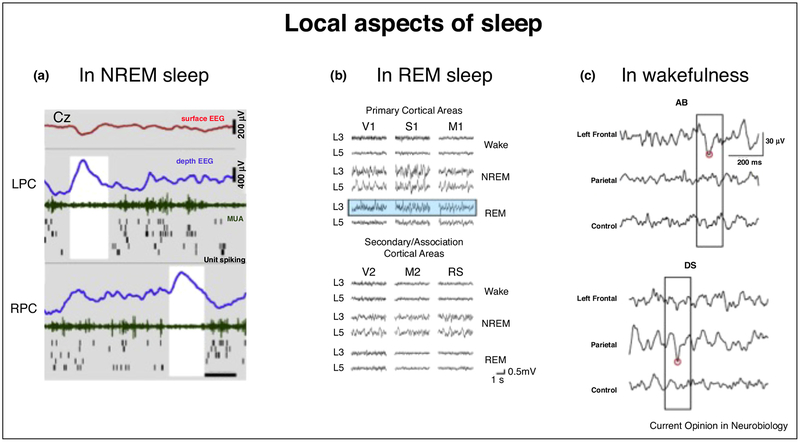
Slow waves, the hallmark of NREM (Non Rapid Eye Movement) sleep, are not uniformly distributed across the cortical surface, but can occur locally and asynchronously across brain regions. Their regional distribution and amplitude is affected by brain maturation and by time spent awake, mediated in part by experience-dependent changes in synaptic strength. Recent studies have shown that local low-frequency oscillations (<10Hz) can also occur in REM sleep and during wakefulness, leading to region-specific cognitive errors. Local decreases and increases of slow wave activity in posterior brain regions have been linked to the occurrence of dreaming and to unconscious sleep, respectively. Finally, the coexistence of local sleep-like and wake-like patterns in different brain areas is characteristic of several sleep disorders and may offer insights into these conditions.
慢波是非快速眼动睡眠的标志,并非均匀分布于整个皮质表面,而是可在大脑区域局部且异步地出现。它们的区域分布和振幅受大脑成熟度以及清醒时长的影响,部分是由突触强度的经验依赖性变化介导的。最近的研究表明,局部低频振荡(<10Hz)也可在快速眼动睡眠和清醒期间出现,导致区域特异性认知错误。后脑区域慢波活动的局部减少和增加分别与做梦的发生和无意识睡眠有关。最后,不同脑区中局部睡眠样和清醒样模式的共存是几种睡眠障碍的特征,可能为了解这些病症提供线索。