Makarev Eugene, Schubert Adrian D, Kanherkar Riya R, London Nyall, Teka Mahder, Ozerov Ivan, Lezhnina Ksenia, Bedi Atul, Ravi Rajani, Mehra Rannee, Hoque Mohammad O, Sloma Ido, Gaykalova Daria A, Csoka Antonei B, Sidransky David, Zhavoronkov Alex, Izumchenko Evgeny
Insilico Medicine, Inc., Emerging Technology Centers, Johns Hopkins University at Eastern, B301, 1101 33rd Street, Baltimore, MD 21218, USA.
Department of Otolaryngology-Head and Neck Cancer Research, Johns Hopkins University, School of Medicine, Baltimore, MD, USA.
Cell Death Discov. 2017 May 22;3:17022. doi: 10.1038/cddiscovery.2017.22. eCollection 2017.
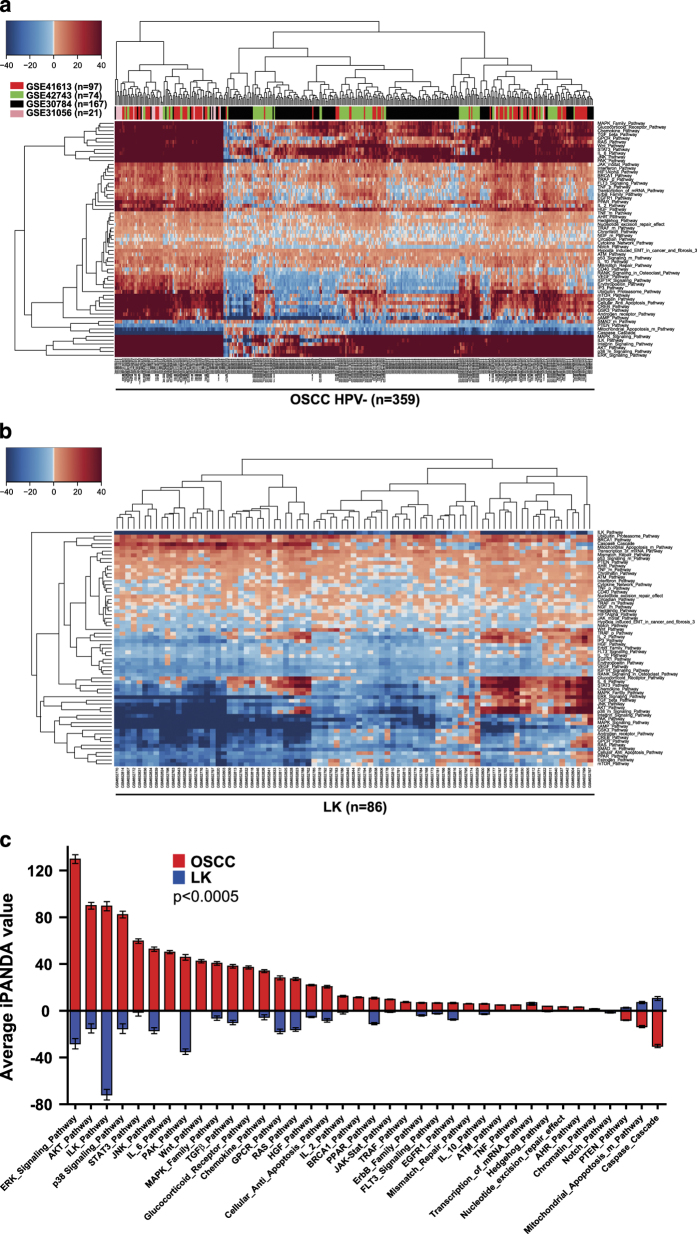
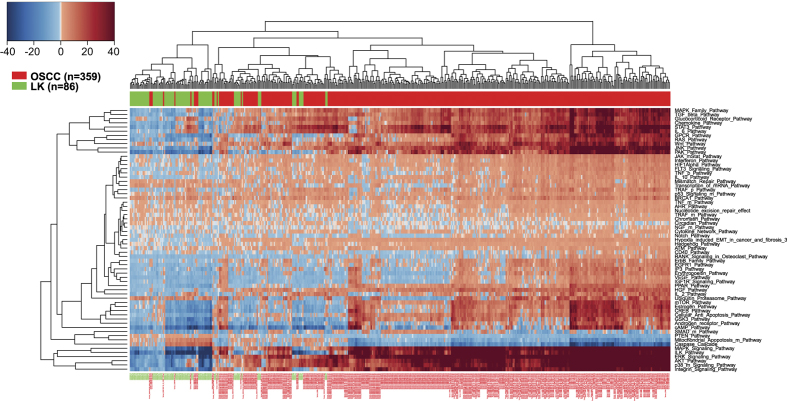
A subset of patients with oral squamous cell carcinoma (OSCC), the most common subtype of head and neck squamous cell carcinoma (HNSCC), harbor dysplastic lesions (often visually identified as leukoplakia) prior to cancer diagnosis. Although evidence suggest that leukoplakia represents an initial step in the progression to cancer, signaling networks driving this progression are poorly understood. Here, we applied Pathway Activation Network Decomposition Analysis (iPANDA), a new bioinformatics software suite for qualitative analysis of intracellular signaling pathway activation using transcriptomic data, to assess a network of molecular signaling in OSCC and pre-neoplastic oral lesions. In tumor samples, our analysis detected major conserved mitogenic and survival signaling pathways strongly associated with HNSCC, suggesting that some of the pathways identified by our algorithm, but not yet validated as HNSCC related, may be attractive targets for future research. While pathways activation landscape in the majority of leukoplakias was different from that seen in OSCC, a subset of pre-neoplastic lesions has demonstrated some degree of similarity to the signaling profile seen in tumors, including dysregulation of the cancer-driving pathways related to survival and apoptosis. These results suggest that dysregulation of these signaling networks may be the driving force behind the early stages of OSCC tumorigenesis. While future studies with larger leukoplakia data sets are warranted to further estimate the values of this approach for capturing signaling features that characterize relevant lesions that actually progress to cancers, our platform proposes a promising new approach for detecting cancer-promoting pathways and tailoring the right therapy to prevent tumorigenesis.
口腔鳞状细胞癌(OSCC)是头颈部鳞状细胞癌(HNSCC)最常见的亚型,一部分OSCC患者在癌症诊断之前就存在发育异常病变(通常肉眼识别为白斑)。尽管有证据表明白斑是癌症进展的初始阶段,但驱动这一进展的信号网络却知之甚少。在此,我们应用了通路激活网络分解分析(iPANDA),这是一种利用转录组数据对细胞内信号通路激活进行定性分析的新型生物信息学软件套件,来评估OSCC和癌前口腔病变中的分子信号网络。在肿瘤样本中,我们的分析检测到与HNSCC密切相关的主要保守促有丝分裂和生存信号通路,这表明我们算法识别出的一些尚未被证实与HNSCC相关的通路,可能是未来研究的有吸引力的靶点。虽然大多数白斑中的通路激活格局与OSCC中所见不同,但一部分癌前病变已表现出与肿瘤中所见信号谱有一定程度的相似性,包括与生存和凋亡相关的癌症驱动通路失调。这些结果表明,这些信号网络的失调可能是OSCC肿瘤发生早期阶段的驱动力。虽然有必要对更大的白斑数据集进行进一步研究,以进一步评估这种方法在捕捉表征实际进展为癌症的相关病变的信号特征方面的价值,但我们的平台提出了一种有前景的新方法,用于检测促癌通路并量身定制正确的治疗方法以预防肿瘤发生。