Khoshdeli Mina, Cong Richard, Parvin Bahram
Biomedical and Electrical Engineering Department, University of Nevada, Reno, NV, U.S.A.
Amador Valley High School, Pleasanton, Ca, U.S.A.
IEEE EMBS Int Conf Biomed Health Inform. 2017 Feb;2017:105-108. doi: 10.1109/BHI.2017.7897216. Epub 2017 Apr 13.
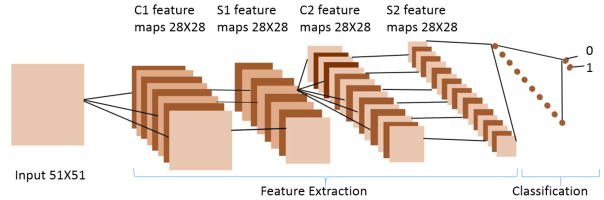
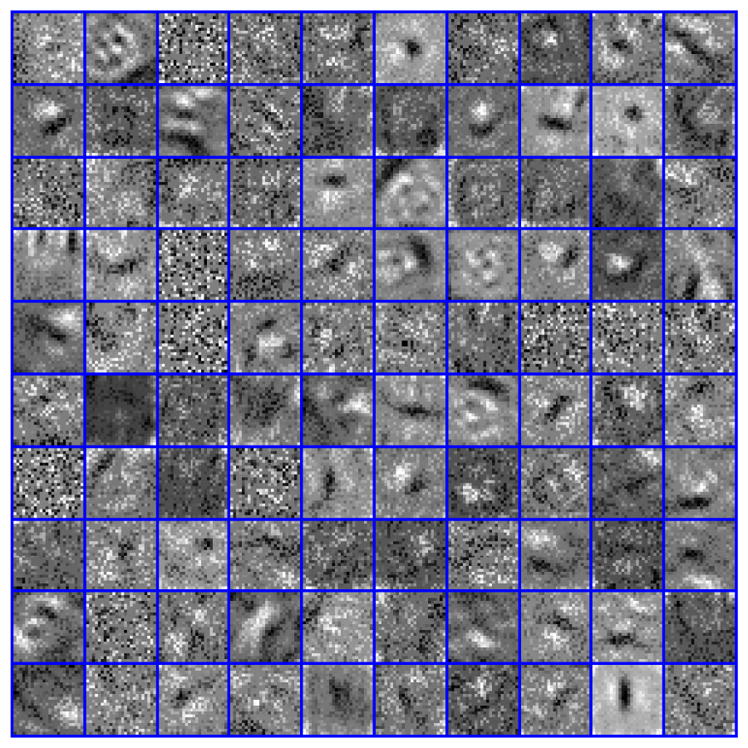
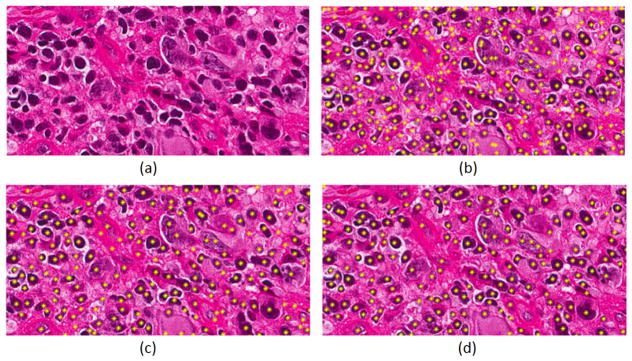
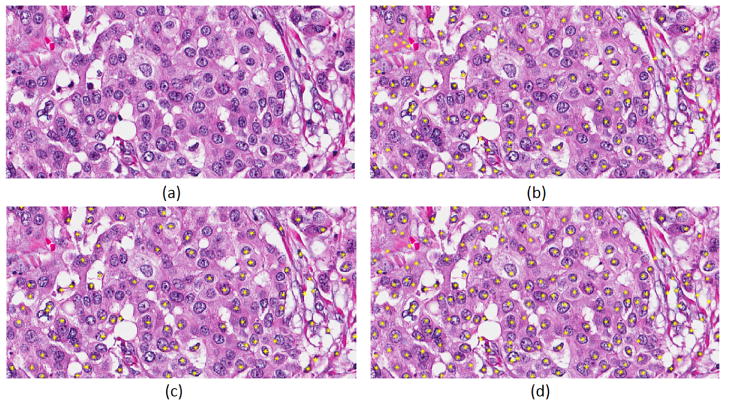
Detection of nuclei is an important step in phenotypic profiling of histology sections that are usually imaged in bright field. However, nuclei can have multiple phenotypes, which are difficult to model. It is shown that convolutional neural networks (CNN)s can learn different phenotypic signatures for nuclear detection, and that the performance is improved with the feature-based representation of the original image. The feature-based representation utilizes Laplacian of Gaussian (LoG) filter, which accentuates blob-shape objects. Several combinations of input data representations are evaluated to show that by LoG representation, detection of nuclei is advanced. In addition, the efficacy of CNN for vesicular and hyperchromatic nuclei is evaluated. In particular, the frequency of detection of nuclei with the vesicular and apoptotic phenotypes is increased. The overall system has been evaluated against manually annotated nuclei and the F-Scores for alternative representations have been reported.
细胞核检测是组织学切片表型分析中的重要步骤,组织学切片通常在明场下成像。然而,细胞核具有多种表型,难以进行建模。研究表明,卷积神经网络(CNN)能够学习用于细胞核检测的不同表型特征,并且通过对原始图像进行基于特征的表示可提高性能。基于特征的表示利用高斯拉普拉斯(LoG)滤波器,该滤波器突出了斑点状物体。对几种输入数据表示的组合进行了评估,结果表明通过LoG表示可推进细胞核检测。此外,还评估了CNN对泡状核和深色核的有效性。特别是,具有泡状和凋亡表型的细胞核的检测频率有所增加。已针对手动注释的细胞核对整个系统进行了评估,并报告了替代表示的F分数。