Rothgangel Andreas, Braun Susy, Smeets Rob, Beurskens Anna
Research Centre for Autonomy and Participation of People with a Chronic Illness, Faculty of Health, Zuyd University of Applied Sciences Heerlen, Heerlen, Netherlands.
CAPHRI School for Public Health and Primary Care, Maastricht University, Maastricht, Netherlands.
JMIR Rehabil Assist Technol. 2017 Feb 15;4(1):e2. doi: 10.2196/rehab.6761.
Phantom limb pain is a frequent and persistent problem following amputation. Achieving sustainable favorable effects on phantom limb pain requires therapeutic interventions such as mirror therapy that target maladaptive neuroplastic changes in the central nervous system. Unfortunately, patients' adherence to unsupervised exercises is generally poor and there is a need for effective strategies such as telerehabilitation to support long-term self-management of patients with phantom limb pain.
The main aim of this study was to describe the user-centered approach that guided the design and development of a telerehabilitation platform for patients with phantom limb pain. We addressed 3 research questions: (1) Which requirements are defined by patients and therapists for the content and functions of a telerehabilitation platform and how can these requirements be prioritized to develop a first prototype of the platform? (2) How can the user interface of the telerehabilitation platform be designed so as to match the predefined critical user requirements and how can this interface be translated into a medium-fidelity prototype of the platform? (3) How do patients with phantom limb pain and their treating therapists judge the usability of the medium-fidelity prototype of the telerehabilitation platform in routine care and how can the platform be redesigned based on their feedback to achieve a high-fidelity prototype?
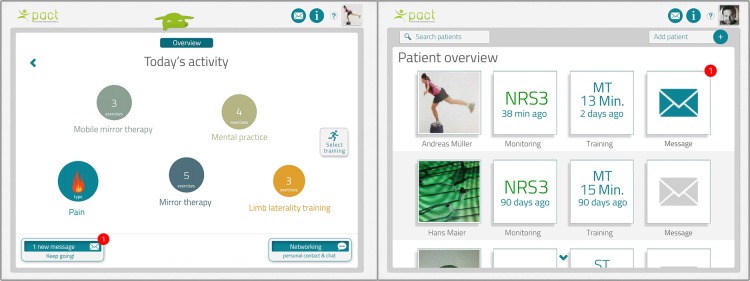
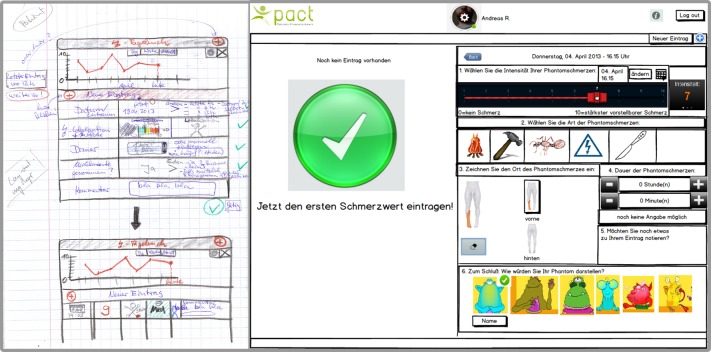
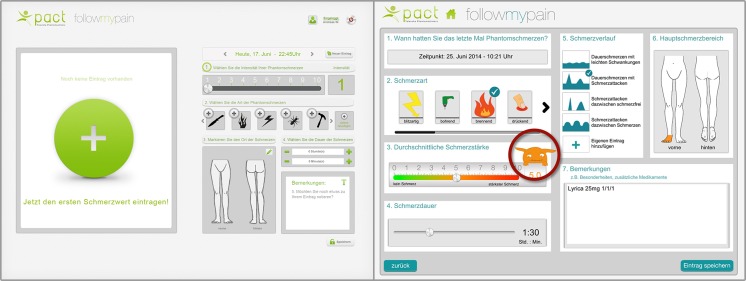
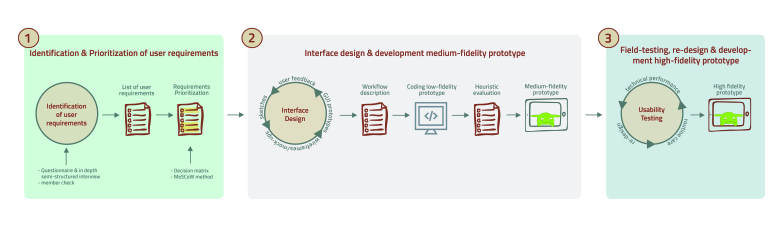
The telerehabilitation platform was developed using an iterative user-centered design process. In the first phase, a questionnaire followed by a semistructured interview was used to identify the user requirements of both the patients and their physical and occupational therapists, which were then prioritized using a decision matrix. The second phase involved designing the interface of the telerehabilitation platform using design sketches, wireframes, and interface mock-ups to develop a low-fidelity prototype. Heuristic evaluation resulted in a medium-fidelity prototype whose usability was tested in routine care in the final phase, leading to the development of a high-fidelity prototype.
A total of 7 categories of patient requirements were identified: monitoring, exercise programs, communication, settings, background information, log-in, and general requirements. One additional category emerged for therapists: patient management. Based on these requirements, patient and therapist interfaces for the telerehabilitation platform were developed and redesigned by the software development team in an iterative process, addressing the usability problems that were reported by the users during 4 weeks of field testing in routine care.
Our findings underline the importance of involving the users and other stakeholders early and continuously in an iterative design process, as well as the need for clear criteria to identify critical user requirements. A decision matrix is presented that incorporates the views of various stakeholders in systematically rating and prioritizing user requirements. The findings and lessons learned might help health care providers, researchers, software designers, and other stakeholders in designing and evaluating new teletreatments, and hopefully increase the likelihood of user acceptance.
幻肢痛是截肢后常见且持续存在的问题。要对幻肢痛产生可持续的良好效果,需要进行如镜像疗法等针对中枢神经系统适应性不良神经可塑性变化的治疗干预。不幸的是,患者对无监督锻炼的依从性普遍较差,因此需要诸如远程康复等有效策略来支持幻肢痛患者的长期自我管理。
本研究的主要目的是描述以用户为中心的方法,该方法指导了用于幻肢痛患者的远程康复平台的设计与开发。我们解决了3个研究问题:(1)患者和治疗师对远程康复平台的内容和功能定义了哪些要求,以及如何对这些要求进行优先级排序以开发该平台的首个原型?(2)如何设计远程康复平台的用户界面以符合预先定义的关键用户要求,以及如何将此界面转化为该平台的中等保真度原型?(3)幻肢痛患者及其治疗师如何评判远程康复平台中等保真度原型在常规护理中的可用性,以及如何根据他们的反馈对平台进行重新设计以实现高保真度原型?
远程康复平台是使用迭代式以用户为中心的设计过程开发的。在第一阶段,通过问卷调查随后进行半结构化访谈来确定患者及其物理治疗师和职业治疗师的用户要求,然后使用决策矩阵对这些要求进行优先级排序。第二阶段涉及使用设计草图、线框图和界面模型来设计远程康复平台的界面,以开发低保真度原型。启发式评估产生了一个中等保真度原型,其可用性在最后阶段的常规护理中进行了测试,从而促成了高保真度原型的开发。
总共确定了7类患者要求:监测、锻炼计划、沟通、设置、背景信息、登录和一般要求。治疗师还有一类额外的要求:患者管理。基于这些要求,软件开发团队在一个迭代过程中开发并重新设计了远程康复平台的患者和治疗师界面,解决了用户在常规护理4周的现场测试中报告的可用性问题。
我们的研究结果强调了在迭代设计过程中尽早且持续让用户和其他利益相关者参与的重要性,以及需要明确的标准来确定关键用户要求。提出了一个决策矩阵,该矩阵纳入了各种利益相关者的观点,用于系统地评估和优先排序用户要求。研究结果和经验教训可能有助于医疗保健提供者、研究人员、软件设计师和其他利益相关者设计和评估新的远程治疗方法,并有望提高用户接受的可能性。