• 文献检索
  • 文档翻译
  • 深度研究
  • 学术资讯
  • Suppr Zotero 插件Zotero 插件
  • 邀请有礼
  • 套餐&价格
  • 历史记录
应用&插件
Suppr Zotero 插件Zotero 插件浏览器插件Mac 客户端Windows 客户端微信小程序
定价
高级版会员购买积分包购买API积分包
服务
文献检索文档翻译深度研究API 文档MCP 服务
关于我们
关于 Suppr公司介绍联系我们用户协议隐私条款
关注我们

Suppr 超能文献

核心技术专利:CN118964589B侵权必究
粤ICP备2023148730 号-1Suppr @ 2026

文献检索

告别复杂PubMed语法,用中文像聊天一样搜索,搜遍4000万医学文献。AI智能推荐,让科研检索更轻松。

立即免费搜索

文件翻译

保留排版,准确专业,支持PDF/Word/PPT等文件格式,支持 12+语言互译。

免费翻译文档

深度研究

AI帮你快速写综述,25分钟生成高质量综述,智能提取关键信息,辅助科研写作。

立即免费体验

使用肌动电流图计数抓握动作:一项针对健康个体的探索性研究。

Counting Grasping Action Using Force Myography: An Exploratory Study With Healthy Individuals.

作者信息

Xiao Zhen Gang, Menon Carlo

机构信息

Simon Fraser University, Burnaby, BC, Canada.

Schools of Mechatronics Systems Engineering and Engineering Science, Simon Fraser University, Surrey, BC, Canada.

出版信息

JMIR Rehabil Assist Technol. 2017 May 16;4(1):e5. doi: 10.2196/rehab.6901.

DOI:10.2196/rehab.6901
PMID:28582263
原文链接:https://pmc.ncbi.nlm.nih.gov/articles/PMC5460070/
Abstract

BACKGROUND

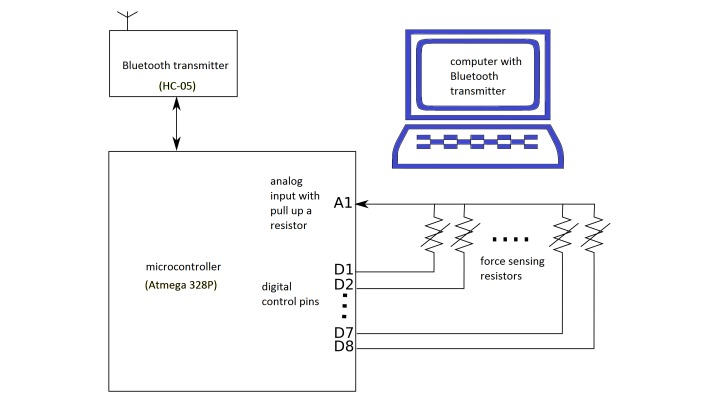
Functional arm movements generally require grasping an object. The possibility of detecting and counting the action of grasping is believed to be of importance for individual with motor function deficits of the arm, as it could be an indication of the number of the functional arm movements performed by the individuals during rehabilitation. In this exploratory work, the feasibility of using armbands recording radial displacements of forearm muscles and tendons (ie, force myography, FMG) to estimate hand grasping with healthy individuals was investigated. In contrast to previous studies, this exploratory study investigates the feasibility of (1) detecting grasping when the participants move their arms, which could introduce large artifacts to the point of potentially preventing the practical use of the proposed technology, and (2) counting grasping during arm-reaching tasks.

OBJECTIVE

The aim of this study was to determine the usefulness of FMG in the detection of functional arm movements. The use of FMG straps placed on the forearm is proposed for counting the number of grasping actions in the presence of arm movements.

METHODS

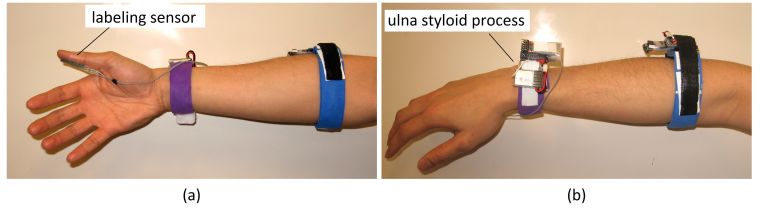
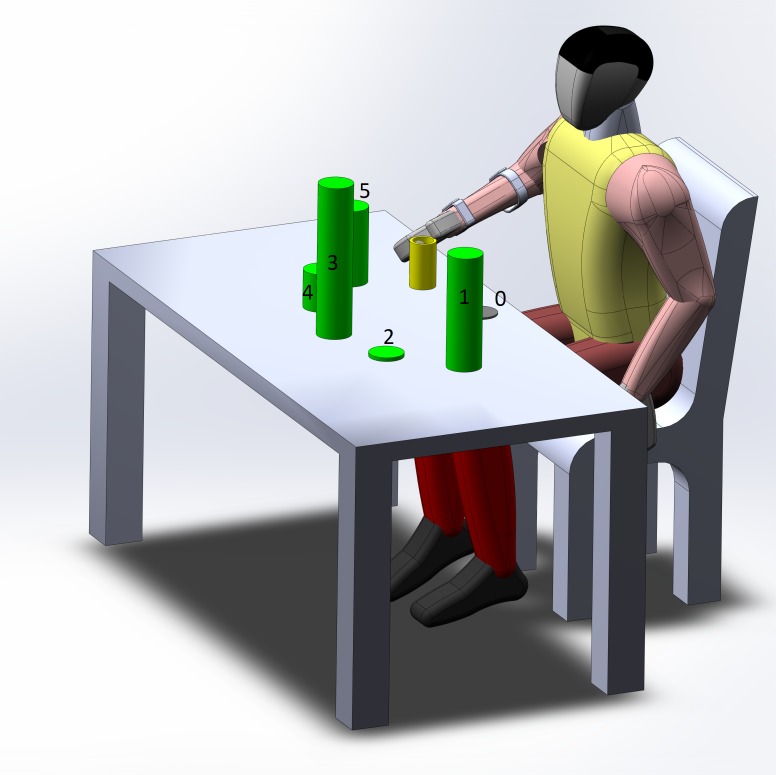
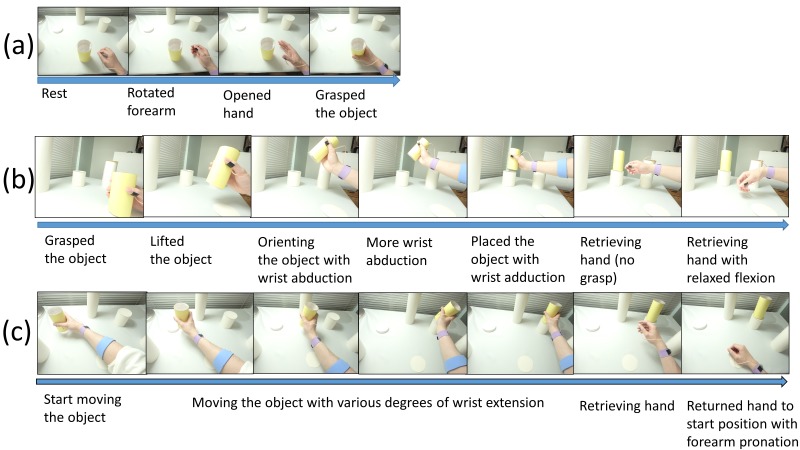
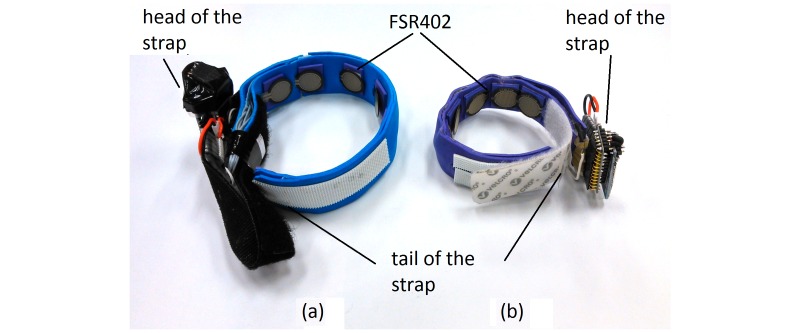
Ten healthy volunteers participated in this study to perform a pick-and-place exercise after providing informed consent. FMG signals were simultaneously collected using 2 FMG straps worn on their wrist and at the midposition of their forearm, respectively. Raw FMG signals and 3 additional FMG features (ie, root mean square, wavelength, and window symmetry) were extracted and fed into a linear discriminant analysis classifier to predict grasping states. The transition from nongrasping to grasping states was detected during the process of counting the number of grasping actions.

RESULTS

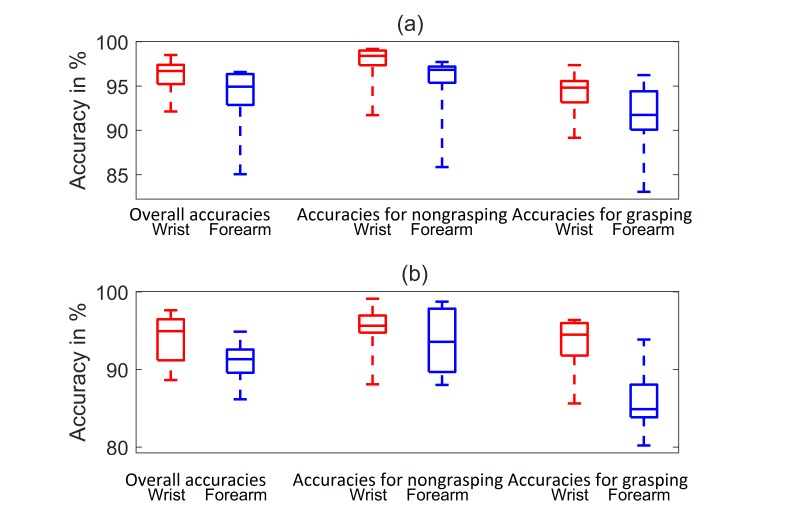
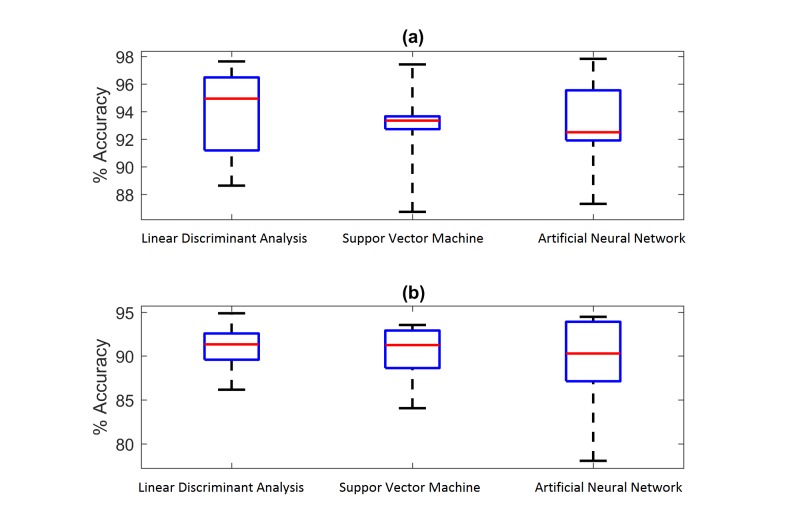
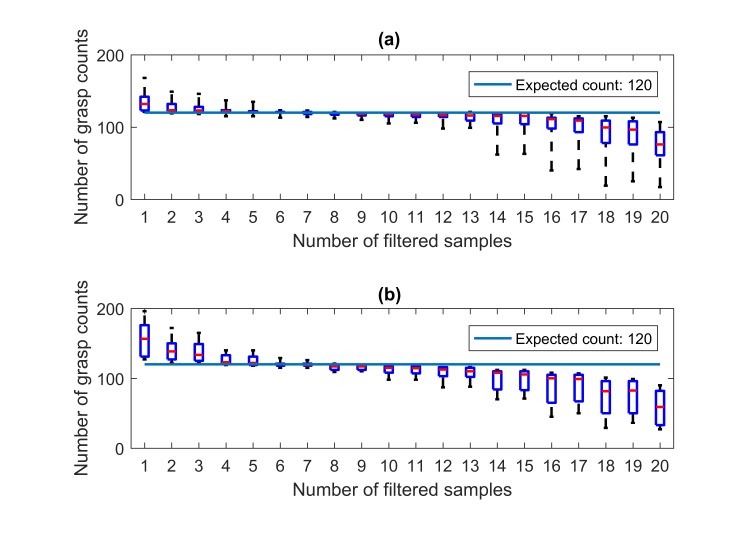
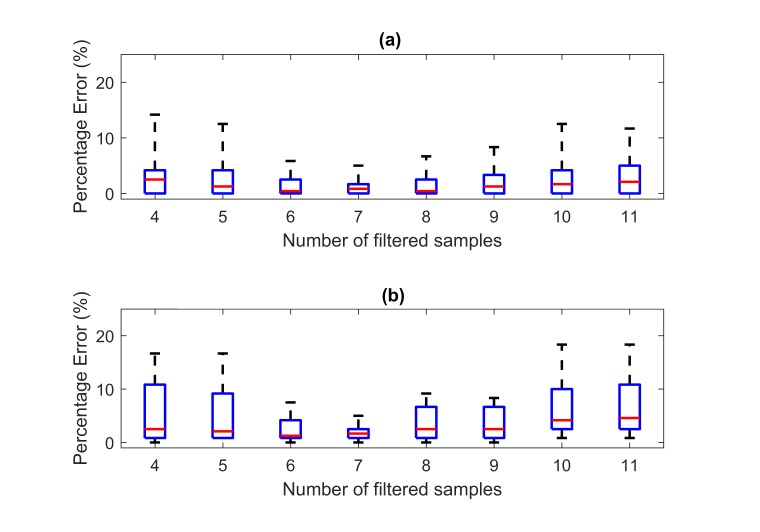
The median accuracy for detecting grasping events using FMG recorded from the wrist was 95%, and the corresponding interquartile range (IQR) was 5%. For forearm FMG classification, the median accuracy was 92%, and the corresponding IQR was 3%. The difference between the 2 median accuracies was statistically significant (P<.001) when using a paired 2-tailed sign test. The median percentage error for counting grasping events when FMG was recorded from the wrist was 1%, and the corresponding IQR was 2%. The median percentage error for FMG recorded from the forearm was 2%, and the corresponding IQR was also 2%. While the median percentage error for the wrist was lower than that of the forearm, the difference between the 2 was not statistically significant based on a paired 2-tailed sign test (P=.29).

CONCLUSIONS

This study reports that grasping can reliably be counted using an unobtrusive and simple FMG strap even in the presence of arm movements. Such a result supports the foundation for future research evaluating the feasibility of monitoring hand grasping during unsupervised ADL, leading to further investigations with individuals with motor function deficits of the arm.
https://cdn.ncbi.nlm.nih.gov/pmc/blobs/8408/5460070/a0a9d0aa13cf/rehab_v4i1e5_fig13.jpg
https://cdn.ncbi.nlm.nih.gov/pmc/blobs/8408/5460070/d45e361fccc3/rehab_v4i1e5_fig1.jpg
https://cdn.ncbi.nlm.nih.gov/pmc/blobs/8408/5460070/8246c4f96afd/rehab_v4i1e5_fig2.jpg
https://cdn.ncbi.nlm.nih.gov/pmc/blobs/8408/5460070/7913395c74db/rehab_v4i1e5_fig3.jpg
https://cdn.ncbi.nlm.nih.gov/pmc/blobs/8408/5460070/3b5ac433cf4f/rehab_v4i1e5_fig4.jpg
https://cdn.ncbi.nlm.nih.gov/pmc/blobs/8408/5460070/e0f0dd8eefdd/rehab_v4i1e5_fig5.jpg
https://cdn.ncbi.nlm.nih.gov/pmc/blobs/8408/5460070/15ba411682cc/rehab_v4i1e5_fig6.jpg
https://cdn.ncbi.nlm.nih.gov/pmc/blobs/8408/5460070/81761fb87311/rehab_v4i1e5_fig7.jpg
https://cdn.ncbi.nlm.nih.gov/pmc/blobs/8408/5460070/e47a817984d8/rehab_v4i1e5_fig8.jpg
https://cdn.ncbi.nlm.nih.gov/pmc/blobs/8408/5460070/46cc1e1e1f83/rehab_v4i1e5_fig9.jpg
https://cdn.ncbi.nlm.nih.gov/pmc/blobs/8408/5460070/c7916f7ca8ef/rehab_v4i1e5_fig10.jpg
https://cdn.ncbi.nlm.nih.gov/pmc/blobs/8408/5460070/0c58fd827bfc/rehab_v4i1e5_fig11.jpg
https://cdn.ncbi.nlm.nih.gov/pmc/blobs/8408/5460070/dbf5a9f7f8fb/rehab_v4i1e5_fig12.jpg
https://cdn.ncbi.nlm.nih.gov/pmc/blobs/8408/5460070/a0a9d0aa13cf/rehab_v4i1e5_fig13.jpg
https://cdn.ncbi.nlm.nih.gov/pmc/blobs/8408/5460070/d45e361fccc3/rehab_v4i1e5_fig1.jpg
https://cdn.ncbi.nlm.nih.gov/pmc/blobs/8408/5460070/8246c4f96afd/rehab_v4i1e5_fig2.jpg
https://cdn.ncbi.nlm.nih.gov/pmc/blobs/8408/5460070/7913395c74db/rehab_v4i1e5_fig3.jpg
https://cdn.ncbi.nlm.nih.gov/pmc/blobs/8408/5460070/3b5ac433cf4f/rehab_v4i1e5_fig4.jpg
https://cdn.ncbi.nlm.nih.gov/pmc/blobs/8408/5460070/e0f0dd8eefdd/rehab_v4i1e5_fig5.jpg
https://cdn.ncbi.nlm.nih.gov/pmc/blobs/8408/5460070/15ba411682cc/rehab_v4i1e5_fig6.jpg
https://cdn.ncbi.nlm.nih.gov/pmc/blobs/8408/5460070/81761fb87311/rehab_v4i1e5_fig7.jpg
https://cdn.ncbi.nlm.nih.gov/pmc/blobs/8408/5460070/e47a817984d8/rehab_v4i1e5_fig8.jpg
https://cdn.ncbi.nlm.nih.gov/pmc/blobs/8408/5460070/46cc1e1e1f83/rehab_v4i1e5_fig9.jpg
https://cdn.ncbi.nlm.nih.gov/pmc/blobs/8408/5460070/c7916f7ca8ef/rehab_v4i1e5_fig10.jpg
https://cdn.ncbi.nlm.nih.gov/pmc/blobs/8408/5460070/0c58fd827bfc/rehab_v4i1e5_fig11.jpg
https://cdn.ncbi.nlm.nih.gov/pmc/blobs/8408/5460070/dbf5a9f7f8fb/rehab_v4i1e5_fig12.jpg
https://cdn.ncbi.nlm.nih.gov/pmc/blobs/8408/5460070/a0a9d0aa13cf/rehab_v4i1e5_fig13.jpg
摘要

背景

功能性手臂运动通常需要抓取物体。对于存在手臂运动功能缺陷的个体而言,检测并计数抓取动作的可能性被认为具有重要意义,因为这可能表明个体在康复过程中执行的功能性手臂运动的次数。在这项探索性研究中,我们调查了使用记录前臂肌肉和肌腱径向位移的臂带(即测力肌电图,FMG)来估计健康个体手部抓握情况的可行性。与以往研究不同的是,这项探索性研究调查了以下两种情况的可行性:(1)在参与者移动手臂时检测抓握动作,这可能会引入大量伪迹,甚至可能阻碍所提出技术的实际应用;(2)在手臂伸展任务中计数抓握动作。

目的

本研究的目的是确定FMG在检测功能性手臂运动方面的实用性。建议使用放置在前臂上的FMG带,以在存在手臂运动的情况下计数抓握动作的次数。

方法

10名健康志愿者在签署知情同意书后参与了本研究,进行了取放练习。分别使用佩戴在他们手腕和前臂中部的2条FMG带同时采集FMG信号。提取原始FMG信号和另外3个FMG特征(即均方根、波长和窗口对称性),并将其输入线性判别分析分类器以预测抓握状态。在计数抓握动作次数的过程中检测从非抓握状态到抓握状态的转变。

结果

使用从手腕记录的FMG检测抓握事件的中位准确率为95%,相应的四分位间距(IQR)为5%。对于前臂FMG分类,中位准确率为92%,相应IQR为3%。使用配对双尾符号检验时,这两个中位准确率之间的差异具有统计学意义(P<0.001)。当从手腕记录FMG时,计数抓握事件的中位百分比误差为1%,相应IQR为2%。从前臂记录的FMG的中位百分比误差为2%,相应IQR也为2%。虽然手腕的中位百分比误差低于前臂,但根据配对双尾符号检验,两者之间的差异无统计学意义(P=0.29)。

结论

本研究报告称,即使在存在手臂运动的情况下,使用不显眼且简单的FMG带也能可靠地计数抓握动作。这一结果为未来评估在无监督日常生活活动中监测手部抓握可行性的研究奠定了基础,从而可对存在手臂运动功能缺陷的个体进行进一步研究。

相似文献

1
Counting Grasping Action Using Force Myography: An Exploratory Study With Healthy Individuals.使用肌动电流图计数抓握动作:一项针对健康个体的探索性研究。
JMIR Rehabil Assist Technol. 2017 May 16;4(1):e5. doi: 10.2196/rehab.6901.
2
Force Myography for Monitoring Grasping in Individuals with Stroke with Mild to Moderate Upper-Extremity Impairments: A Preliminary Investigation in a Controlled Environment.用于监测轻度至中度上肢损伤的中风患者抓握功能的测力肌动描记法:在可控环境下的初步研究
Front Bioeng Biotechnol. 2017 Jul 27;5:42. doi: 10.3389/fbioe.2017.00042. eCollection 2017.
3
A preliminary investigation on the utility of temporal features of Force Myography in the two-class problem of grasp vs. no-grasp in the presence of upper-extremity movements.在存在上肢运动的情况下,对力量肌电图时间特征在抓握与非抓握两类问题中的效用进行的初步研究。
Biomed Eng Online. 2017 May 16;16(1):59. doi: 10.1186/s12938-017-0349-4.
4
Does force myography recorded at the wrist correlate to resistance load levels during bicep curls?在进行二头肌弯举时,记录于手腕的力肌电图与阻力负荷水平相关吗?
J Biomech. 2019 Jan 23;83:310-314. doi: 10.1016/j.jbiomech.2018.11.035. Epub 2018 Nov 29.
5
Wrist-worn wearables based on force myography: on the significance of user anthropometry.基于力量肌电的腕戴可穿戴设备:用户人体测量学的意义。
Biomed Eng Online. 2020 Jun 12;19(1):46. doi: 10.1186/s12938-020-00789-w.
6
Regressing grasping using force myography: an exploratory study.使用力肌电图回归抓握:一项探索性研究。
Biomed Eng Online. 2018 Oct 23;17(1):159. doi: 10.1186/s12938-018-0593-2.
7
High-density force myography: A possible alternative for upper-limb prosthetic control.高密度肌动描记法:上肢假肢控制的一种可能替代方法。
J Rehabil Res Dev. 2016;53(4):443-56. doi: 10.1682/JRRD.2015.03.0041.
8
Assessment of Low-Density Force Myography Armband for Classification of Upper Limb Gestures.评估用于上肢手势分类的低密度力肌电臂带。
Sensors (Basel). 2023 Mar 1;23(5):2716. doi: 10.3390/s23052716.
9
An Investigation on the Sampling Frequency of the Upper-Limb Force Myographic Signals.上肢力量肌电信号采样频率的研究
Sensors (Basel). 2019 May 28;19(11):2432. doi: 10.3390/s19112432.
10
Estimation of User-Applied Isometric Force/Torque Using Upper Extremity Force Myography.使用上肢力量肌电图估计用户施加的等长力/扭矩。
Front Robot AI. 2019 Nov 22;6:120. doi: 10.3389/frobt.2019.00120. eCollection 2019.

引用本文的文献

1
Gesture Recognition Framework for Teleoperation of Infrared (IR) Consumer Devices Using a Novel pFMG Soft Armband.使用新型 pFMG 软臂带进行红外(IR)消费设备遥操作的手势识别框架。
Sensors (Basel). 2024 Sep 22;24(18):6124. doi: 10.3390/s24186124.
2
A survey on the state of the art of force myography technique (FMG): analysis and assessment.力肌电图技术(FMG)现状调查:分析与评估。
Med Biol Eng Comput. 2024 May;62(5):1313-1332. doi: 10.1007/s11517-024-03019-w. Epub 2024 Feb 2.
3
A Wearable Force Myography-Based Armband for Recognition of Upper Limb Gestures.

本文引用的文献

1
High-density force myography: A possible alternative for upper-limb prosthetic control.高密度肌动描记法:上肢假肢控制的一种可能替代方法。
J Rehabil Res Dev. 2016;53(4):443-56. doi: 10.1682/JRRD.2015.03.0041.
2
Force Myography to Control Robotic Upper Extremity Prostheses: A Feasibility Study.肌电控制机器人上肢假肢:一项可行性研究。
Front Bioeng Biotechnol. 2016 Mar 8;4:18. doi: 10.3389/fbioe.2016.00018. eCollection 2016.
3
Stable force-myographic control of a prosthetic hand using incremental learning.基于增量学习的假手稳定力肌电控制。
一种基于可穿戴力电肌图的臂带,用于识别上肢手势。
Sensors (Basel). 2023 Nov 23;23(23):9357. doi: 10.3390/s23239357.
4
Feasibility of force myography for the direct control of an assistive robotic hand orthosis in non-impaired individuals.力肌电图在非损伤个体中直接控制辅助机器人手矫形器的可行性。
J Neuroeng Rehabil. 2023 Aug 3;20(1):101. doi: 10.1186/s12984-023-01222-8.
5
Tactile Signatures and Hand Motion Intent Recognition for Wearable Assistive Devices.可穿戴辅助设备的触觉特征与手部运动意图识别
Front Robot AI. 2019 Nov 21;6:124. doi: 10.3389/frobt.2019.00124. eCollection 2019.
6
Wrist-worn wearables based on force myography: on the significance of user anthropometry.基于力量肌电的腕戴可穿戴设备:用户人体测量学的意义。
Biomed Eng Online. 2020 Jun 12;19(1):46. doi: 10.1186/s12938-020-00789-w.
7
Investigation of Channel Selection for Gesture Classification for Prosthesis Control Using Force Myography: A Case Study.基于表面肌电的假肢控制手势分类的通道选择研究:一项案例研究
Front Bioeng Biotechnol. 2019 Dec 10;7:331. doi: 10.3389/fbioe.2019.00331. eCollection 2019.
8
Investigation of Regression Methods for Reduction of Errors Caused by Bending of FSR-Based Pressure Sensing Systems Used for Prosthetic Applications.用于假肢应用的基于 FSR 的压力感测系统弯曲引起的误差减少的回归方法研究。
Sensors (Basel). 2019 Dec 13;19(24):5519. doi: 10.3390/s19245519.
9
A Review of Force Myography Research and Development.力肌电图研究与发展述评。
Sensors (Basel). 2019 Oct 20;19(20):4557. doi: 10.3390/s19204557.
10
An Investigation on the Sampling Frequency of the Upper-Limb Force Myographic Signals.上肢力量肌电信号采样频率的研究
Sensors (Basel). 2019 May 28;19(11):2432. doi: 10.3390/s19112432.
Annu Int Conf IEEE Eng Med Biol Soc. 2015 Aug;2015:4828-31. doi: 10.1109/EMBC.2015.7319474.
4
Evaluation of a portable markerless finger position capture device: accuracy of the Leap Motion controller in healthy adults.便携式无标记手指位置捕捉设备的评估:健康成年人中Leap Motion控制器的准确性
Physiol Meas. 2015 May;36(5):1025-35. doi: 10.1088/0967-3334/36/5/1025. Epub 2015 Apr 22.
5
Quantifying Real-World Upper-Limb Activity in Nondisabled Adults and Adults With Chronic Stroke.量化非残疾成年人和慢性中风成年人的实际上肢活动情况。
Neurorehabil Neural Repair. 2015 Nov-Dec;29(10):969-78. doi: 10.1177/1545968315583720. Epub 2015 Apr 20.
6
A comparative analysis of three non-invasive human-machine interfaces for the disabled.三种针对残疾人的非侵入式人机接口的比较分析。
Front Neurorobot. 2014 Oct 27;8:24. doi: 10.3389/fnbot.2014.00024. eCollection 2014.
7
Proceedings of the first workshop on Peripheral Machine Interfaces: going beyond traditional surface electromyography.第一届外围机器接口研讨会论文集:超越传统表面肌电图
Front Neurorobot. 2014 Aug 15;8:22. doi: 10.3389/fnbot.2014.00022. eCollection 2014.
8
An accelerometry-based methodology for assessment of real-world bilateral upper extremity activity.一种基于加速度计的用于评估现实世界中双侧上肢活动的方法。
PLoS One. 2014 Jul 28;9(7):e103135. doi: 10.1371/journal.pone.0103135. eCollection 2014.
9
A learning scheme for reach to grasp movements: on EMG-based interfaces using task specific motion decoding models.一种用于抓握动作的学习方案:基于肌电图的接口中使用特定任务运动解码模型的情况。
IEEE J Biomed Health Inform. 2013 Sep;17(5):915-21. doi: 10.1109/JBHI.2013.2259594.
10
Investigating measures of intensity during a structured upper limb exercise program in stroke rehabilitation: an exploratory study.探究中风康复中结构化上肢运动计划的强度测量:一项探索性研究。
Arch Phys Med Rehabil. 2014 Dec;95(12):2410-9. doi: 10.1016/j.apmr.2014.05.025. Epub 2014 Jun 16.