Blázquez Mercedes, Medina Paula, Crespo Berta, Gómez Ana, Zanuy Silvia
Instituto de Acuicultura de Torre la Sal, Consejo Superior de Investigaciones Científicas (IATS-CSIC), Ribera de Cabanes, 12595, Castellón, Spain.
Instituto de Ciencias del Mar, Consejo Superior de Investigaciones Científicas (ICM-CSIC), Passeig Maritim 37-49, 08003, Barcelona, Spain.
BMC Genomics. 2017 Jun 5;18(1):441. doi: 10.1186/s12864-017-3823-2.
Spermatogenesis is a complex process characterized by the activation and/or repression of a number of genes in a spatio-temporal manner. Pubertal development in males starts with the onset of the first spermatogenesis and implies the division of primary spermatogonia and their subsequent entry into meiosis. This study is aimed at the characterization of genes involved in the onset of puberty in European sea bass, and constitutes the first transcriptomic approach focused on meiosis in this species.
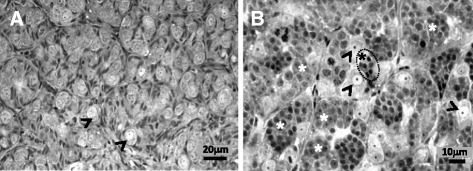
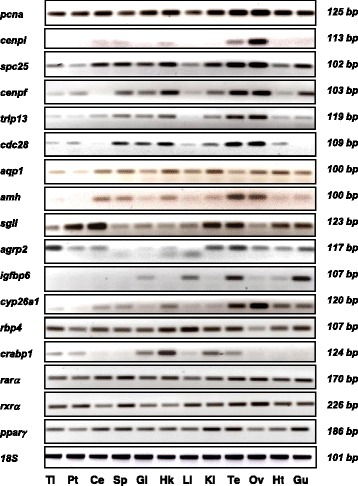
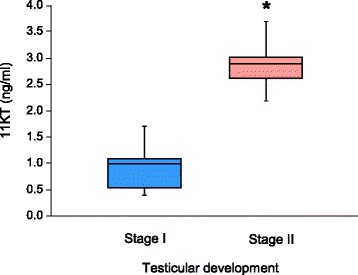
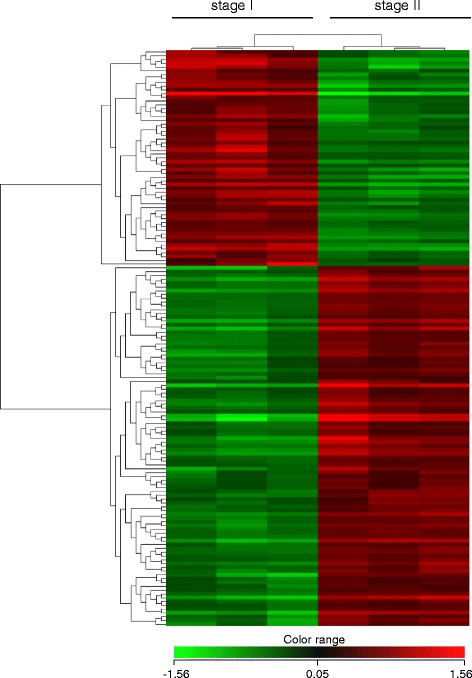
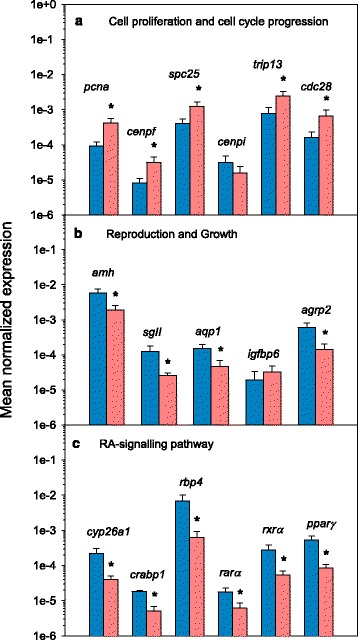
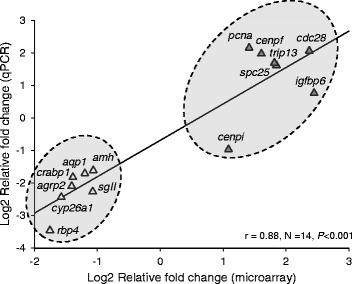
European sea bass testes collected at the onset of puberty (first successful reproduction) were grouped in stage I (resting stage), and stage II (proliferative stage). Transition from stage I to stage II was marked by an increase of 11ketotestosterone (11KT), the main fish androgen, whereas the transcriptomic study resulted in 315 genes differentially expressed between the two stages. The onset of puberty induced 1) an up-regulation of genes involved in cell proliferation, cell cycle and meiosis progression, 2) changes in genes related with reproduction and growth, and 3) a down-regulation of genes included in the retinoic acid (RA) signalling pathway. The analysis of GO-terms and biological pathways showed that cell cycle, cell division, cellular metabolic processes, and reproduction were affected, consistent with the early events that occur during the onset of puberty. Furthermore, changes in the expression of three RA nuclear receptors point at the importance of the RA-signalling pathway during this period, in agreement with its role in meiosis.
The results contribute to boost our knowledge of the early molecular and endocrine events that trigger pubertal development and the onset of spermatogenesis in fish. These include an increase in 11KT plasma levels and changes in the expression of several genes involved in cell proliferation, cell cycle progression, meiosis or RA-signalling pathway. Moreover, the results can be applied to study meiosis in this economically important fish species for Mediterranean countries, and may help to develop tools for its sustainable aquaculture.
精子发生是一个复杂的过程,其特征是许多基因在时空上被激活和/或抑制。雄性青春期发育始于首次精子发生的开始,意味着初级精原细胞的分裂及其随后进入减数分裂。本研究旨在表征参与欧洲海鲈青春期开始的基因,并构成了该物种首次聚焦于减数分裂的转录组学研究。
在青春期开始时(首次成功繁殖)收集的欧洲海鲈睾丸被分为I期(静止期)和II期(增殖期)。从I期到II期的转变以主要鱼类雄激素11酮睾酮(11KT)的增加为标志,而转录组学研究导致两个阶段之间有315个基因差异表达。青春期的开始诱导了1)参与细胞增殖、细胞周期和减数分裂进程的基因上调,2)与繁殖和生长相关的基因变化,以及3)视黄酸(RA)信号通路中包含的基因下调。GO术语和生物学途径分析表明,细胞周期、细胞分裂、细胞代谢过程和繁殖受到影响,这与青春期开始时发生的早期事件一致。此外,三种RA核受体表达的变化表明RA信号通路在此期间的重要性,这与其在减数分裂中的作用一致。
这些结果有助于增进我们对触发鱼类青春期发育和精子发生开始的早期分子和内分泌事件的了解。这些事件包括血浆11KT水平的增加以及参与细胞增殖、细胞周期进程、减数分裂或RA信号通路的几个基因表达的变化。此外,这些结果可应用于研究这种对地中海国家具有重要经济意义的鱼类的减数分裂,并可能有助于开发其可持续水产养殖的工具。