Larayetan Rotimi A, Okoh Omobola O, Sadimenko Alexander, Okoh Anthony I
Department of Pure and Applied Chemistry, University of Fort Hare, Alice, 5700, South Africa.
Chemistry Department, Kogi State University, Anyigba, Kogi, Nigeria.
BMC Complement Altern Med. 2017 Jun 5;17(1):292. doi: 10.1186/s12906-017-1804-2.
Volatile oil from aromatic plants has been used by ancient Egyptians in embalming for the inhibition of bacterial growth and prevention of decay, Callistemon citrinus is used in traditional therapies for the treatment of bronchitis, cough, inflammation and as an antimicrobial herbs. This study examines the essential constituents of the volatile oils obtained from the aerial parts of the plant as well as its antioxidant activity, free radical scavenging, phenolic content and the antibacterial potential of the oils.
A portion of 500 g, 250 g and 150 g of the leaves, flowers and stems of this plant respectively were subjected to hydro-distillation process for three hours. The oils collected from the various plant parts were immediately subjected to GC-MS analysis. The overall phenolic content of the leaves oil, radical scavenging, antibacterial action and antioxidant activities of the essential oils of both the leaves and flowers of Callistemon citrinus were determined using standard methods, with free radical DPPH and ABTS as a reference antioxidant.
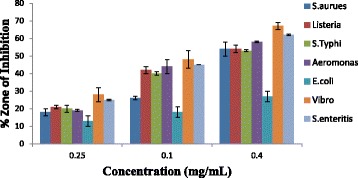
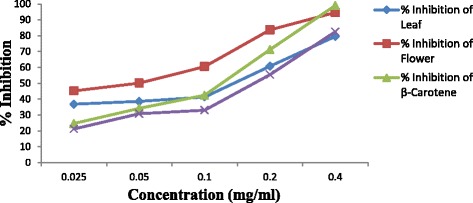
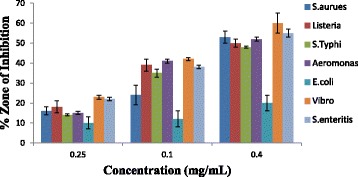
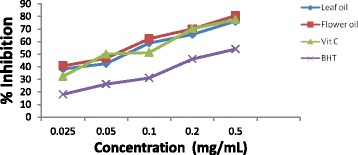
Analyses of the three oils revealed a total of twenty-six components for the leaves oil representing 96.84% of the total oil composition, forty-one components for the flowers oil accounting for 98.92% of the whole composition and ten components for the stem oil amounting to 99.98% of the entire oil constituents. The dominant compounds in the leaves oil were eucalyptol (48.98%) and α-terpineol (8.01%), while α-eudesmol (12.93%), caryophyllene (11.89%), (-)-bornyl-acetate (10.02%) and eucalyptol (8.11%) were the main constituents of the flowers oil. In the same vein, the leading constituents in the stems oil were eucalyptol (56.00%) and α-pinene (31.03%). The antioxidant capacities of both the leaves and flowers oils of the plant were evaluated and their IC were (1.49 and 1.13) for DPPH and (0.14 and 0.03) for ABTS assay respectively. The antibacterial activities of the oils from the (leaves and flowers) were also examined and were found to have wide range of activities against the bacterial strains used in this study.
Observations drawn from this experiment shows clearly that the leaves and flowers of Callistemon citrinus possess phenolic compounds and cyclic ether of several pharmacological behaviors.
芳香植物的挥发油在古埃及被用于防腐,以抑制细菌生长和防止腐烂。柠檬桉在传统疗法中用于治疗支气管炎、咳嗽、炎症,是一种抗菌草药。本研究检测了从该植物地上部分提取的挥发油的主要成分,以及其抗氧化活性、自由基清除能力、酚类含量和挥发油的抗菌潜力。
分别称取该植物500g叶片、250g花朵和150g茎,进行三小时的水蒸馏。从不同植物部位收集的挥发油立即进行气相色谱-质谱联用(GC-MS)分析。采用标准方法测定柠檬桉叶片挥发油的总酚含量、自由基清除能力、抗菌作用以及叶片和花朵挥发油的抗氧化活性,以自由基二苯基苦味酰基自由基(DPPH)和2,2'-联氮-双(3-乙基苯并噻唑啉-6-磺酸)二铵盐(ABTS)作为参考抗氧化剂。
对三种挥发油的分析显示,叶片挥发油共有26种成分,占总油成分的96.84%;花朵挥发油有41种成分,占整个成分的98.92%;茎挥发油有10种成分,占全部油成分的99.98%。叶片挥发油中的主要化合物是桉叶油素(48.98%)和α-松油醇(8.01%),而α-桉叶醇(12.93%)、石竹烯(11.89%)、(-)-乙酸冰片酯(10.02%)和桉叶油素(8.11%)是花朵挥发油的主要成分。同样,茎挥发油的主要成分是桉叶油素(56.00%)和α-蒎烯(31.03%)。评估了该植物叶片和花朵挥发油的抗氧化能力,其对DPPH的半数抑制浓度(IC)分别为(1.49和1.13),对ABTS测定的IC分别为(0.14和0.03)。还检测了(叶片和花朵)挥发油的抗菌活性,发现其对本研究中使用的细菌菌株具有广泛的活性。
从本实验得出的观察结果清楚地表明,柠檬桉的叶片和花朵含有具有多种药理行为的酚类化合物和环醚。