Wei Daimin, Sun Yun, Liu Jiayin, Liang Xiaoyan, Zhu Yimin, Shi Yuhua, Chen Zi-Jiang
Center for Reproductive Medicine, Shandong Provincial Hospital Affiliated to Shandong University, Key Laboratory of Reproductive Endocrinology, Shandong University, Ministry of Education, and National Research Center for Assisted Reproductive Technology and Reproductive Genetics, Jinan, China.
Center for Reproductive Medicine, Ren Ji Hospital, School of Medicine, Shanghai Jiao Tong University, Shanghai Key Laboratory for Assisted Reproduction and Reproductive Genetics, Shanghai, China.
Trials. 2017 Jun 5;18(1):253. doi: 10.1186/s13063-017-1993-5.
Multiple pregnancies are one of the major safety concerns of in vitro fertilization (IVF) due to the increased risk of maternal and neonatal complications. Single embryo transfer is the most effective way to reduce the risk of multiple pregnancies. Selection of the embryo and optimization of the implantation environment are crucial to retain the success rate when the number of transferred embryos is diminished. Fresh embryo transfer with supra-physiological levels of hormones has been suggested to have an adverse effect on implantation. Elective frozen embryo transfer has been suggested to result in a higher rate of live birth than fresh embryo transfer. However, there is still a lack of evidence from randomized clinical trials comparing the efficacy and safety between frozen and fresh single blastocyst transfers.
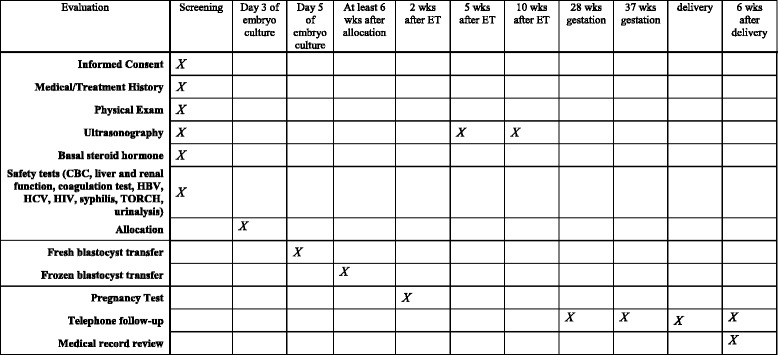
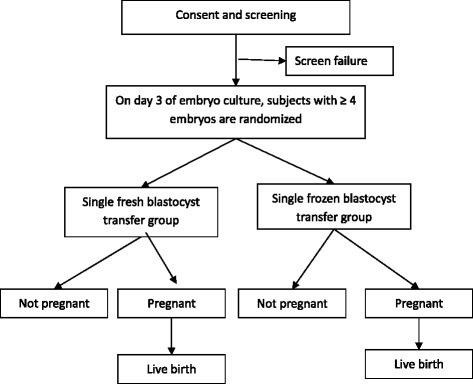
METHODS/DESIGN: We are conducting a randomized controlled trial in women aged 20-35 undergoing their first cycle of IVF with or without intracytoplasmic sperm injection. After ovarian stimulation with a gonadotropin-releasing hormone antagonist protocol, women who obtain four or more embryos on day 3 of the embryo culture are randomized into two parallel groups: a single fresh blastocyst transfer group and a single frozen blastocyst transfer group (all blastocysts vitrified and a deferred frozen blastocyst transfer). The primary outcome is singleton live birth.
The results of this study will provide evidence for the efficacy and safety of the strategy of elective frozen single blastocyst transfer in women with a good prognosis.
Chinese Clinical Trial Registry, ChiCTR-IOR-14005405 . Registered on 30 Oct 2014.
多胎妊娠是体外受精(IVF)主要的安全问题之一,因为母婴并发症风险会增加。单胚胎移植是降低多胎妊娠风险的最有效方法。当移植胚胎数量减少时,胚胎选择和着床环境优化对于维持成功率至关重要。有研究表明,激素水平超生理状态的新鲜胚胎移植对着床有不利影响。有人提出,选择性冻融胚胎移植的活产率高于新鲜胚胎移植。然而,目前仍缺乏来自随机临床试验的证据,以比较冷冻和新鲜单囊胚移植之间的疗效和安全性。
方法/设计:我们正在对年龄在20 - 35岁、首次接受IVF(无论是否进行卵胞浆内单精子注射)的女性进行一项随机对照试验。在采用促性腺激素释放激素拮抗剂方案进行卵巢刺激后,在胚胎培养第3天获得4个或更多胚胎的女性被随机分为两个平行组:单新鲜囊胚移植组和单冷冻囊胚移植组(所有囊胚玻璃化保存并进行延期冷冻囊胚移植)。主要结局是单胎活产。
本研究结果将为选择性冷冻单囊胚移植策略在预后良好女性中的疗效和安全性提供证据。
中国临床试验注册中心,ChiCTR - IOR - 14005405。于2014年10月30日注册。