Laboratory of Medical and Molecular Parasitology-Mycology (LP3M), LR 12ES08. Faculty of Pharmacy, University of Monastir, 5000, Monastir, Tunisia.
Laboratory of Biomass Valorisation and Production of Eukaryotic Proteins, Center of Biotechnology, University of Sfax, 3018, Sfax, Tunisia.
Parasit Vectors. 2017 Jun 5;10(1):280. doi: 10.1186/s13071-017-2208-3.
Although data on the parasite environmental contamination are crucial to implement strategies for control and treatment, information about zoonotic helminths is very limited in Tunisia. Contamination of areas with canid faeces harboring infective parasite elements represents a relevant health-risk impact for humans. The aim of this study was to assess the environmental contamination with eggs and oocysts of gastrointestinal parasites of dogs and wild canids in Tunisia with special attention to those that can be transmitted to humans.
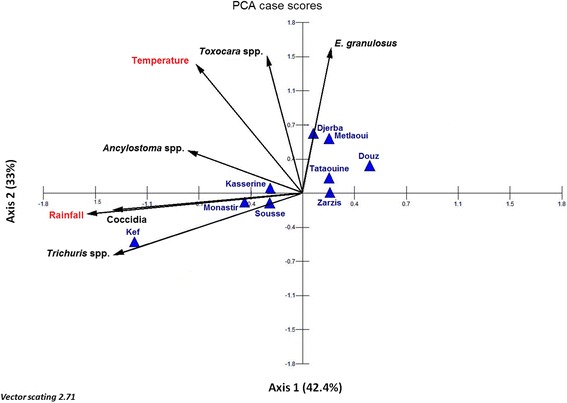
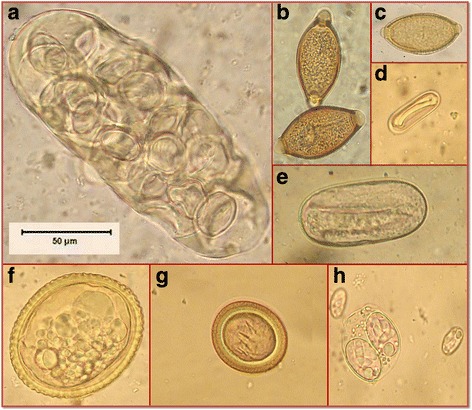
One thousand two hundred and seventy faecal samples from stray dogs and 104 from wild canids (red foxes and golden jackals) were collected from different geographical regions throughout Tunisia. The helminth eggs and protozoan oocysts were concentrated by sucrose flotation and identified by microscopic examination. The most frequently observed parasites in dog samples were Toxocara spp. (27.2%), E. granulosus (25.8%), and Coccidia (13.1%). For wild canid faeces, the most commonly encountered parasites were Toxocara spp. (16.3%) followed by Capillaria spp. (9.6%). The parasite contamination of dog faeces varied significantly from one region to another in function of the climate.
To our knowledge, the study highlights for the first time in Tunisia a serious environmental contamination by numerous parasitic stages infective to humans. Efforts should be made to increase the awareness of the contamination risk of such parasites in the environment and implement a targeted educational program.
尽管寄生虫环境污染的数据对于实施控制和治疗策略至关重要,但突尼斯关于人畜共患寄生虫的信息非常有限。受感染的寄生虫元素污染犬类粪便区域,对人类健康构成了重大风险。本研究旨在评估突尼斯犬类和野生犬科动物(狐狸和金豺)的胃肠道寄生虫卵和卵囊的环境污染情况,特别关注那些可能传染给人类的寄生虫。
从突尼斯各地不同的地理区域采集了 1270 份流浪犬和 104 份野生犬科动物(狐狸和金豺)的粪便样本。采用蔗糖漂浮法浓缩寄生虫卵和原虫卵囊,并通过显微镜检查进行鉴定。在犬类样本中最常观察到的寄生虫是犬弓首蛔虫(27.2%)、细粒棘球绦虫(25.8%)和球虫(13.1%)。对于野生犬科动物的粪便,最常见的寄生虫是犬弓首蛔虫(16.3%),其次是毛细线虫(9.6%)。犬类粪便的寄生虫污染因气候的不同而在各地区之间存在显著差异。
据我们所知,本研究首次在突尼斯强调了环境受到多种对人类具有感染性的寄生虫阶段的严重污染。应努力提高人们对环境中此类寄生虫污染风险的认识,并实施有针对性的教育计划。