National Veterinary Research Institute, al. Partyzantow 57, 24-100, Pulawy, Poland.
Parasit Vectors. 2018 Jul 28;11(1):436. doi: 10.1186/s13071-018-3021-3.
The red fox (Vulpes vulpes) is widely distributed in the world; in central Europe, it is the most numerous wild species of the family Canidae. It can play the role of a definitive host for many intestinal parasites, including zoonotic helminths. Poland, with its geographical location (central Europe), is an interesting area for parasitological investigations of this species. The aim of this study was to evaluate and compare the prevalence of intestinal helminths in red foxes in different regions of Poland.
Intestines of 473 red foxes from four different regions were examined using the sedimentation and counting technique (SCT). In addition, 344 samples of faeces were examined using flotation.
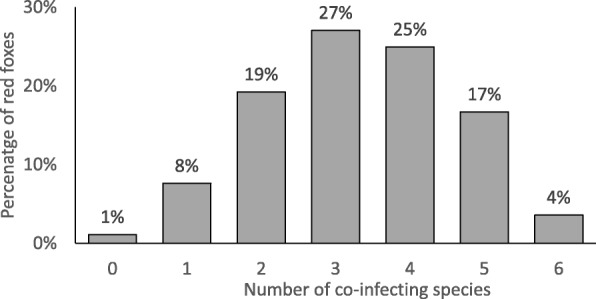
Overall, intestinal helminths were found in 98.9% of red foxes. The average prevalence of detected parasites was as follows: Mesocestoides spp. (84.1%); hookworms (67.9%); Alaria alata (61.5%); Toxocara/Toxascaris (49.5%); Taenia spp. (42.5%); Echinococcus multilocularis (25.6%); and Trichuris vulpis (2.3%). The prevalence of the majority of parasite species was similar in each region. Significant differences between regions were observed in the case of E. multilocularis: a low prevalence in the south-western and northern regions (0% and 0.9%, respectively) and a high prevalence in the south-east and northeast (39.3% and 42.7%, respectively). In the case of A. alata, important differences were found between northern (96.5% and 93.7% in northern and northeast regions, respectively) and southern regions (15.2% and 24.7% for south-western and south-east regions, respectively). The percentage of positive samples obtained with coproscopic examination (except for Trichuris) was significantly lower than that obtained with SCT. Analysis of the prevalence estimated in individual regions with the use of both methods (flotation and SCT) showed a high correlation for all parasite species (except for Mesocestoides spp.). The flotation method also allowed us to detect the eggs of the lung nematode Eucoleus aerophilus (syn. Capillaria aerophila) (76.2% of positive foxes).
This study showed a very high percentage of red foxes infected with intestinal helminths in different parts of Poland. Depending on the location, some differences were observed regarding the prevalence of dangerous zoonotic parasites, which should be considered in the assessment of infection risk for humans.
红狐(Vulpes vulpes)广泛分布于世界各地;在中欧,它是犬科家族中数量最多的野生动物。它可以作为许多肠道寄生虫的终末宿主,包括人畜共患的蠕虫。波兰地处中欧,地理位置独特,是研究该物种寄生虫的理想地区。本研究旨在评估和比较波兰不同地区红狐肠道寄生虫的流行情况。
采用沉淀计数技术(SCT)对来自波兰四个不同地区的 473 只红狐的肠道进行检查。此外,还对 344 份粪便样本进行了漂浮检查。
总体而言,98.9%的红狐肠道中发现了肠道寄生虫。检测到的寄生虫平均流行率如下:Mesocestoides spp.(84.1%);钩虫(67.9%);Alaria alata(61.5%);Toxocara/Toxascaris(49.5%);Taenia spp.(42.5%);泡状带绦虫(25.6%);和犬弓首蛔虫(2.3%)。大多数寄生虫的流行率在每个地区都相似。在东部和东北部地区,泡状带绦虫的流行率较低(分别为 0%和 0.9%),而在东南部和西北部地区,泡状带绦虫的流行率较高(分别为 39.3%和 42.7%),这表明不同地区之间存在显著差异。在东北部和西北部地区,泡状带绦虫的流行率分别为 96.5%和 93.7%,而在东南部和西南部地区,泡状带绦虫的流行率分别为 15.2%和 24.7%,这表明在北部地区(东北部和西北部)和南部地区(西南部和东南部)之间存在重要差异。在北部地区(东北部和西北部),泡状带绦虫的流行率分别为 96.5%和 93.7%,而在南部地区(西南部和东南部),泡状带绦虫的流行率分别为 15.2%和 24.7%,这表明在北部地区(东北部和西北部)和南部地区(西南部和东南部)之间存在重要差异。在北部地区(东北部和西北部),泡状带绦虫的流行率分别为 96.5%和 93.7%,而在南部地区(西南部和东南部),泡状带绦虫的流行率分别为 15.2%和 24.7%,这表明在北部地区(东北部和西北部)和南部地区(西南部和东南部)之间存在重要差异。在北部地区(东北部和西北部),泡状带绦虫的流行率分别为 96.5%和 93.7%,而在南部地区(西南部和东南部),泡状带绦虫的流行率分别为 15.2%和 24.7%,这表明在北部地区(东北部和西北部)和南部地区(西南部和东南部)之间存在重要差异。此外,A. alata 在北部地区(北部和东北部地区分别为 96.5%和 93.7%)和南部地区(西南部和东南部地区分别为 15.2%和 24.7%)之间存在重要差异。用粪便检查(除犬弓首蛔虫外)获得的阳性样本百分比明显低于 SCT 获得的百分比。对使用两种方法(漂浮法和 SCT)在各个地区估计的流行率进行分析表明,除 Mesocestoides spp. 外,所有寄生虫的流行率均高度相关。漂浮法还可以检测到肺线虫 Eucoleus aerophilus(原名为 Capillaria aerophila)的卵(阳性狐狸的 76.2%)。
本研究表明,波兰不同地区的红狐肠道寄生虫感染率非常高。根据地理位置的不同,一些危险的人畜共患寄生虫的流行率存在差异,这在评估人类感染风险时应予以考虑。