Seachrist Darcie D, Sizemore Steven T, Johnson Emhonta, Abdul-Karim Fadi W, Weber Bonk Kristen L, Keri Ruth A
Department of Pharmacology, Case Western Reserve University School of Medicine, 10900 Euclid Avenue, Cleveland, OH, 44106-4965, USA.
Present address: Department of Radiation Oncology, The James Comprehensive Cancer Center, The Ohio State University, Columbus, OH, 43210, USA.
Breast Cancer Res. 2017 Jun 5;19(1):66. doi: 10.1186/s13058-017-0857-y.
Follistatin (FST) is an intrinsic inhibitor of activin, a member of the transforming growth factor-β superfamily of ligands. The prognostic value of FST and its family members, the follistatin-like (FSTL) proteins, have been studied in various cancers. However, these studies, as well as limited functional analyses of the FSTL proteins, have yielded conflicting results on the role of these proteins in disease progression. Furthermore, very few have been focused on FST itself. We assessed whether FST may be a suppressor of tumorigenesis and/or metastatic progression in breast cancer.
Using publicly available gene expression data, we examined the expression patterns of FST and INHBA, a subunit of activin, in normal and cancerous breast tissue and the prognostic value of FST in breast cancer metastases, recurrence-free survival, and overall survival. The functional effects of activin and FST on in vitro proliferation, migration, and invasion of breast cancer cells were also examined. FST overexpression in an autochthonous mouse model of breast cancer was then used to assess the in vivo impact of FST on metastatic progression.
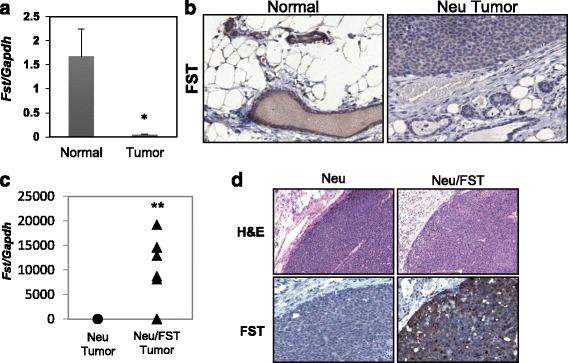
Examination of multiple breast cancer datasets revealed that FST expression is reduced in breast cancers compared with normal tissue and that low FST expression predicts increased metastasis and reduced overall survival. FST expression was also reduced in a mouse model of HER2/Neu-induced metastatic breast cancer. We found that FST blocks activin-induced breast epithelial cell migration in vitro, suggesting that its loss may promote breast cancer aggressiveness. To directly determine if FST restoration could inhibit metastatic progression, we transgenically expressed FST in the HER2/Neu model. Although FST had no impact on tumor initiation or growth, it completely blocked the formation of lung metastases.
These data indicate that FST is a bona fide metastasis suppressor in this mouse model and support future efforts to develop an FST mimetic to suppress metastatic progression.
卵泡抑素(FST)是激活素的一种内源性抑制剂,激活素是转化生长因子-β超家族配体的成员之一。FST及其家族成员,即类卵泡抑素(FSTL)蛋白的预后价值已在多种癌症中进行了研究。然而,这些研究以及对FSTL蛋白的有限功能分析,在这些蛋白在疾病进展中的作用方面产生了相互矛盾的结果。此外,很少有研究聚焦于FST本身。我们评估了FST是否可能是乳腺癌肿瘤发生和/或转移进展的抑制因子。
利用公开可用的基因表达数据,我们检测了FST和激活素的一个亚基抑制素βA(INHBA)在正常和癌性乳腺组织中的表达模式,以及FST在乳腺癌转移、无复发生存期和总生存期方面的预后价值。还检测了激活素和FST对乳腺癌细胞体外增殖、迁移和侵袭的功能影响。然后在乳腺癌的原位小鼠模型中过表达FST,以评估FST对转移进展的体内影响。
对多个乳腺癌数据集的检测显示,与正常组织相比,乳腺癌中FST表达降低,且FST低表达预示着转移增加和总生存期缩短。在HER2/Neu诱导的转移性乳腺癌小鼠模型中,FST表达也降低。我们发现FST在体外可阻断激活素诱导的乳腺上皮细胞迁移,这表明其缺失可能促进乳腺癌的侵袭性。为了直接确定FST的恢复是否能抑制转移进展,我们在HER2/Neu模型中通过转基因表达FST。尽管FST对肿瘤起始或生长没有影响,但它完全阻断了肺转移的形成。
这些数据表明,在该小鼠模型中FST是一种真正的转移抑制因子,并支持未来开发FST模拟物以抑制转移进展的努力。