Makarawate Pattarapong, Chaosuwannakit Narumol, Vannaprasaht Suda, Sahasthas Dujdao, Koo Seok Hwee, Lee Edmund Jon Deoon, Tassaneeyakul Wichittra, Barajas-Martinez Hector, Hu Dan, Sawanyawisuth Kittisak
Department of Medicine, Faculty of Medicine, Khon Kaen University, Khon Kaen, Thailand.
Department of Radiology, Faculty of Medicine, Khon Kaen University, Khon Kaen, Thailand.
J Am Heart Assoc. 2017 Jun 5;6(6):e005009. doi: 10.1161/JAHA.116.005009.
Brugada syndrome (BrS) is an inherited primary arrhythmia disorder leading to sudden cardiac arrest. , encoding the α-subunit of the cardiac sodium channel (Nav1.5), is the most common pathogenic gene of BrS. An implantable cardioverter defibrillator (ICD) is the standard treatment for secondary prevention. This study aimed to evaluate association of the variant with this cardiac conduction disturbance and appropriate ICD shock therapy in Thai symptomatic BrS patients with ICD implants.
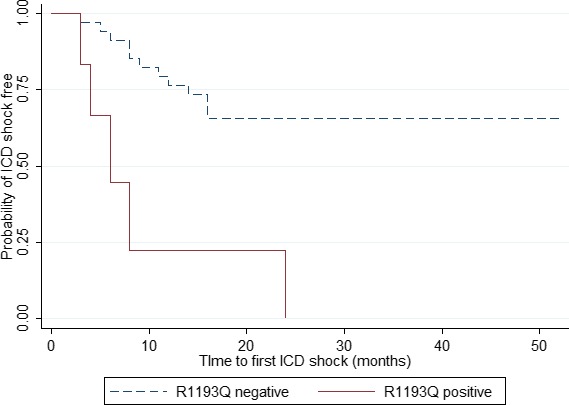
Symptomatic BrS patients diagnosed at university hospital were enrolled from 2008 to 2011. The primary outcome of the study was an appropriate ICD shock defined as having non-pacing-associated ICD shock after the occurrence of ventricular tachycardia or ventricular fibrillation. Associations between polymorphisms, cardiac conduction disturbance, and potential confounding factors associated with appropriate ICD shock therapy were analyzed. All 40 symptomatic BrS patients (median age, 43 years) with ICD implantations were followed for 24 months. There were 16 patients (40%) who had the appropriate ICD shock therapy after ICD treatment. An independent factor associated with appropriate ICD shock therapy was R1193Q with an adjusted hazard ratio of 10.550 (95% CI, 1.631-68.232).
R1193Q is associated with cardiac conduction disturbances. It may be a genetic marker associated with ventricular arrhythmia leading to appropriate ICD shock therapy in symptomatic BrS patients with ICD treatment. Because of the small sample size of study population and the appropriate ICD shock outcome, further large studies are needed to confirm the results of this study.
Brugada综合征(BrS)是一种遗传性原发性心律失常疾病,可导致心脏骤停。编码心脏钠通道(Nav1.5)α亚基的 是BrS最常见的致病基因。植入式心律转复除颤器(ICD)是二级预防的标准治疗方法。本研究旨在评估泰国有症状且植入ICD的BrS患者中 变异与这种心脏传导障碍及适当的ICD电击治疗之间的关联。
2008年至2011年纳入了在大学医院诊断出的有症状BrS患者。该研究的主要结局是适当的ICD电击,定义为在室性心动过速或心室颤动发生后出现非起搏相关的ICD电击。分析了 多态性、心脏传导障碍以及与适当的ICD电击治疗相关的潜在混杂因素之间的关联。对所有40例植入ICD的有症状BrS患者(中位年龄43岁)进行了24个月的随访。有16例患者(40%)在ICD治疗后接受了适当的ICD电击治疗。与适当的ICD电击治疗相关的独立因素是R1193Q,调整后的风险比为10.550(95%CI,1.631 - 68.232)。
R1193Q与心脏传导障碍相关。它可能是一个与室性心律失常相关的遗传标志物,导致有症状且接受ICD治疗的BrS患者接受适当的ICD电击治疗。由于研究人群样本量小以及适当的ICD电击结局,需要进一步的大型研究来证实本研究结果。