Wang Qian, Bao Wei-Fang, Yang Fan, Xu Bin, Yang Yi-Zhong
College of Horticulture and Plant Protection, Yangzhou University, Yangzhou, China.
State Key Laboratory for Biology of Plant Diseases and Insect Pests, Institute of Plant Protection, Chinese Academy of Agricultural Sciences, Beijing, China.
PLoS One. 2017 Jun 6;12(6):e0177789. doi: 10.1371/journal.pone.0177789. eCollection 2017.
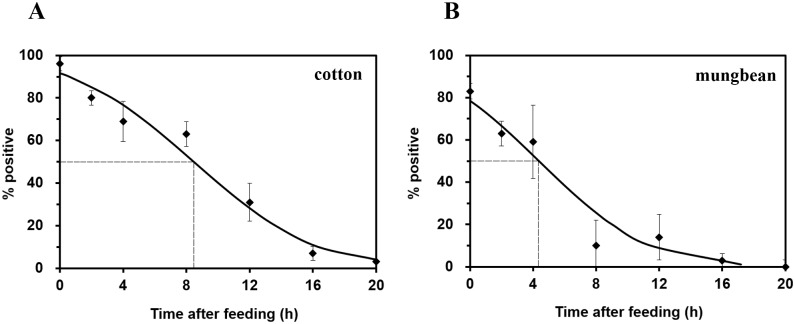
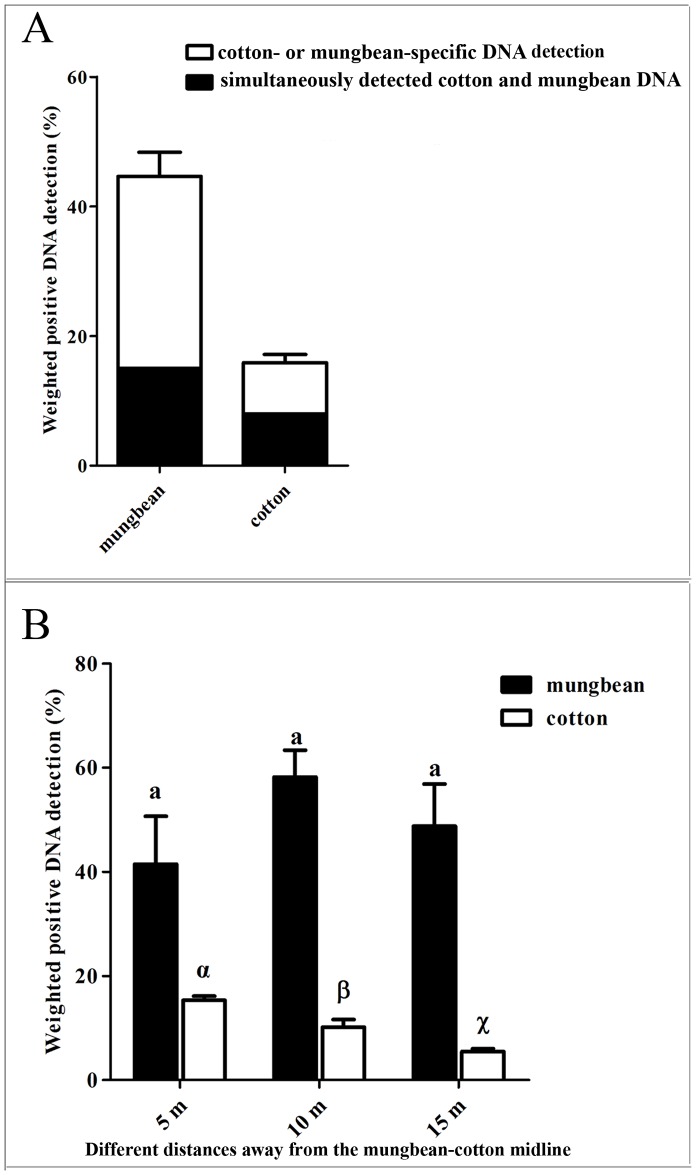
The polyphagous mirid bug Apolygus lucorum (Heteroptera: Miridae) has more than 200 species of host plants and is an insect pest of important agricultural crops, including cotton (Gossypium hirsutum) and mungbean (Vigna radiata). Previous field trials have shown that A. lucorum adults prefer mungbean to cotton plants, indicating the considerable potential of mungbean as a trap crop in cotton fields. However, direct evidence supporting the migration of A. lucorum adults from cotton to mungbean is lacking. We developed a DNA-based polymerase chain reaction (PCR) approach to reveal the movement of A. lucorum between neighboring mungbean and cotton fields. Two pairs of PCR primers specific to cotton or mungbean were designed to target the trnL-trnF region of chloroplast DNA. Significant differences in the detectability half-life (DS50) were observed between these two host plants, and the mean for cotton (8.26 h) was approximately two times longer than that of mungbean (4.38 h), requiring weighted mean calculations to compare the detectability of plant DNA in the guts of field-collected bugs. In field trials, cotton DNA was detected in the guts of the adult A. lucorum individuals collected in mungbean plots, and the cotton DNA detection rate decreased successively from 5 to 15 m away from the mungbean-cotton midline. In addition to the specific detection of cotton- and mungbean-fed bugs, both cotton and mungbean DNA were simultaneously detected within the guts of single individuals caught from mungbean fields. This study successfully established a tool for molecular gut-content analyses and clearly demonstrated the movement of A. lucorum adults from cotton to neighboring mungbean fields, providing new insights into understanding the feeding characteristics and landscape-level ecology of A. lucorum under natural conditions.
多食性盲蝽绿盲蝽(半翅目:盲蝽科)有200多种寄主植物,是包括棉花(陆地棉)和绿豆(绿豆)在内的重要农作物的害虫。先前的田间试验表明,绿盲蝽成虫更喜欢绿豆而不是棉花植株,这表明绿豆作为棉田诱集作物具有很大潜力。然而,缺乏支持绿盲蝽成虫从棉花迁移到绿豆的直接证据。我们开发了一种基于DNA的聚合酶链反应(PCR)方法来揭示绿盲蝽在相邻绿豆田和棉花田之间的移动情况。设计了两对分别针对棉花或绿豆的PCR引物,以靶向叶绿体DNA的trnL-trnF区域。在这两种寄主植物之间观察到可检测性半衰期(DS50)存在显著差异,棉花的平均值(8.26小时)大约是绿豆(4.38小时)的两倍,需要进行加权平均计算来比较田间采集的虫子肠道中植物DNA的可检测性。在田间试验中,在绿豆地块采集的绿盲蝽成虫个体的肠道中检测到了棉花DNA,并且从绿豆 - 棉花中线向外5至15米处,棉花DNA检测率依次下降。除了对取食棉花和绿豆的虫子进行特异性检测外,在从绿豆田捕获的单个个体的肠道中同时检测到了棉花和绿豆DNA。本研究成功建立了一种用于分子肠道内容物分析的工具,并清楚地证明了绿盲蝽成虫从棉花迁移到相邻绿豆田,为理解自然条件下绿盲蝽的取食特性和景观水平生态学提供了新的见解。