Bradshaw Ralph A, Mobley William, Rush Robert A
Department of Physiology and Biophysics, University of California, Irvine, CA 92697, USA.
Department of Pharmacology, University of California, San Diego, La Jolla, CA 92093, USA.
Int J Mol Sci. 2017 May 26;18(6):1143. doi: 10.3390/ijms18061143.
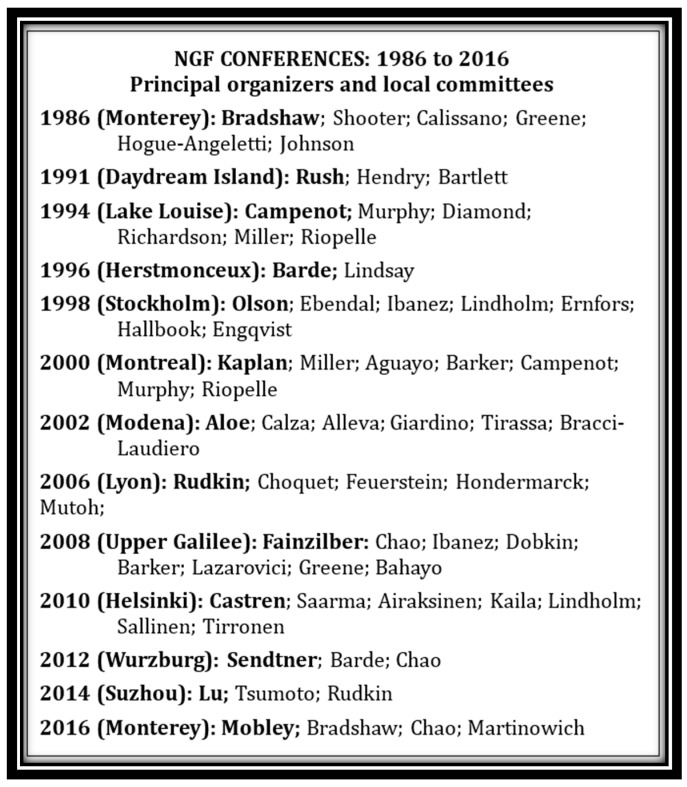
Nerve growth factor (NGF) is a protein whose importance to research and its elucidation of fundamental mechanisms in cell and neurobiology far outstrips its basic physiological roles. It was the first of a broad class of cell regulators, largely acting through autocrine and paracrine interactions which will be described herein. It was of similar significance in establishing the identity and unique roles of neurotrophic factors in the development and maintenance of the peripheral and central nervous systems. Finally, it contributed to many advances in the elaboration of cell surface receptor mechanisms and intracellular cell signaling. As such, it can be considered to be a "molecular Rosetta Stone". In this brief review, the highlights of these various studies are summarized, particularly as illustrated by their coverage in the 13 NGF international meetings that have been held since 1986.
神经生长因子(NGF)是一种蛋白质,其对研究的重要性以及在细胞生物学和神经生物学中对基本机制的阐释,远远超过了其基本生理作用。它是一大类细胞调节因子中的首个成员,主要通过自分泌和旁分泌相互作用发挥作用,本文将对此进行描述。在确立神经营养因子在周围神经系统和中枢神经系统发育及维持中的特性和独特作用方面,它具有同样重要的意义。最后,它推动了细胞表面受体机制和细胞内信号传导阐述方面的诸多进展。因此,它可被视为一块“分子罗塞塔石碑”。在这篇简短的综述中,总结了这些不同研究的要点,特别是自1986年以来召开的13次NGF国际会议所涵盖的内容对这些要点的阐释。