Hao Jiejing, Ren Jiaojiao, Wu Qunhong, Hao Yanhua, Sun Hong, Ning Ning, Ding Ding
Department of Social Medicine, School of Public Health, Harbin Medical University, Harbin 150000, China.
The Innovation Center for Social Risk Governance in Health, Shanghai 200032, China.
Int J Environ Res Public Health. 2017 Jun 4;14(6):597. doi: 10.3390/ijerph14060597.
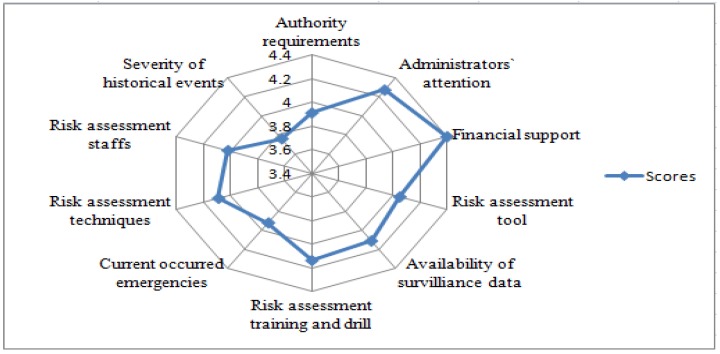
This study aimed to better understand the current situation of risk assessment and identify the factors associated with competence of emergency responders in public health risk assessment. The participants were selected by a multi-stage, stratified cluster sampling method in Heilongjiang Centers for Disease Control and Prevention (CDC). The questionnaires that measured their perceptions on risk assessment competences were administered through the face-to-face survey. A final sample of 1889 staff was obtained. Of this sample, 78.6% of respondents rated their own risk assessment competences as "relatively low", contrasting with 21.4% rated as "relatively high". Most of the respondents (62.7%) did not participate in any risk assessment work. Only 13.7% and 42.7% of respondents reported participating in risk assessment training and were familiar with risk assessment tools. There existed statistical significance between risk assessment-related characteristics of respondents and their self-rated competences scores. Financial support from the government and administrative attention were regarded as the important factors contributing to risk assessment competences of CDC responders. Higher attention should be given to risk assessment training and enhancing the availability of surveillance data. Continuous efforts should be made to remove the financial and technical obstacles to improve the competences of risk assessment for public health emergency responders.
本研究旨在更好地了解风险评估的现状,并确定与公共卫生风险评估中应急响应人员能力相关的因素。参与者通过多阶段分层整群抽样方法在黑龙江省疾病预防控制中心(CDC)选取。通过面对面调查发放测量他们对风险评估能力认知的问卷。最终获得了1889名工作人员的样本。在这个样本中,78.6%的受访者将自己的风险评估能力评为“相对较低”,相比之下,21.4%的受访者评为“相对较高”。大多数受访者(62.7%)没有参与任何风险评估工作。只有13.7%和42.7%的受访者报告参加过风险评估培训并熟悉风险评估工具。受访者的风险评估相关特征与其自评能力得分之间存在统计学意义。政府的财政支持和行政关注被视为有助于疾控中心应急响应人员风险评估能力的重要因素。应更加重视风险评估培训并提高监测数据的可获得性。应持续努力消除财政和技术障碍,以提高公共卫生应急响应人员的风险评估能力。