La Duong Duc, Nguyen Tuan Anh, Jones Lathe A, Bhosale Sheshanath V
School of Science, RMIT University, GPO Box 2476, Melbourne, VIC 3001, Australia.
Applied Nanomaterial Laboratory, ANTECH, Hanoi 100000, Vietnam.
Sensors (Basel). 2017 Jun 5;17(6):1292. doi: 10.3390/s17061292.
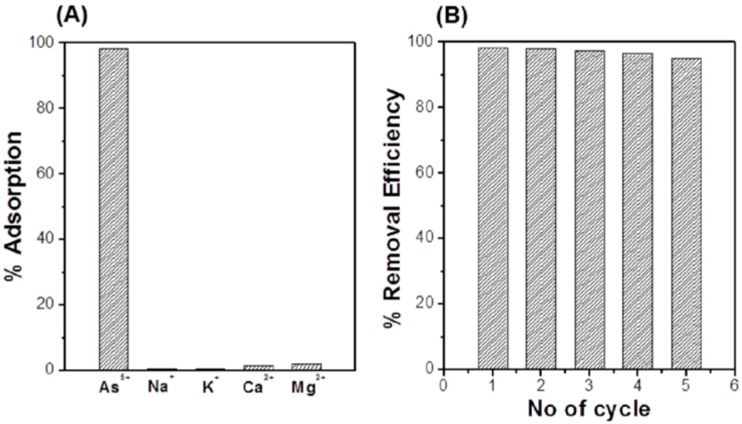
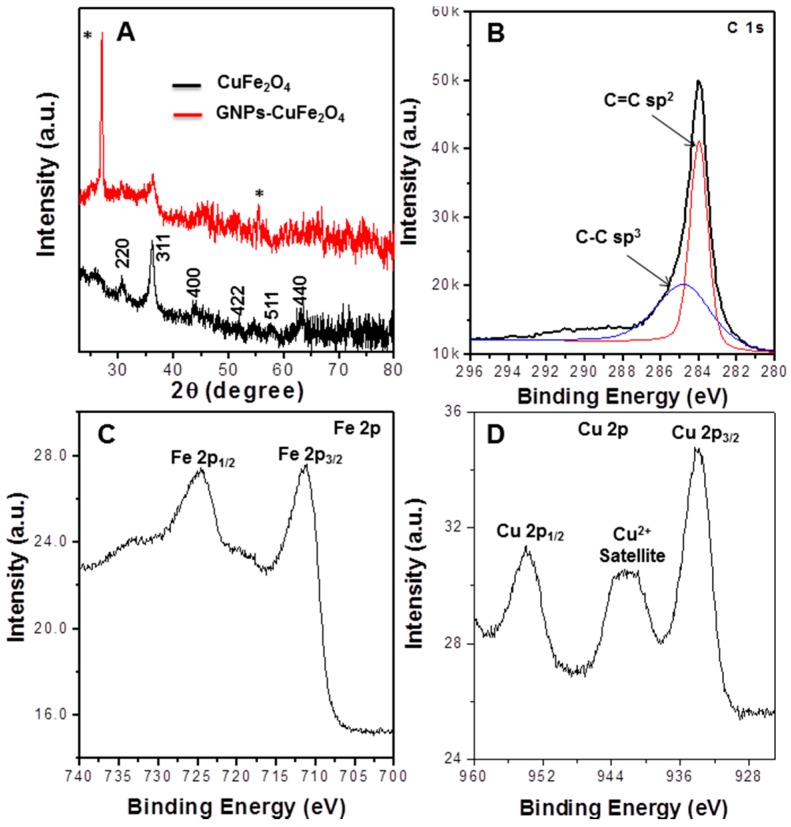
A graphene nanoplate-supported spinel CuFe₂O₄ composite (GNPs/CuFe₂O₄) was successfully synthesized by using a facile thermal decomposition route. Scanning electron microscopy (SEM), high resolution transmission electron microscopy (HRTEM), Electron Dispersive Spectroscopy (EDS), X-ray diffraction (XRD) and X-ray Photoelectron Spectroscopy (XPS) were employed to characterize the prepared composite. The arsenic adsorption behavior of the GNPs/CuFe₂O₄ composite was investigated by carrying out batch experiments. Both the Langmuir and Freundlich models were employed to describe the adsorption isotherm, where the sorption kinetics of arsenic adsorption by the composite were found to be pseudo-second order. The selectivity of the adsorbent toward arsenic over common metal ions in water was also demonstrated. Furthermore, the reusability and regeneration of the adsorbent were investigated by an assembled column filter test. The GNPs/CuFe₂O₄ composite exhibited significant, fast adsorption of arsenic over a wide range of solution pHs with exceptional durability, selectivity, and recyclability, which could make this composite a very promising candidate for effective removal of arsenic from aqueous solution. The highly sensitive adsorption of the material toward arsenic could be potentially employed for arsenic sensing.
通过简便的热分解路线成功合成了一种石墨烯纳米片负载的尖晶石型CuFe₂O₄复合材料(GNPs/CuFe₂O₄)。采用扫描电子显微镜(SEM)、高分辨率透射电子显微镜(HRTEM)、电子能谱(EDS)、X射线衍射(XRD)和X射线光电子能谱(XPS)对制备的复合材料进行表征。通过批量实验研究了GNPs/CuFe₂O₄复合材料对砷的吸附行为。采用朗缪尔模型和弗伦德里希模型描述吸附等温线,发现复合材料对砷的吸附动力学符合准二级动力学。还证明了吸附剂对水中砷相对于常见金属离子的选择性。此外,通过组装柱式过滤器试验研究了吸附剂的可重复使用性和再生性。GNPs/CuFe₂O₄复合材料在很宽的溶液pH范围内对砷表现出显著、快速的吸附,具有出色的耐久性、选择性和可回收性,这使得该复合材料成为从水溶液中有效去除砷的非常有前景的候选材料。该材料对砷的高灵敏度吸附可潜在地用于砷传感。