Ng Wy Ching, Soto-Acosta Ruben, Bradrick Shelton S, Garcia-Blanco Mariano A, Ooi Eng Eong
Programme in Emerging Infectious Diseases, Duke-National University of Singapore Medical School, Singapore 169857, Singapore.
Department of Biochemistry, University of Texas Medical Branch, Galveston, TX 77555, USA.
Viruses. 2017 Jun 6;9(6):137. doi: 10.3390/v9060137.
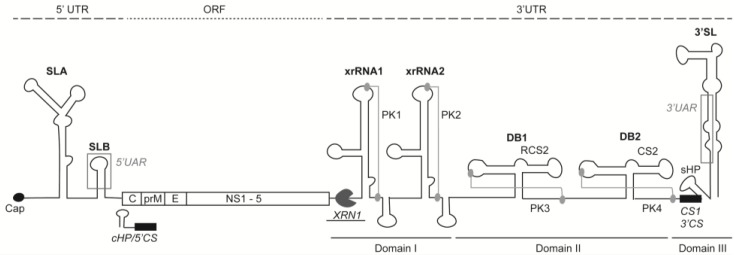
Flaviviruses are enveloped arthropod-borne viruses with a single-stranded, positive-sense RNA genome that can cause serious illness in humans and animals. The 11 kb 5' capped RNA genome consists of a single open reading frame (ORF), and is flanked by 5' and 3' untranslated regions (UTR). The ORF is a polyprotein that is processed into three structural and seven non-structural proteins. The UTRs have been shown to be important for viral replication and immune modulation. Both of these regions consist of elements that are essential for genome cyclization, resulting in initiation of RNA synthesis. Genome mutation studies have been employed to investigate each component of the essential elements to show the necessity of each component and its role in viral RNA replication and growth. Furthermore, the highly structured 3'UTR is responsible for the generation of subgenomic flavivirus RNA (sfRNA) that helps the virus evade host immune response, thereby affecting viral pathogenesis. In addition, changes within the 3'UTR have been shown to affect transmissibility between vector and host, which can influence the development of vaccines.
黄病毒是有包膜的节肢动物传播病毒,其基因组为单链正义RNA,可导致人类和动物患上严重疾病。11 kb的5'端加帽RNA基因组由一个单一的开放阅读框(ORF)组成,两侧是5'和3'非翻译区(UTR)。该ORF是一个多聚蛋白,可被加工成三种结构蛋白和七种非结构蛋白。UTR已被证明对病毒复制和免疫调节很重要。这两个区域都由基因组环化所必需的元件组成,从而启动RNA合成。基因组突变研究已被用于研究必需元件的每个组成部分,以显示每个组成部分的必要性及其在病毒RNA复制和生长中的作用。此外,高度结构化的3'UTR负责产生亚基因组黄病毒RNA(sfRNA),它有助于病毒逃避宿主免疫反应,从而影响病毒发病机制。此外,3'UTR内的变化已被证明会影响载体与宿主之间的传播能力,这可能会影响疫苗的开发。