Lee Michelle Felicia, Long Chiau Ming, Poh Chit Laa
Department of Biological Sciences, School of Medical and Life Sciences, Sunway University, Selangor 47500, Malaysia.
Department of Medical Sciences, School of Medical and Life Sciences, Sunway University, Selangor 47500, Malaysia.
Vaccine X. 2024 Dec 17;22:100604. doi: 10.1016/j.jvacx.2024.100604. eCollection 2025 Jan.
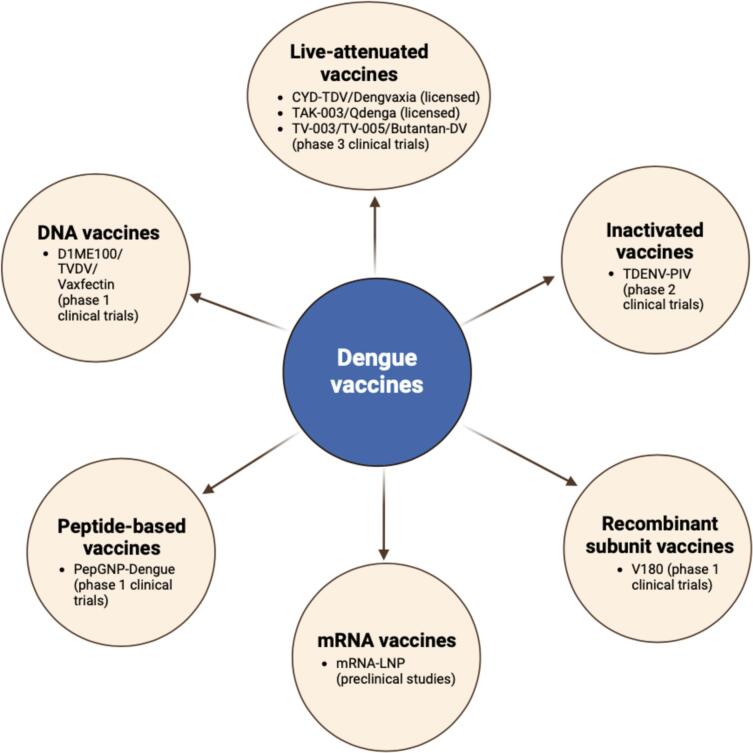
Dengue fever is caused by the mosquito-borne dengue virus (DENV), which is endemic in more than 100 countries. Annually, there are approximately 390 million dengue cases, with a small subset manifesting into severe illnesses, such as dengue haemorrhagic fever or dengue shock syndrome. Current treatment options for dengue infections remain supportive management due to the lack of an effective vaccine and clinically approved antiviral. Although the CYD-TDV (Dengvaxia®) vaccine with an overall vaccine efficacy of 60 % has been licensed for clinical use since 2015, it poses an elevated risk of severe dengue infections especially in dengue-naïve children below 9 years of age. The newly approved Qdenga vaccine was able to achieve an overall vaccine efficacy of 80 % after 12 months, but it was not able to provide a protective effect against DENV-3 in dengue naïve individuals. The Butantan-DV vaccine candidate is still undergoing phase 3 clinical trials for safety and efficacy evaluations in humans. Apart from live-attenuated vaccines, various other vaccine types are also currently being studied in preclinical and clinical studies. This review discusses the current status of dengue vaccine development.
登革热由蚊媒传播的登革病毒(DENV)引起,该病毒在100多个国家呈地方性流行。每年约有3.9亿例登革热病例,其中一小部分会发展为严重疾病,如登革出血热或登革休克综合征。由于缺乏有效的疫苗和临床批准的抗病毒药物,目前登革热感染的治疗选择仍然是支持性治疗。尽管自2015年以来,总体疫苗效力为60%的CYD-TDV(登革热疫苗)已获临床使用许可,但它会增加严重登革热感染的风险,尤其是在9岁以下初次感染登革热的儿童中。新批准的Qdenga疫苗在12个月后总体疫苗效力能够达到80%,但它无法为初次感染登革热的个体提供针对DENV-3的保护作用。Butantan-DV候选疫苗仍在进行3期临床试验,以评估其在人体中的安全性和有效性。除了减毒活疫苗外,目前在临床前和临床研究中还在研究各种其他类型的疫苗。本综述讨论了登革热疫苗研发的现状。