Vergeer Ineke, Bennie Jason A, Charity Melanie J, Harvey Jack T, van Uffelen Jannique G Z, Biddle Stuart J H, Eime Rochelle M
Institute for Resilient Regions, University of Southern Queensland, Springfield Campus, PO Box 4393, Raceview, QLD, 4305, Australia.
Institute of Sport, Exercise and Active Living (ISEAL), Active Living & Public Health Program, Victoria University, Melbourne, VIC, Australia.
BMC Complement Altern Med. 2017 Jun 6;17(1):296. doi: 10.1186/s12906-017-1800-6.
In recent decades, the evidence supporting the physical and mental health benefits of holistic movement practices such as yoga and t'ai chi have become increasingly established. Consequently, investigating the participation prevalence and patterns of these practices is a relevant pursuit in the public health field. Few studies have provided population-level assessment of participation rates, however, and even fewer have focused on patterns over time. The purpose of this study was to examine participation prevalence and trends in yoga/Pilates and t'ai chi/qigong over a ten-year period in a nationally representative sample of Australians aged 15 years and over, with particular attention to sex and age. A secondary purpose was to juxtapose these findings with participation trends in traditional fitness activities over the same period.
Data comprised modes and types of physical activity, age, and sex variables collected through the Exercise, Recreation and Sport Survey (ERASS), a series of independent cross-sectional Australia-wide surveys conducted yearly between 2001 and 2010. For each year, weighted population estimates were calculated for those participating in yoga/Pilates, t'ai chi/qigong, and fitness activities (e.g. aerobics, calisthenics). Linear regression and multiple logistic regression analyses were used to examine trends in prevalence rates over time and differences among sex and age (15-34; 35-54; 55+ years) groups, respectively.
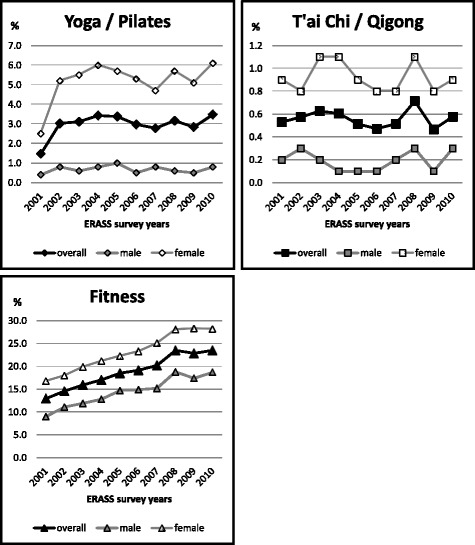
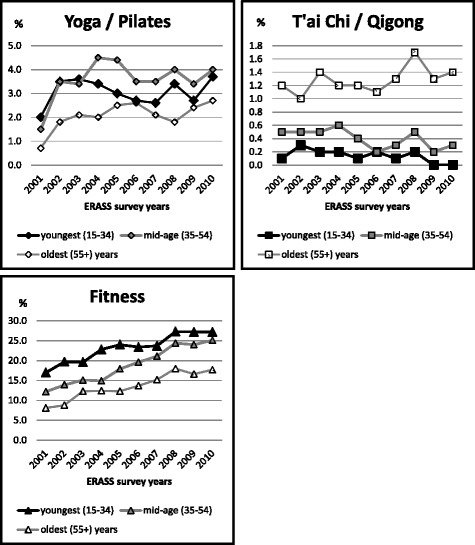
Average prevalence rates between 2001 and 2010 were 3.0% (95% CI 2.9-3.1) for yoga/Pilates, 0.6% (95% CI 0.5-0.6) for t'ai chi/qigong, and 19.2% (95% CI 18.9-19.4) for fitness activities. Across the decade, overall participation rates remained relatively stable for yoga/Pilates and t'ai chi/qigong, while increasing linearly for fitness activities. For both genders and in all three age groups, participation in fitness activities increased, whereas only in the 55+ age group was there a significant increase in yoga/Pilates participation; participation in t'ai chi/qigong declined significantly in the two younger age groups.
Participation rates in yoga/Pilates and t'ai chi/qigong in Australia were low and relatively stable. As fitness activities increased in popularity across the decade, holistic movement practices did not. These findings point to the need to investigate activity-specific barriers and facilitators to participation, including intrapersonal, interpersonal, organisational, and environmental factors.
近几十年来,支持瑜伽和太极等整体运动练习对身心健康有益的证据越来越多。因此,调查这些练习的参与率和模式是公共卫生领域的一项相关研究。然而,很少有研究提供人群层面的参与率评估,关注随时间变化模式的研究更少。本研究的目的是在一个具有全国代表性的15岁及以上澳大利亚样本中,考察瑜伽/普拉提和太极/气功在十年间的参与率和趋势,特别关注性别和年龄。第二个目的是将这些结果与同期传统健身活动的参与趋势进行对比。
数据包括通过运动、娱乐和体育调查(ERASS)收集的身体活动的方式和类型、年龄和性别变量,ERASS是2001年至2010年期间每年在澳大利亚全国范围内进行的一系列独立横断面调查。每年计算参与瑜伽/普拉提、太极/气功和健身活动(如有氧运动、健身操)的加权人口估计数。分别使用线性回归和多元逻辑回归分析来考察患病率随时间的趋势以及性别和年龄组(15 - 34岁;35 - 54岁;55岁及以上)之间的差异。
2001年至2010年期间,瑜伽/普拉提的平均患病率为3.0%(95%置信区间2.9 - 3.1),太极/气功为0.6%(95%置信区间0.5 - 0.6),健身活动为19.2%(95%置信区间18.9 - 19.4)。在这十年间,瑜伽/普拉提和太极/气功的总体参与率相对稳定,而健身活动的参与率呈线性上升。对于男性和女性以及所有三个年龄组,健身活动的参与率都有所增加,而只有55岁及以上年龄组的瑜伽/普拉提参与率有显著增加;在两个较年轻的年龄组中,太极/气功的参与率显著下降。
澳大利亚瑜伽/普拉提和太极/气功的参与率较低且相对稳定。在这十年间,随着健身活动越来越受欢迎,整体运动练习却并非如此。这些发现表明需要调查参与特定活动的障碍和促进因素,包括个人、人际、组织和环境因素。