Qiao Yuan, Gao Ke, Wang Yangwei, Wang Xueliang, Cui Bo
Department of Endocrinology, Shaanxi Provincial Hospital, Xi'an, Shaanxi 710068, P.R. China.
Department of Neurosurgery, The First Affiliated Hospital of Xi'an Jiaotong University School of Medicine, Xi'an, Shaanxi 710061, P.R. China.
Exp Ther Med. 2017 Jun;13(6):3223-3230. doi: 10.3892/etm.2017.4420. Epub 2017 May 4.
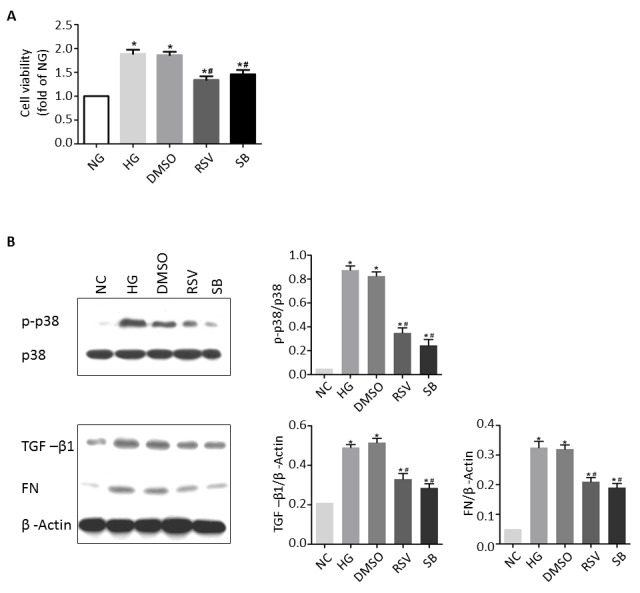
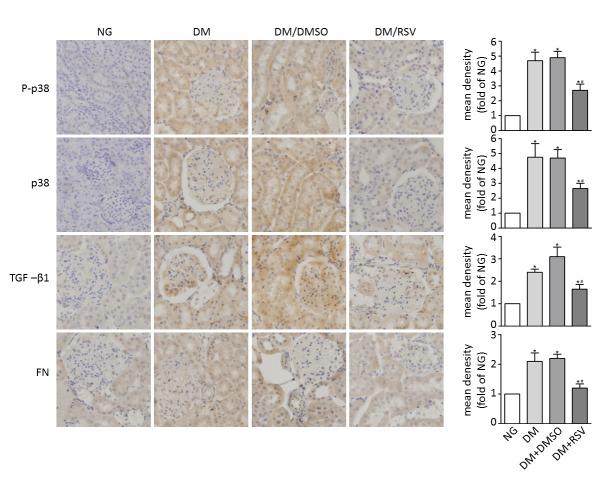
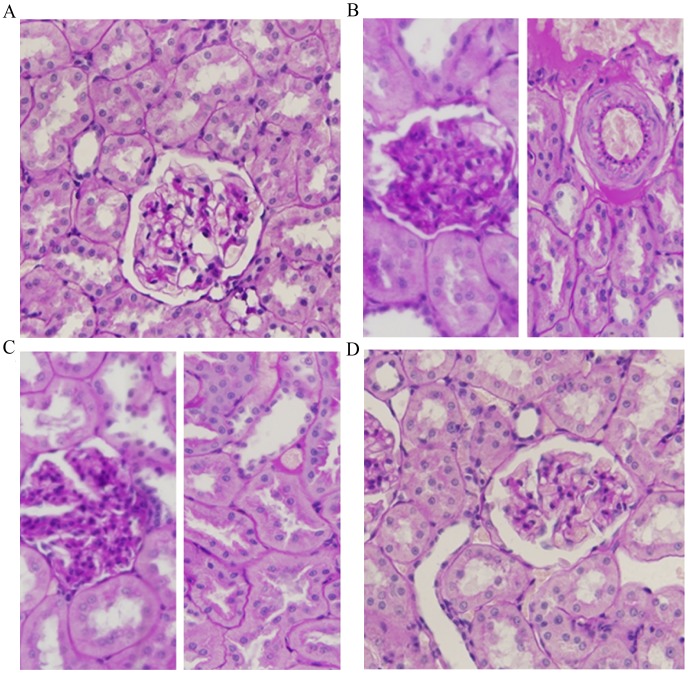
Resveratrol (RSV) has been shown to have a renoprotective effect against diabetic nephropathy, but the underlying mechanisms of this have not been fully elucidated. The aim of the current study was to explore the mechanisms responsible for the therapeutic effects of RSV in rat mesangial cells and in a rat model of diabetic nephropathy. The viability of CRL-2573 rat mesangial cells and their expression levels of p38, phosphorylated (p)-p38, transforming growth factor beta 1 (TGF-β1) and fibronectin were assessed in response to treatment with high glucose, with or without RSV. Diabetic nephropathy was also induced in Sprague-Dawley rats by streptozotocin treatment. At 8 weeks, basic biochemical parameters and histopathological abnormalities as well as the expression of p38, p-p38, TGF-β1 and fibronectin in rat kidneys were compared between control diabetic rats and those treated with 20 mg/kg RSV daily for 4 weeks. In the mesangial cell line, RSV inhibited high glucose-induced increases in cell viability and fibronectin expression by significantly reducing p38 mitogen-activated protein kinase (MAPK) activation and TGF-β1 expression (P<0.05). In diabetic rats, RSV significantly decreased blood glucose, serum creatinine and urinary albumin levels, as well as the kidney weight and ratio of kidney weight/body weight compared with the control group (P<0.05). Moreover, RSV ameliorated renal histological changes and downregulated the expression of p-p38, TGF-β1 and fibronectin in the kidneys of diabetic rats. These data suggested that RSV protected renal tissue from diabetes-induced injury and that this activity may be via inhibition of the p38 MAPK/TGF-β1 signaling pathway.
白藜芦醇(RSV)已被证明对糖尿病肾病具有肾脏保护作用,但其潜在机制尚未完全阐明。本研究的目的是探讨RSV在大鼠系膜细胞和糖尿病肾病大鼠模型中发挥治疗作用的机制。在用或不用RSV处理高糖环境下,评估CRL-2573大鼠系膜细胞的活力及其p38、磷酸化(p)-p38、转化生长因子β1(TGF-β1)和纤连蛋白的表达水平。通过链脲佐菌素处理在Sprague-Dawley大鼠中诱导糖尿病肾病。在第8周时,比较对照糖尿病大鼠与每日用20mg/kg RSV处理4周的大鼠的基本生化参数、组织病理学异常以及大鼠肾脏中p38、p-p38、TGF-β1和纤连蛋白的表达。在系膜细胞系中,RSV通过显著降低p38丝裂原活化蛋白激酶(MAPK)的激活和TGF-β1的表达,抑制高糖诱导的细胞活力增加和纤连蛋白表达(P<0.05)。在糖尿病大鼠中,与对照组相比,RSV显著降低血糖、血清肌酐和尿白蛋白水平,以及肾脏重量和肾脏重量/体重比(P<0.05)。此外,RSV改善了肾脏组织学变化,并下调了糖尿病大鼠肾脏中p-p38、TGF-β1和纤连蛋白的表达。这些数据表明,RSV保护肾脏组织免受糖尿病诱导的损伤,并且这种活性可能是通过抑制p38 MAPK/TGF-β1信号通路实现的。