Akullian Adam, Bershteyn Anna, Klein Daniel, Vandormael Alain, Bärnighausen Till, Tanser Frank
aInstitute for Disease Modeling, Global Good Fund, Bellevue, Washington, USA bAfrica Health Research Institute, University of KwaZulu-Natal, Mtubatuba, South Africa cInstitute for Public Health, Faculty of Medicine, University of Heidelberg, Heidelberg, Germany dDepartment of Infection and Population Health, Institute of Epidemiology and Health Care, University College London, London, UK.
AIDS. 2017 Jul 31;31(12):1755-1764. doi: 10.1097/QAD.0000000000001553.
To quantify the contribution of specific sexual partner age groups to the risk of HIV acquisition in men and women in a hyperendemic region of South Africa.
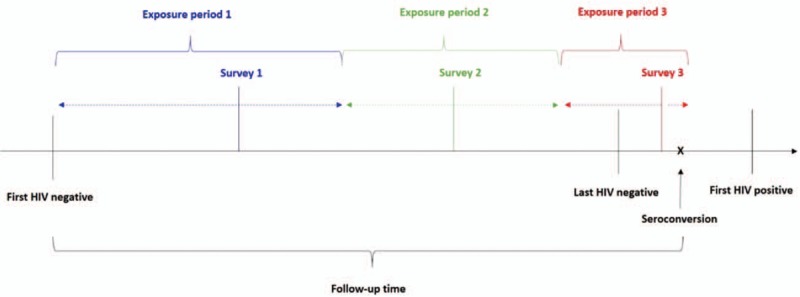
We conducted a population-based cohort study among women (15-49 years of age) and men (15-55 years of age) between 2004 and 2015 in KwaZulu-Natal, South Africa.
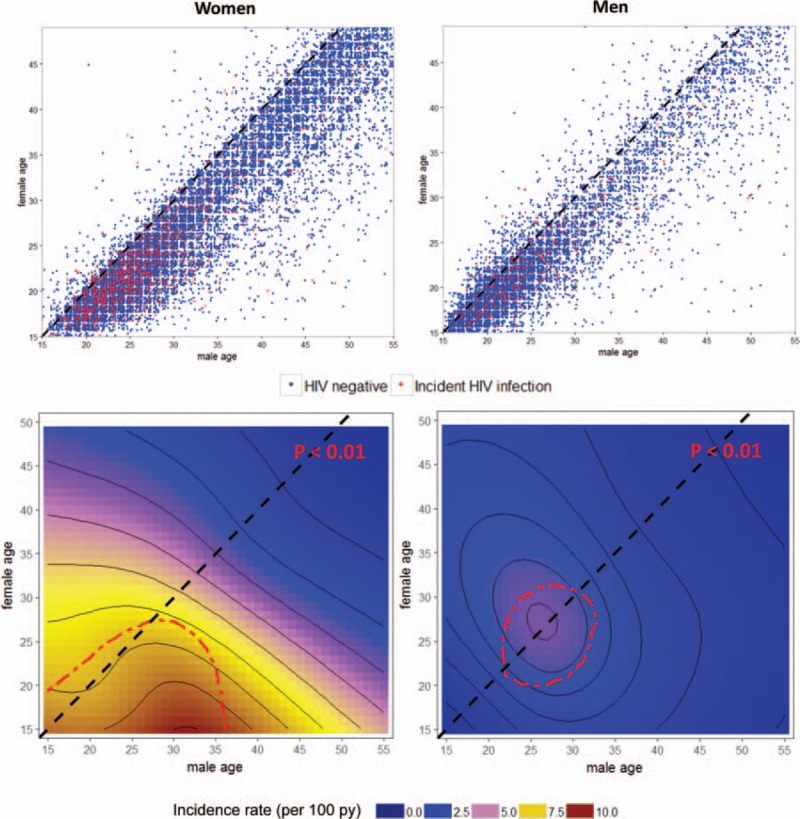
Generalized additive models were used to estimate smoothed HIV incidence rates across partnership age pairings in men and women. Cox proportional hazards regression was used to estimate the relative risk of HIV acquisition by partner age group.
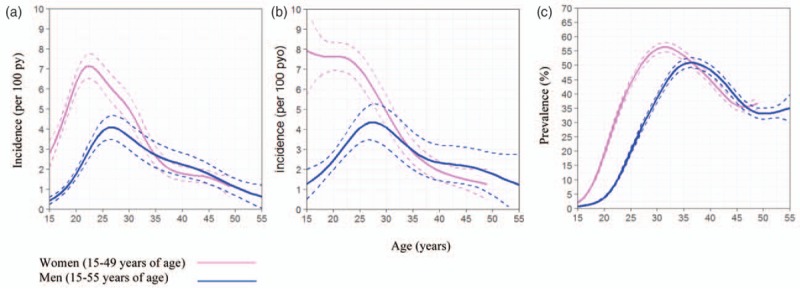
A total of 882 HIV seroconversions were observed in 15 935 person-years for women, incidence rate = 5.5 per 100 person-years [95% confidence interval (CI), 5.2-5.9] and 270 HIV seroconversions were observed in 9372 person-years for men, incidence rate = 2.9 per 100 person-years (95% CI, 2.6-3.2). HIV incidence was highest among 15-24-year-old women reporting partnerships with 30-34-year-old men, incidence rate = 9.7 per 100 person-years (95% CI, 7.2-13.1). Risk of HIV acquisition in women was associated with male partners aged 25-29 years (adjusted hazard ratio; aHR = 1.44, 95% CI, 1.02-2.04) and 30-34 years (aHR = 1.50, 95% CI, 1.08-2.09) relative to male partners aged 35 and above. Risk of HIV acquisition in men was associated with 25-29-year-old (aHR = 1.72, 95% CI, 1.02-2.90) and 30-34-year-old women (aHR = 2.12, 95% CI, 1.03-4.39) compared to partnerships with women aged 15-19 years.
Age of sexual partner is a major risk factor for HIV acquisition in both men and women, independent of one's own age. Partner age pairings play a critical role in driving the cycle of HIV transmission.
量化特定性伴侣年龄组对南非高流行地区男性和女性感染艾滋病毒风险的影响。
2004年至2015年期间,我们在南非夸祖鲁-纳塔尔省对15至49岁的女性和15至55岁的男性进行了一项基于人群的队列研究。
使用广义相加模型估计男性和女性在不同伴侣年龄配对中的平滑艾滋病毒发病率。采用Cox比例风险回归估计按伴侣年龄组划分的感染艾滋病毒的相对风险。
在15935人年的观察期内,女性共出现882例艾滋病毒血清阳转,发病率为每100人年5.5例[95%置信区间(CI),5.2 - 5.9];在9372人年的观察期内,男性共出现270例艾滋病毒血清阳转,发病率为每100人年2.9例(95%CI,2.6 - 3.2)。在报告与30至34岁男性有性伴侣关系的15至24岁女性中,艾滋病毒发病率最高,为每100人年9.7例(95%CI,7.2 - 13.1)。与35岁及以上男性为性伴侣的女性相比,与25至29岁男性(调整后风险比;aHR = 1.44,95%CI,1.02 - 2.04)和30至34岁男性(aHR = 1.50,95%CI,1.08 - 2.09)为性伴侣的女性感染艾滋病毒的风险更高。与年龄在15至19岁女性为性伴侣的男性相比,与25至29岁女性(aHR = 1.72,95%CI,1.02 - 2.90)和30至34岁女性(aHR = 2.12,95%CI,1.03 - 4.39)为性伴侣的男性感染艾滋病毒的风险更高。
性伴侣年龄是男性和女性感染艾滋病毒的主要危险因素,与自身年龄无关。伴侣年龄配对在推动艾滋病毒传播循环中起着关键作用。