Fu Yanrong, Ji Chenbo, Chen Xiaohui, Cui Xianwei, Wang Xing, Feng Jie, Li Yun, Qin Rui, Guo Xirong
Nanjing Maternal and Child Health Medical Institute, Nanjing Maternal and Child Health Hospital, Obstetrics and Gynecology Hospital Affiliated to Nanjing Medical University, 123 Tianfei Lane, Mochou Road, Nanjing, 210004, China.
Department of Child Health Care, Jiangsu Women and Children Health Hospital, Women and Child Branch Hospital of Jiangsu Province Hospital, The First Affiliated Hospital with Nanjing Medical University, Nanjing, 210036, China.
AMB Express. 2017 Dec;7(1):119. doi: 10.1186/s13568-017-0409-y. Epub 2017 Jun 6.
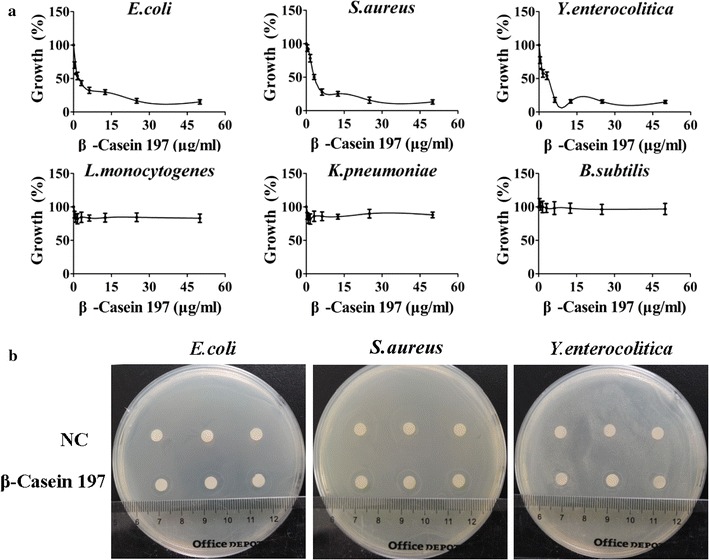
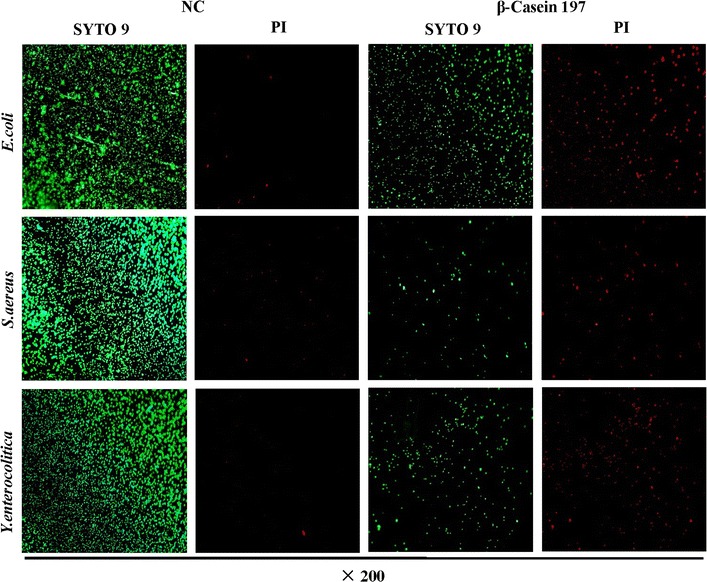
A novel endogenous peptide cleaved from 197-213 AA of β-casein, named β-casein 197, was identified by tandem mass spectrometry. β-casein 197 constituted a significant proportion of the peptide content in preterm milk. This study investigated the antibacterial effects and mechanisms against common pathogenic bacteria. Six bacterial strains were selected for this study: Escherichia coli, Staphylococcus aureus, Yersinia enterocolitica, Listeria monocytogenes, Klebsiella pneumonia and Bacillus subtilis. After synthesis, serial twofold dilutions of β-casein 197 were added to select for sensitive bacteria. The disk diffusion method and analysis of bacterial staining were used to identify antibacterial effect, while DNA-binding, scanning electron microscopy and transmission electron microscopy were used to explore antimicrobial mechanisms. Disk diffusion showed that E. coli, S. aureus and Y. enterocolitica were sensitive to the β-casein 197. In addition, live/dead fluorescent staining also confirmed antibacterial effects. Scanning electron and transmission electron microscopy revealed affected extracellular and intracellular structure for three species of bacteria, while a DNA-binding assay showed that the antimicrobial activity did not occur through DNA binding. This study suggests that β-casein 197 has antimicrobial activity against common pathogenic bacteria in newborns with infection. The peptide induced membrane permeabilization but did not bind to genomic DNA. Based on our findings, β-casein 197 has potential clinical value for preventing infections of premature infants.
通过串联质谱法鉴定出一种从β-酪蛋白197-213氨基酸处切割下来的新型内源性肽,命名为β-酪蛋白197。β-酪蛋白197在早产母乳的肽含量中占很大比例。本研究调查了其对常见病原菌的抗菌作用及机制。本研究选择了六种细菌菌株:大肠杆菌、金黄色葡萄球菌、小肠结肠炎耶尔森菌、单核细胞增生李斯特菌、肺炎克雷伯菌和枯草芽孢杆菌。合成后,将β-酪蛋白197进行系列两倍稀释,以筛选敏感细菌。采用纸片扩散法和细菌染色分析来鉴定抗菌效果,同时利用DNA结合、扫描电子显微镜和透射电子显微镜来探索抗菌机制。纸片扩散法显示大肠杆菌、金黄色葡萄球菌和小肠结肠炎耶尔森菌对β-酪蛋白197敏感。此外,活菌/死菌荧光染色也证实了抗菌效果。扫描电子显微镜和透射电子显微镜显示三种细菌的细胞外和细胞内结构均受到影响,而DNA结合试验表明抗菌活性并非通过DNA结合产生。本研究表明,β-酪蛋白197对感染新生儿的常见病原菌具有抗菌活性。该肽可诱导膜通透性增加,但不与基因组DNA结合。基于我们的研究结果,β-酪蛋白197在预防早产儿感染方面具有潜在的临床价值。