Malmberg Milijana, Lunner Thomas, Kähäri Kim, Andersson Gerhard
Hearing Organization, Habilitation and Health, Region Västra Götaland, Sweden.
Department of Health and Rehabilitation, Institute of Neuroscience and Physiology, Sahlgrenska Academy, University of Gothenburg, Göteborg, Sweden.
BMJ Open. 2017 Jun 6;7(5):e013047. doi: 10.1136/bmjopen-2016-013047.
Guided internet-based intervention beyond hearing aid (HA) fitting has been shown to be efficacious in randomised controlled trials (RCTs). However, internet interventions have rarely been applied clinically as a part of regular aural rehabilitation (AR). Our aim was to evaluate the effectiveness of internet-based AR for HA users from a clinical population.
The Hearing Handicap Inventory for the Elderly (HHIE) was used as the primary outcome measure, and the Communication Strategies Scale (CSS) and the Hospital Anxiety and Depression Scale were used as secondary outcome measures. All questionnaires were administered before and directly after the intervention and at 6 months postintervention.
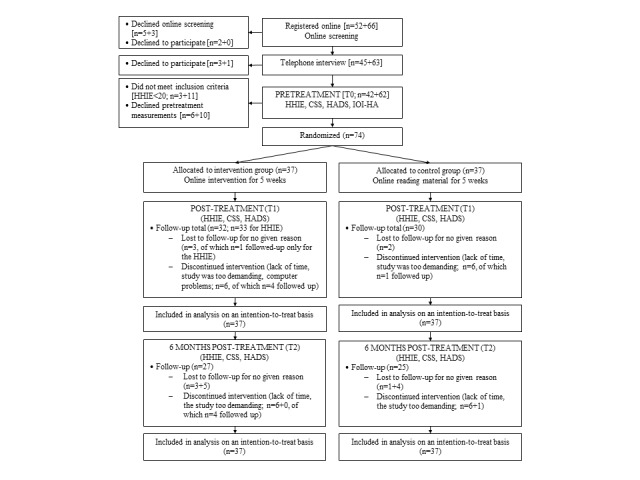
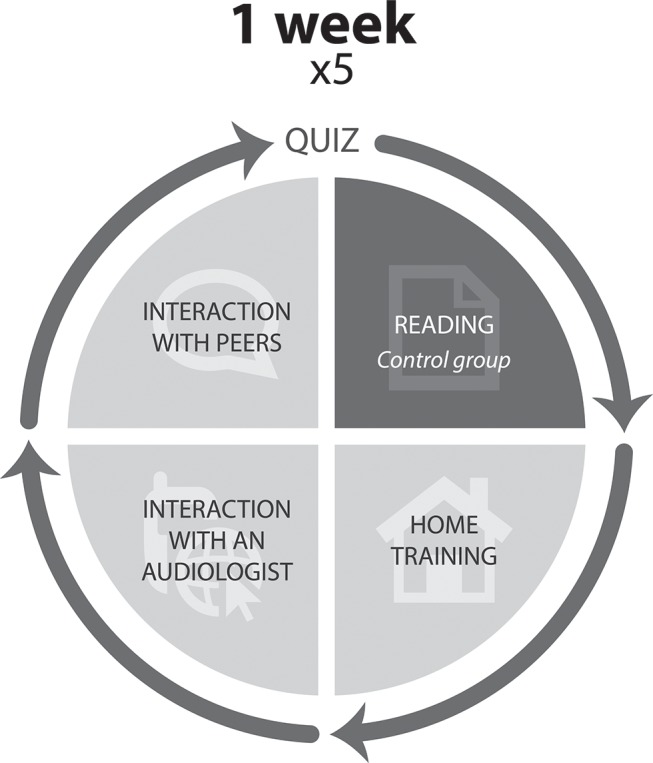
We used a parallel group design (RCT). The data were collected in 2013-2014 at three different clinics. Seventy-four HA users were randomly assigned to receive either full internet-based AR (intervention group, n=37) or one element of the internet-based AR (control group, n=37).
Data were analysed following the intention-to-treat principle. Each group showed improved HHIE scores over time and did not differ significantly from each other. The intervention group showed significantly greater improvement compared with the control group for the CSS total and the subscale scores. The intervention group and control group were also subdivided into two age groups: 20-59 years and 60-80 years. Significantly better improvement on the CSS total and subscale scores was found in the older group compared with the younger participants.
This study indicates that participants in an internet-based intervention applied in general clinical practice showed improved self-reported communication skills compared with a control group. Receiving a full intervention was not more effective in improving self-reported hearing problems than receiving just one element of the internet-based intervention.
This trial is registered at ClinicalTrals.gov, NCT01837550; results.
在随机对照试验(RCT)中,已证明助听器(HA)验配之外的基于互联网的指导性干预措施是有效的。然而,作为常规听觉康复(AR)的一部分,互联网干预措施在临床中很少应用。我们的目的是评估针对临床人群中使用HA的患者进行基于互联网的AR的有效性。
使用老年听力障碍量表(HHIE)作为主要结果测量指标,使用沟通策略量表(CSS)和医院焦虑抑郁量表作为次要结果测量指标。所有问卷在干预前、干预后即刻以及干预后6个月进行发放。
我们采用平行组设计(RCT)。数据于2013年至2014年在三个不同诊所收集。74名HA使用者被随机分配接受完全基于互联网的AR(干预组,n = 37)或基于互联网的AR的一个组成部分(对照组,n = 37)。
按照意向性分析原则对数据进行分析。随着时间推移,每组的HHIE评分均有所改善,且两组之间无显著差异。干预组在CSS总分及各子量表评分方面与对照组相比有显著更大的改善。干预组和对照组还被细分为两个年龄组:20 - 59岁和60 - 80岁。与年轻参与者相比,老年组在CSS总分及各子量表评分方面有显著更好的改善。
本研究表明,与对照组相比,在一般临床实践中应用基于互联网的干预措施的参与者自我报告的沟通技能有所改善。接受全面干预在改善自我报告的听力问题方面并不比仅接受基于互联网干预的一个组成部分更有效。
本试验在ClinicalTrals.gov注册,NCT01837550;结果。