
后极化Wnt5a受体-肌动蛋白-肌球蛋白极性(WRAMP)结构促进细胞定向迁移的速度和持续性。
Rear-polarized Wnt5a-receptor-actin-myosin-polarity (WRAMP) structures promote the speed and persistence of directional cell migration.
作者信息
Connacher Mary Katherine, Tay Jian Wei, Ahn Natalie G
机构信息
Department of Chemistry and Biochemistry, University of Colorado, Boulder, CO 80309.
BioFrontiers Institute Advanced Light Microscopy Core, University of Colorado, Boulder, CO 80309.
出版信息
Mol Biol Cell. 2017 Jul 7;28(14):1924-1936. doi: 10.1091/mbc.E16-12-0875. Epub 2017 Jun 7.
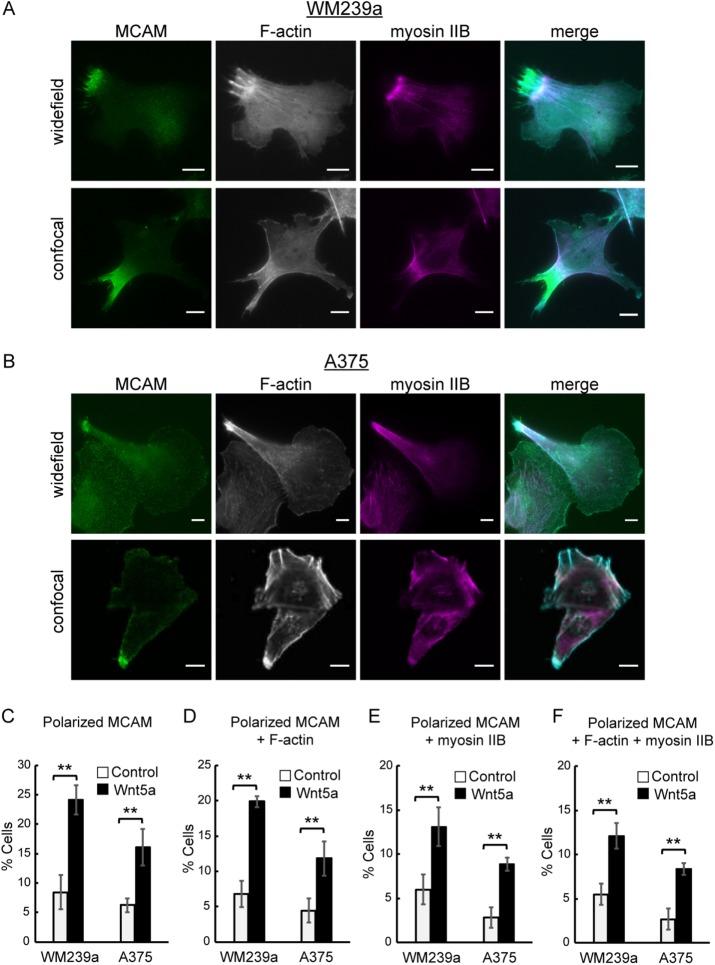
In contrast to events at the cell leading edge, rear-polarized mechanisms that control directional cell migration are poorly defined. Previous work described a new intracellular complex, the Wnt5a-receptor-actomyosin polarity (WRAMP) structure, which coordinates the polarized localization of MCAM, actin, and myosin IIB in a Wnt5a-induced manner. However, the polarity and function for the WRAMP structure during cell movement were not determined. Here we characterize WRAMP structures during extended cell migration using live-cell imaging. The results demonstrate that cells undergoing prolonged migration show WRAMP structures stably polarized at the rear, where they are strongly associated with enhanced speed and persistence of directional movement. Strikingly, WRAMP structures form transiently, with cells displaying directional persistence during periods when they are present and cells changing directions randomly when they are absent. Cells appear to pause locomotion when WRAMP structures disassemble and then migrate in new directions after reassembly at a different location, which forms the new rear. We conclude that WRAMP structures represent a rear-directed cellular mechanism to control directional migration and that their ability to form dynamically within cells may control changes in direction during extended migration.
与细胞前沿发生的事件不同,控制细胞定向迁移的后极化机制目前尚不清楚。先前的研究描述了一种新的细胞内复合物,即Wnt5a受体-肌动球蛋白极性(WRAMP)结构,它以Wnt5a诱导的方式协调MCAM、肌动蛋白和肌球蛋白IIB的极化定位。然而,细胞运动过程中WRAMP结构的极性和功能尚未确定。在这里,我们使用活细胞成像技术对细胞长时间迁移过程中的WRAMP结构进行了表征。结果表明,经历长时间迁移的细胞显示WRAMP结构在细胞后部稳定极化,在那里它们与定向运动的速度和持续性增强密切相关。引人注目的是,WRAMP结构是短暂形成的,当它们存在时细胞表现出定向持续性,而当它们不存在时细胞随机改变方向。当WRAMP结构解体时,细胞似乎会暂停运动,然后在不同位置重新组装后向新的方向迁移,从而形成新的后部。我们得出结论,WRAMP结构代表了一种控制定向迁移的后向细胞机制,并且它们在细胞内动态形成的能力可能控制长时间迁移过程中的方向变化。



 Zotero 插件