Kawamura Mariko, Maeda Yoshikazu, Yamamoto Kazutaka, Takamatsu Shigeyuki, Sato Yoshitaka, Minami Hiroki, Saga Yusuke, Kume Kyo, Tameshige Yuji, Sasaki Makoto, Tamamura Hiroyasu, Ohta Kouji, Itoh Yoshiyuki, Naganawa Shinji
Department of Radiology, Nagoya University Graduate School of Medicine, Nagoya, Aichi, Japan.
Proton Therapy Center, Fukui Prefectural Hospital, Fukui, Japan.
J Appl Clin Med Phys. 2017 Jul;18(4):155-160. doi: 10.1002/acm2.12116. Epub 2017 Jun 8.
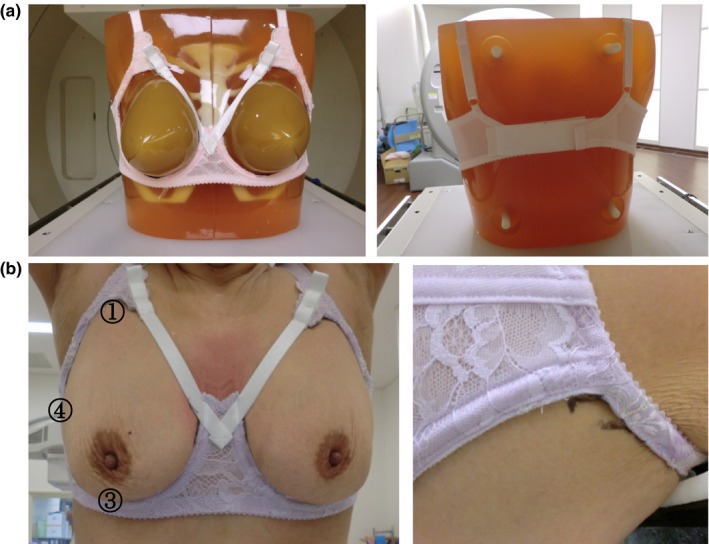
PURPOSE/OBJECTIVE(S): Accurate and reproducible positioning of the breast is difficult due to its deformability and softness; thus, targeting a breast tumor or tumor bed with fractionated radiotherapy using external beam radiation is difficult. The aim of this study was to develop a novel bra to aid in breast immobilization in the prone position.
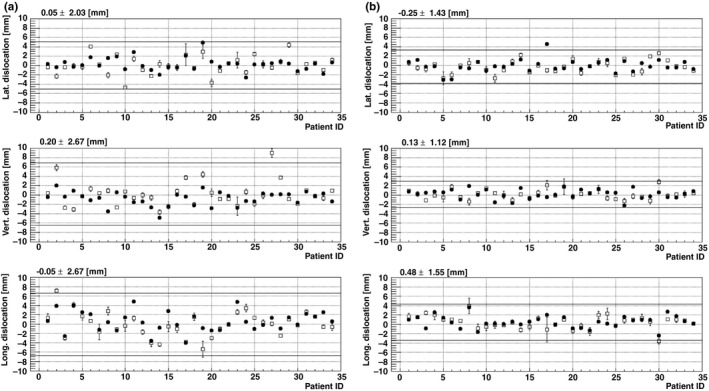
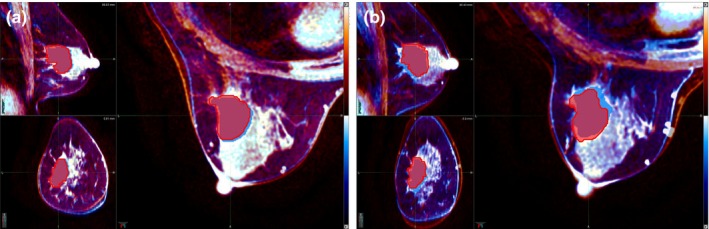
MATERIALS & METHODS: To assess the accuracy of prone position fixation of breast tumors, 33 breast cancer patients with 34 lesions were recruited. The bra used in this verification was customized from a commercially available bra. Duplicate MRI were acquired in the prone position, alternating with and without the bra, and for each series, patients were asked to step off the MRI table and re-set up in the prone position. Patients were also asked to remove and re-fit the bra for the second MRI. Each pair of images were superimposed to match the shape of the skin surface, and the maximum difference in tumor geometric center in three axes was measured. The required set up margin was calculated as: required margin = mean difference in geometric center + 2.5 standard deviation. The volumetric overlap of the tumor, as well as contouring uncertainties, was evaluated using contour analysis software.
The median breast size was 498 cc. The required margins for the lateral, vertical, and longitudinal directions were estimated to be 4.1, 4.1, and 5.0 mm, respectively, with the bra, and 5.1, 6.9, and 6.7 mm, respectively, without the bra. These margins covered the dislocation of more than 33 lesions in total. With the bra, 33 lesions had achieved an objective overlap of 95% and 99% with 2 and 4 mm margins, respectively, whereas 4 and 8 mm, respectively, were needed without the bra.
The use of an immobilizing bra reduced the setup margin for prone position fixation of breast tumors.
由于乳房具有可变形性和柔软性,准确且可重复地对乳房进行定位较为困难;因此,使用外照射进行分次放疗时,要瞄准乳房肿瘤或肿瘤床很困难。本研究的目的是开发一种新型胸罩,以辅助在俯卧位固定乳房。
为评估乳房肿瘤俯卧位固定的准确性,招募了33例患有34个病灶的乳腺癌患者。本验证中使用的胸罩是由市售胸罩定制而成。在俯卧位下采集重复的磁共振成像(MRI),有胸罩和无胸罩的情况交替进行,对于每个系列,要求患者从MRI检查台上下来并重新在俯卧位摆好姿势。还要求患者在进行第二次MRI检查时取下并重新佩戴胸罩。将每对图像进行叠加以匹配皮肤表面形状,并测量肿瘤几何中心在三个轴向上的最大差异。所需的摆位边界计算如下:所需边界=几何中心的平均差异+2.5倍标准差。使用轮廓分析软件评估肿瘤的体积重叠以及轮廓不确定性。
乳房中位体积为498立方厘米。有胸罩时,横向、纵向和纵向上所需的边界估计分别为4.1毫米、4.1毫米和5.0毫米,无胸罩时分别为5.1毫米、6.9毫米和6.7毫米。这些边界总共覆盖了超过33个病灶的移位。有胸罩时,33个病灶在边界为2毫米和4毫米时分别实现了95%和99%的目标重叠,而无胸罩时分别需要4毫米和8毫米。
使用固定胸罩可减少乳房肿瘤俯卧位固定时的摆位边界。