Costa Francisco B, da Costa Andréa P, Moraes-Filho Jonas, Martins Thiago F, Soares Herbert S, Ramirez Diego G, Dias Ricardo A, Labruna Marcelo B
Department of Preventive Veterinary Medicine and Animal Health, Faculty of Veterinary Medicine, University of São Paulo, São Paulo, SP, Brazil.
Preventive Veterinary Medicine, Faculty of Veterinary Medicine, State University of Maranhão, São Luís, MA, Brazil.
PLoS One. 2017 Jun 8;12(6):e0179163. doi: 10.1371/journal.pone.0179163. eCollection 2017.
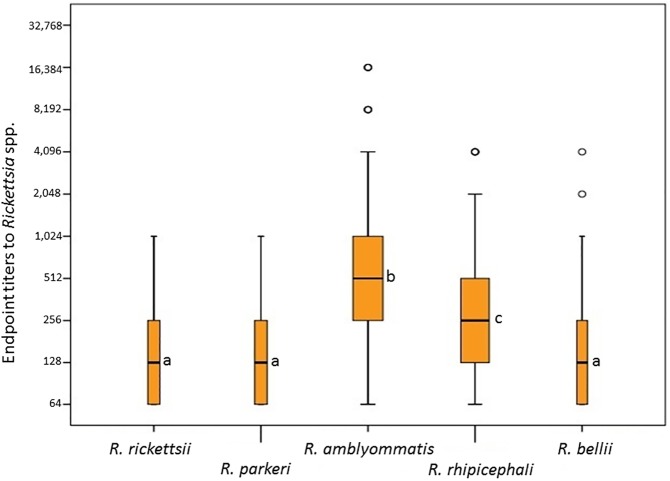
This study was performed in Maranhão state, a transition area two Brazilian biomes, Amazon and Cerrado. During 2011-2013, 1,560 domestic dogs were sampled for collection of serum blood samples and ticks in eight counties (3 within the Amazon and 5 within the Cerrado). A total of 959 ticks were collected on 150 dogs (9.6%). Rhipicephalus sanguineus sensu lato (s.l.) was the most abundant tick (68% of all collected specimens), followed by Amblyomma cajennense sensu lato (s.l.) (12.9%), Amblyomma parvum (9.2%), and Amblyomma ovale (5.2%). Other less abundant species (<1%) were Amblyomma oblongoguttatum, Rhipicephalus microplus, Haemaphysalis juxtakochi, and Amblyomma rotundatum. Females of A. cajennense s.l. ticks were morphologically identified as A. cajennense sensu stricto (s.s.) or A. sculptum. Molecular analyses of 779 canine ticks revealed three Rickettsia species: Rickettsia amblyommatis in 1% (1/100) A. cajennense s.l., 'Candidatus Rickettsia andeanae' in 20.7% (12/58) A. parvum, Rickettsia bellii in 6.8% (3/44) A. ovale and 100% (1/1) A. rotundatum ticks. An additional collection of A. sculptum from horses in a Cerrado area, and A. cajennense s.s. from pigs in an Amazon area revealed R. amblyommatis infecting only the A. cajennense s.s. ticks. Serological analysis of the 1,560 canine blood samples revealed 12.6% canine seroreactivity to Rickettsia spp., with the highest specific seroreactivity rate (10.2%) for R. amblyommatis. Endpoint titers to R. amblyommatis were significantly higher than those for the other Rickettsia antigens, suggesting that most of the seroreactive dogs were exposed to R. amblyommatis-infected ticks. Highest canine seroreactivity rates per locality (13.1-30.8%) were found in Amazon biome, where A. cajennense s.s. predominated. Lowest seroreactivity rates (1.9-6.5%) were found in Cerrado localities that were further from the Amazon, where A. sculptum predominated. Multivariate analyses revealed that canine seroreactivity to Rickettsia spp. or R. amblyommatis was statistically associated with rural dogs, exposed to Amblyomma ticks.
本研究在巴西马兰热州进行,该州是亚马逊和塞拉多这两个巴西生物群落的过渡区域。在2011年至2013年期间,从八个县(亚马逊地区3个县,塞拉多地区5个县)的1560只家犬身上采集血清血样和蜱虫。共在150只狗(9.6%)身上采集到959只蜱虫。血红扇头蜱狭义亚种(Rhipicephalus sanguineus sensu lato,s.l.)是最常见的蜱虫(占所有采集标本的68%),其次是卡延钝眼蜱狭义亚种(Amblyomma cajennense sensu lato,s.l.)(12.9%)、微小钝眼蜱(Amblyomma parvum)(9.2%)和椭圆钝眼蜱(Amblyomma ovale)(5.2%)。其他不太常见的种类(<1%)包括长形花蜱(Amblyomma oblongoguttatum)、微小牛蜱(Rhipicephalus microplus)、近科氏血蜱(Haemaphysalis juxtakochi)和圆形钝眼蜱(Amblyomma rotundatum)。卡延钝眼蜱狭义亚种蜱虫的雌性在形态上被鉴定为卡延钝眼蜱指名亚种(Amblyomma cajennense sensu stricto,s.s.)或雕刻钝眼蜱(Amblyomma sculptum)。对779只犬蜱的分子分析发现了三种立克次体物种:在1%(1/100)的卡延钝眼蜱狭义亚种中检测到安氏立克次体(Rickettsia amblyommatis),在20.7%(12/58)的微小钝眼蜱中检测到“卡氏立克次体安德亚种(Candidatus Rickettsia andeanae)”,在6.8%(3/44)的椭圆钝眼蜱和100%(1/1)的圆形钝眼蜱中检测到贝利立克次体(Rickettsia bellii)。在塞拉多地区从马身上额外采集的雕刻钝眼蜱,以及在亚马逊地区从猪身上采集的卡延钝眼蜱指名亚种,发现安氏立克次体仅感染卡延钝眼蜱指名亚种蜱虫。对1560份犬血样的血清学分析显示,12.6%的犬对立克次体属有血清反应,其中对安氏立克次体的特异性血清反应率最高(10.2%)。对安氏立克次体的终点滴度显著高于其他立克次体抗原,这表明大多数有血清反应的犬接触过感染安氏立克次体的蜱虫。在亚马逊生物群落中发现每个地区犬的最高血清反应率(13.1 - 30.8%),该地区以卡延钝眼蜱指名亚种为主。在距离亚马逊较远、以雕刻钝眼蜱为主的塞拉多地区发现最低血清反应率(1.9 - 6.5%)。多变量分析显示,犬对立克次体属或安氏立克次体的血清反应与农村犬以及接触钝眼蜱有关。