Lanfredini Simone, Olivero Carlotta, Borgogna Cinzia, Calati Federica, Powell Kathryn, Davies Kelli-Jo, De Andrea Marco, Harries Sarah, Tang Hiu Kwan Carolyn, Pfister Herbert, Gariglio Marisa, Patel Girish K
European Cancer Stem Cell Research Institute, School of Biosciences, Cardiff University, Cardiff, UK.
Virology Unit, Department of Translational Medicine, Novara Medical School, Novara, Italy.
J Invest Dermatol. 2017 Oct;137(10):2208-2216. doi: 10.1016/j.jid.2017.04.039. Epub 2017 Jun 6.
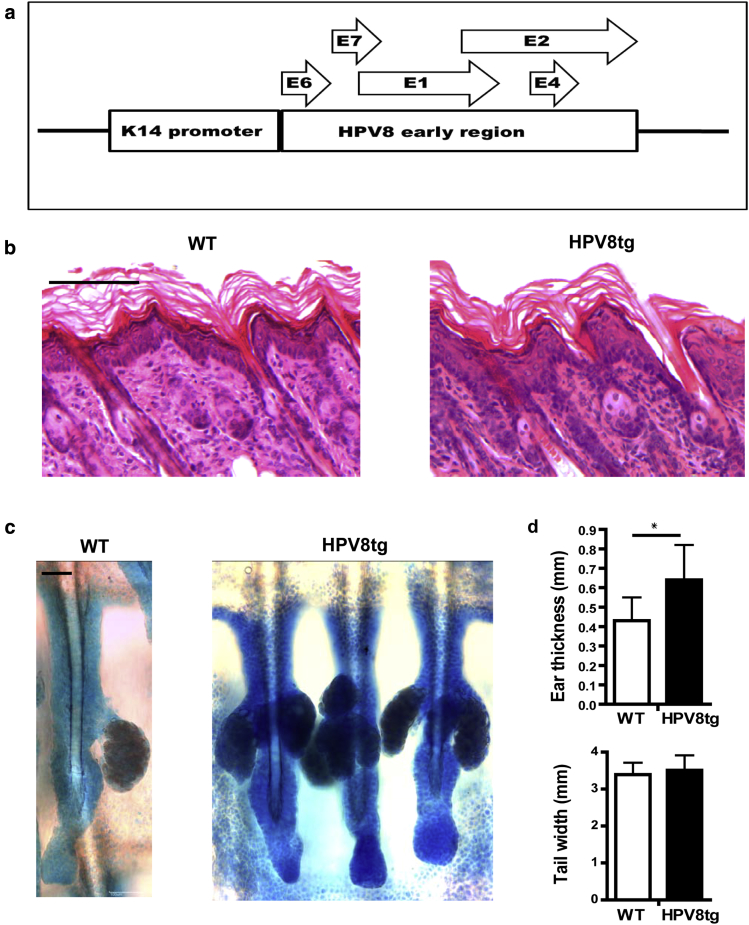
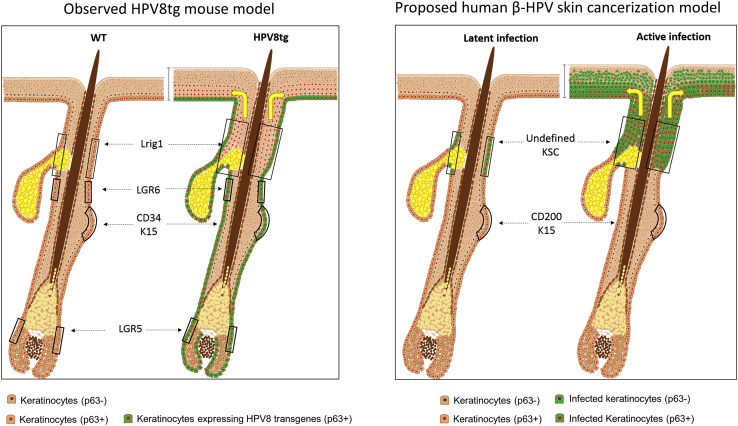
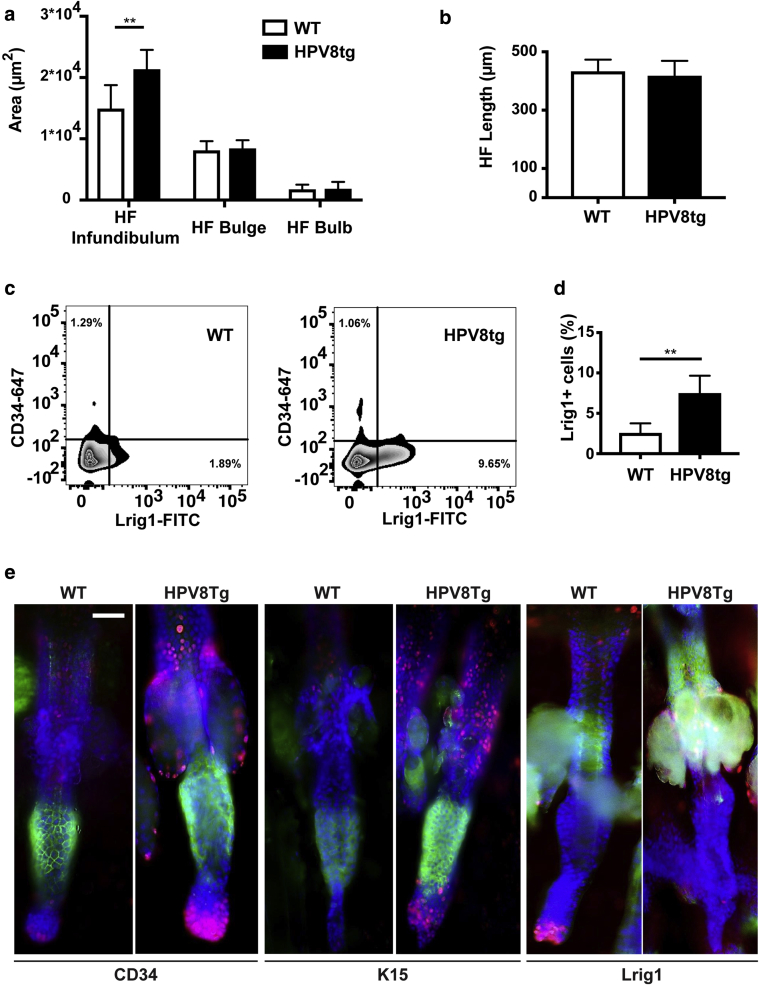
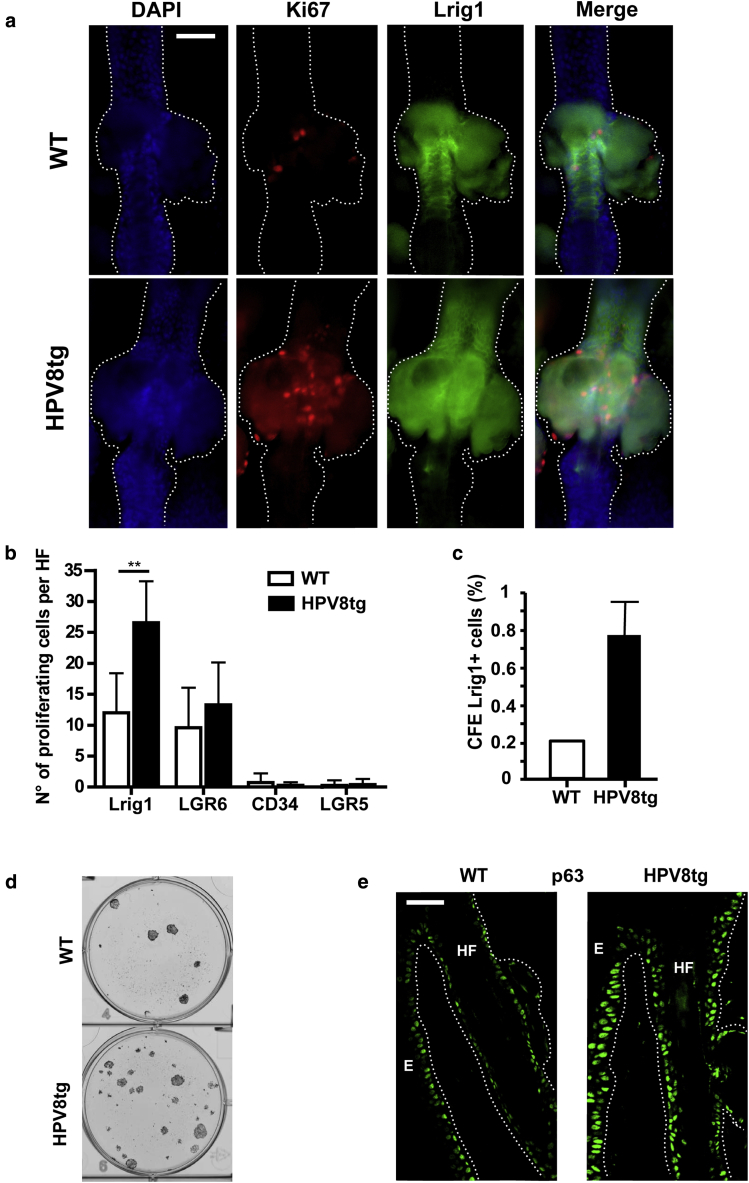
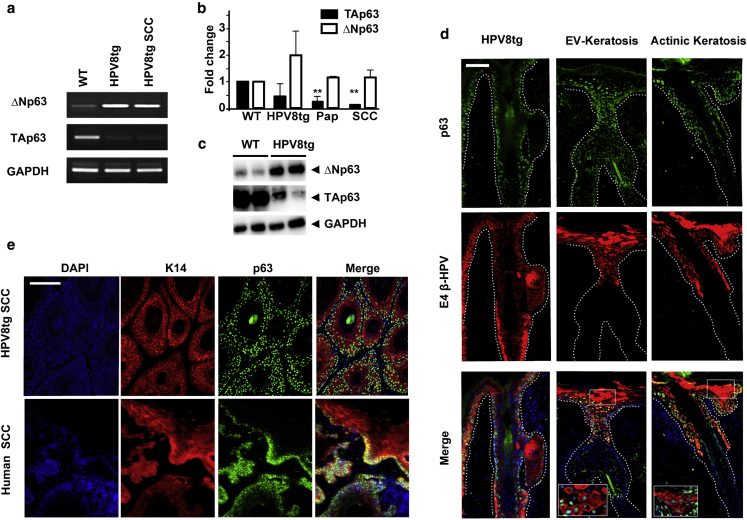
β-Human papillomaviruses (HPVs) cause near ubiquitous latent skin infection within long-lived hair follicle (HF) keratinocyte stem cells. In patients with epidermodysplasia verruciformis, β-HPV viral replication is associated with skin keratosis and cutaneous squamous cell carcinoma. To determine the role of HF keratinocyte stem cells in β-HPV-induced skin carcinogenesis, we utilized a transgenic mouse model in which the keratin 14 promoter drives expression of the entire HPV8 early region (HPV8tg). HPV8tg mice developed thicker skin in comparison with wild-type littermates consistent with a hyperproliferative epidermis. HF keratinocyte proliferation was evident within the Lrig1+ keratinocyte stem cell population (69 vs. 55%, P < 0.01, n = 7), and not in the CD34+, LGR5+, and LGR6+ keratinocyte stem cell populations. This was associated with a 2.8-fold expansion in Lrig1+ keratinocytes and 3.8-fold increased colony-forming efficiency. Consistent with this, we observed nuclear p63 expression throughout this population and the HF infundibulum and adjoining interfollicular epidermis, associated with a switch from p63 transcriptional activation isoforms to ΔNp63 isoforms in HPV8tg skin. Epidermodysplasia verruciformis keratosis and in some cases actinic keratoses demonstrated similar histology associated with β-HPV reactivation and nuclear p63 expression within the HF infundibulum and perifollicular epidermis. These findings would suggest that β-HPV field cancerization arises from the HF junctional zone and predispose to squamous cell carcinoma.
β-人乳头瘤病毒(HPVs)在长寿毛囊(HF)角质形成干细胞内引起几乎无处不在的潜伏性皮肤感染。在疣状表皮发育不良患者中,β-HPV病毒复制与皮肤角化病和皮肤鳞状细胞癌相关。为了确定HF角质形成干细胞在β-HPV诱导的皮肤癌发生中的作用,我们利用了一种转基因小鼠模型,其中角蛋白14启动子驱动整个HPV8早期区域(HPV8tg)的表达。与野生型同窝小鼠相比,HPV8tg小鼠的皮肤更厚,这与表皮过度增殖一致。HF角质形成细胞增殖在Lrig1 +角质形成干细胞群体中明显(69%对55%,P < 0.01,n = 7),而在CD34 +、LGR5 +和LGR6 +角质形成干细胞群体中不明显。这与Lrig1 +角质形成细胞2.8倍的扩增和3.8倍的集落形成效率增加相关。与此一致的是,我们在整个该群体以及HF漏斗部和相邻的毛囊间表皮中观察到核p63表达,这与HPV8tg皮肤中从p63转录激活异构体向ΔNp63异构体的转变相关。疣状表皮发育不良角化病以及在某些情况下光化性角化病表现出与β-HPV重新激活以及HF漏斗部和毛囊周围表皮内的核p63表达相关的相似组织学。这些发现表明β-HPV场癌化起源于HF交界区并易患鳞状细胞癌。