Nickla Debora L, Jordan Kelsey, Yang Jane, Totonelly Kristen
The New England College of Optometry, Biosciences Dept., 424 Beacon St., Boston, MA, USA.
The New England College of Optometry, Biosciences Dept., 424 Beacon St., Boston, MA, USA.
Exp Eye Res. 2017 Aug;161:132-142. doi: 10.1016/j.exer.2017.06.003. Epub 2017 Jun 5.
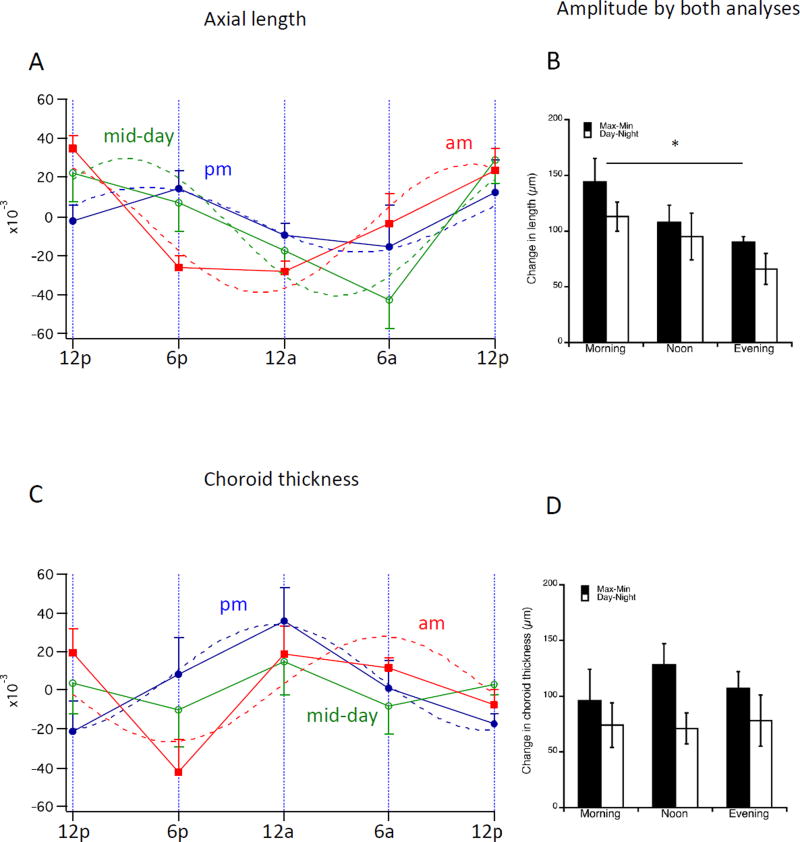
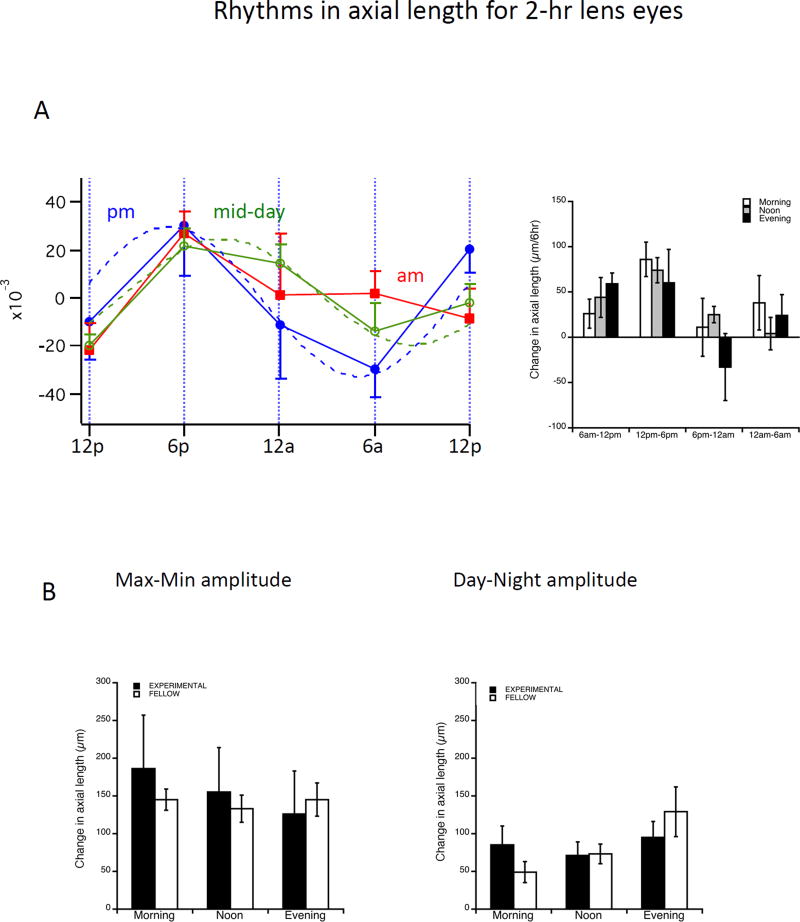
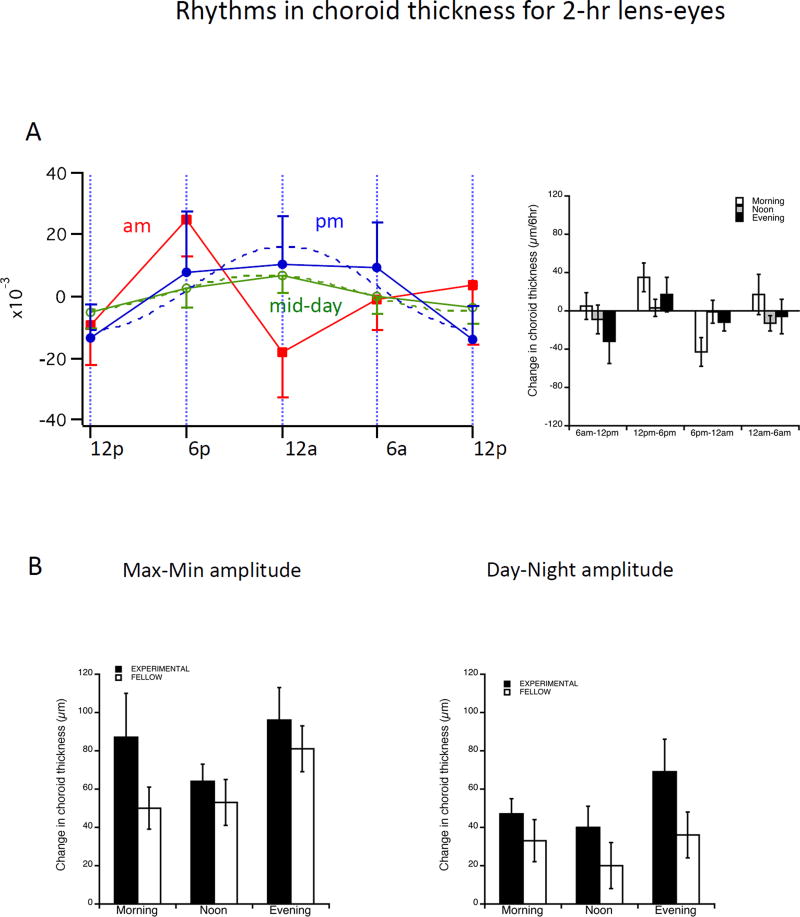
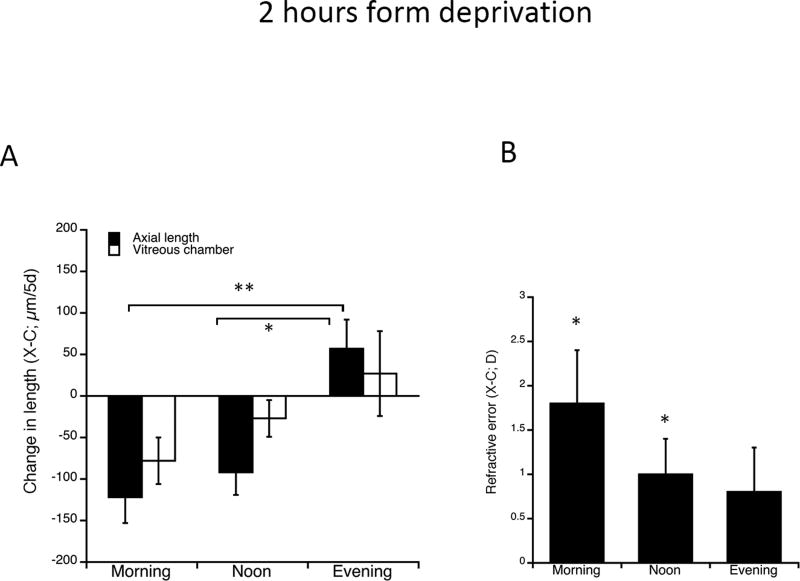
It is generally accepted that myopic defocus is a more potent signal to the emmetropization system than hyperopic defocus: one hour per day of myopic defocus cancels out 11 h of hyperopic defocus. However, we have recently shown that the potency of brief episodes of myopic defocus at inhibiting eye growth depends on the time of day of exposure. We here ask if this will also be true of the responses to brief periods of hyperopic defocus: may integration of the signal depend on time of day? If so, are the rhythms in axial length and choroidal thickness altered? Hyperopic defocus: Birds had one eye exposed to hyperopic defocus by the wearing of -10D lenses for 2 or 6 h at one of 3 times of day for 5 days: Morning (7 am - 9 am: n = 13; 7 am - 1 pm: n = 6), Mid-day (12 pm - 2 pm: n = 20; 10 am - 4 pm: n = 8), or Evening (7 pm - 9 pm: n = 12; 2 pm - 8 pm: n = 11). A separate group wore monocular lenses continually as a control (n = 12). Form deprivation: Birds wore a diffuser over one eye for 2 h at one of 3 times of day for 5 days: Morning (n = 12); Mid-day (n = 19) or Evening (n = 6). For all groups, ocular dimensions were measured using high-frequency A-scan ultrasonography at noon on the first day, under inhalation anesthesia. On day 5, eye dimensions were re-measured at 12 pm, and refractive errors were measured using a Hartinger's refractometer. A subset of birds in the 2-h lens group (morning, n = 8; mid-day, n = 8; evening, n = 6), and the deprivation group (n = 6 per time point), were also measured at 6 pm, 12 am, 6 am and 12 pm on the last day of exposure, to obtain the parameters of the diurnal rhythms in axial length and choroidal thickness. The effects of 2 h of defocus depended on time of day of exposure: it stimulated eye growth when exposure was in the morning and inhibited it when it was at mid-day (change in vitreous chamber, X-C; ANOVA p < 0.0005; 120 μm vs -77 μm/5d, respectively; t-tests: p = 0.001; p = 0.01; post-hoc tests: p = 0.002). For mid-day, experimental eyes were more hyperopic (1.4 D; p < 0.0001). Similar to 2 h defocus, 6 h exposures at mid-day inhibited growth and produced hyperopia (X-C: -167 μm; t-test p = 0.005; RE: 1.8 D; p = 0.03). The effects of 2 h of FD were similar to those of hyperopic defocus in inhibiting growth for mid-day exposures, but FD inhibited growth for the morning exposures as well (Axial length: X-C: Morning: -122 μm; mid-day: -92 μm; ttests p = 0.006 and p = 0.016 respectively). Experimental eyes were more hyperopic (1.8 D; 1.0 D; p < 0.05). The rhythms in axial length were altered for the morning exposures in both conditions. Form deprivation in the morning, which caused inhibition, caused the phases of the two rhythms to shift toward one another (peaks at 6:00 am and 10:45 am for choroid and axial length respectively). Our findings imply that the retinal "integrator", and/or scleral growth regulator exhibit diurnal rhythms. Furthermore, they suggest that reading activities early in the day may be contraindicated in school children at risk of becoming myopic.
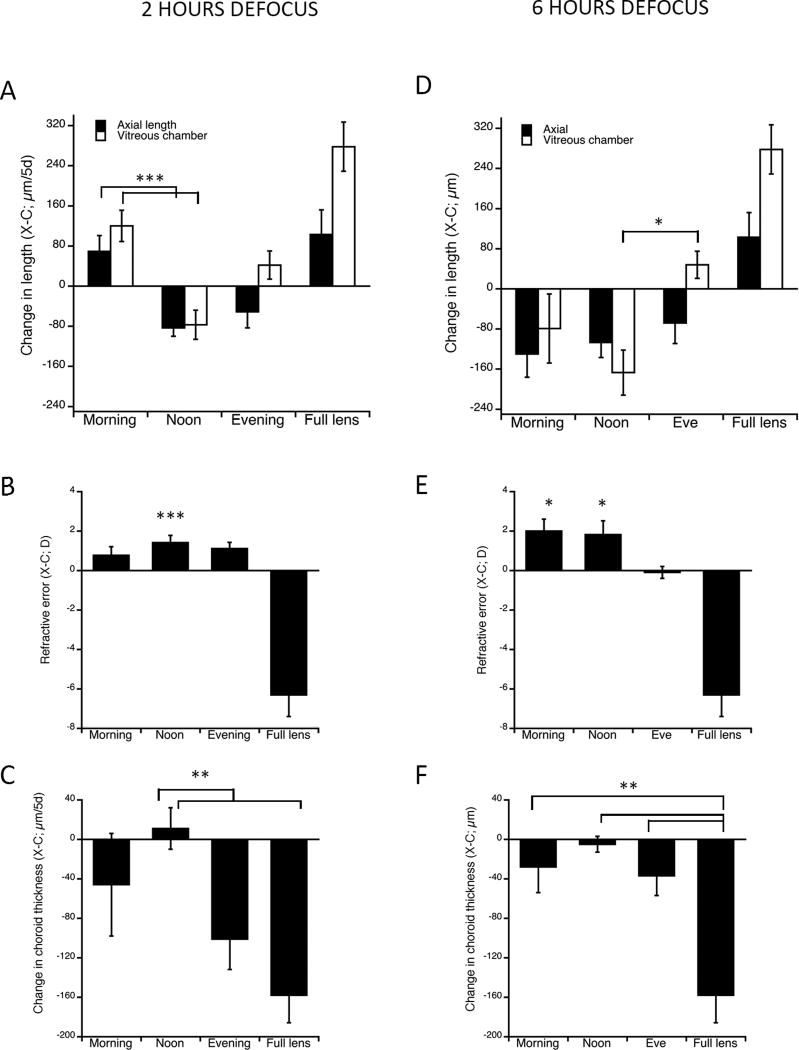
一般认为,近视性离焦对正视化系统而言是比远视性离焦更强有力的信号:每天1小时的近视性离焦可抵消11小时的远视性离焦。然而,我们最近发现,短时间近视性离焦抑制眼球生长的效力取决于暴露的时间。在此我们探讨对短时间远视性离焦的反应是否也是如此:信号整合是否取决于时间?如果是,眼轴长度和脉络膜厚度的节律是否会改变?远视性离焦:鸟类在一天中的3个时间段之一,佩戴-10D透镜使一只眼睛处于远视性离焦状态2或6小时,持续5天:上午(上午7点 - 9点:n = 13;上午7点 - 下午1点:n = 6),中午(中午12点 - 下午2点:n = 20;上午10点 - 下午4点:n = 8),或晚上(晚上7点 - 9点:n = 12;下午2点 - 晚上8点:n = 11)。另一组持续佩戴单眼透镜作为对照(n = 12)。形觉剥夺:鸟类在一天中的3个时间段之一,用漫射器覆盖一只眼睛2小时,持续5天:上午(n = 12);中午(n = 19)或晚上(n = 6)。对于所有组,在吸入麻醉下,于第一天中午使用高频A超超声测量眼部尺寸。在第5天,下午12点再次测量眼部尺寸,并使用哈廷格屈光计测量屈光不正。2小时透镜组(上午、中午、晚上各有一部分鸟)和剥夺组(每个时间点n = 6)中的一部分鸟,在暴露的最后一天下午6点、上午12点、上午6点和下午12点也进行了测量,以获取眼轴长度和脉络膜厚度的昼夜节律参数。2小时离焦的影响取决于暴露的时间:上午暴露时刺激眼球生长,中午暴露时抑制眼球生长(玻璃体腔变化,X - C;方差分析p < 0.0005;分别为120μm与 - 77μm/5天;t检验:p = 0.001;p = 0.01;事后检验:p = 0.002)。对于中午暴露,实验眼的远视度数更高(1.4 D;p < 0.0001)。与2小时离焦类似,中午6小时暴露抑制生长并产生远视(X - C: - 167μm;t检验p = 0.005;屈光不正:1.8 D;p = 0.03)。2小时形觉剥夺的影响与远视性离焦在中午暴露时抑制生长的情况相似,但形觉剥夺在上午暴露时也抑制生长(眼轴长度:X - C:上午: - 122μm;中午: - 92μm;t检验分别为p = 0.006和p = 0.016)。实验眼的远视度数更高(1.8 D;1.0 D;p < 0.05)。在两种情况下,上午暴露时眼轴长度的节律均发生改变。上午的形觉剥夺导致抑制,使两种节律的相位相互偏移(脉络膜和眼轴长度的峰值分别在上午6:00和上午10:45)。我们的研究结果表明,视网膜“整合器”和/或巩膜生长调节因子表现出昼夜节律。此外,这表明对于有近视风险的学龄儿童,白天较早进行阅读活动可能是不合适的。