Sanders J N, Turok D K, Royer P A, Thompson I S, Gawron L M, Storck K E
Department of Obstetrics and Gynecology, University of Utah, 30 North 1900 East, Room 2B200, Salt Lake City, UT 84132-2209, USA.
Department of Obstetrics and Gynecology, University of Utah, 30 North 1900 East, Room 2B200, Salt Lake City, UT 84132-2209, USA.
Contraception. 2017 Aug;96(2):99-105. doi: 10.1016/j.contraception.2017.05.012. Epub 2017 Jun 5.
OBJECTIVE(S): This study compares 1-year intrauterine device (IUD) continuation among women presenting for emergency contraception (EC) and initiating the copper (Cu T380A) IUD or the levonorgestrel (LNG) 52 mg IUD plus 1.5 mg oral LNG.
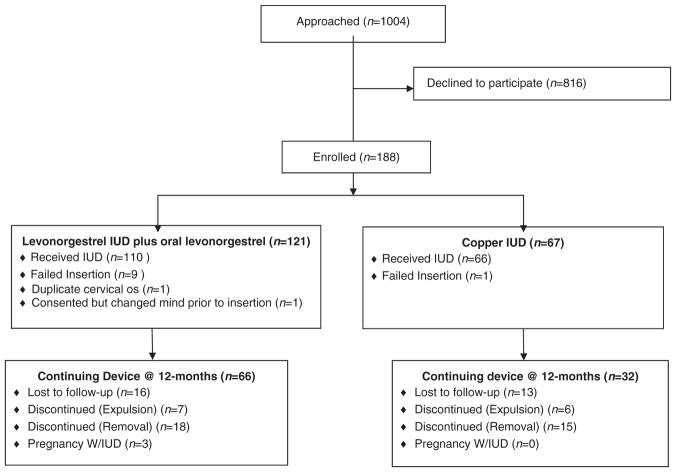
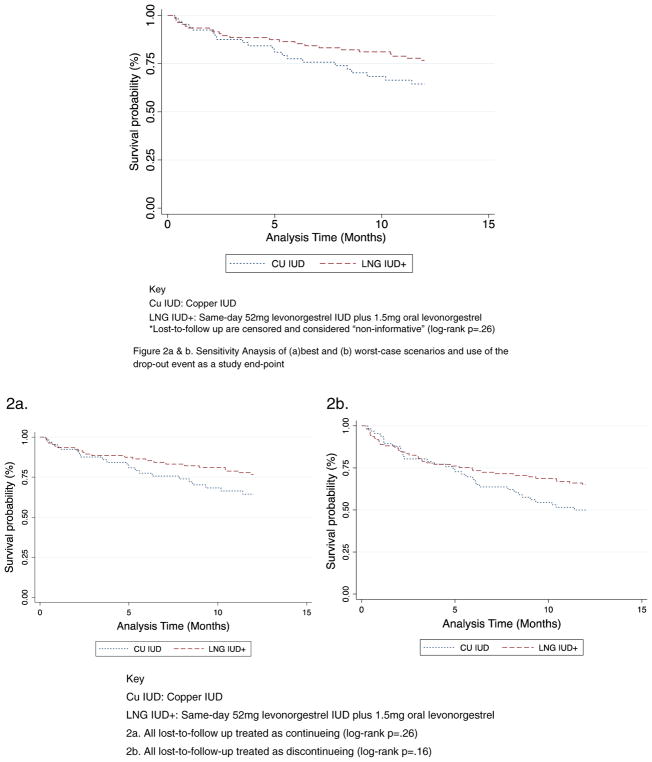
This cohort study enrolled 188 women who presented at a single family planning clinic in Utah between June 2013 and September 2014 and selected either the Cu T380A IUD or LNG 52 mg IUD plus oral LNG for EC. Trained personnel followed participants by phone, text or e-mail for 12 months or until discontinuation occurred. We assessed reasons for discontinuation and used Cox proportional hazard models, Kaplan-Meier estimates and log-rank tests to assess differences in continuation rates between IUDs.
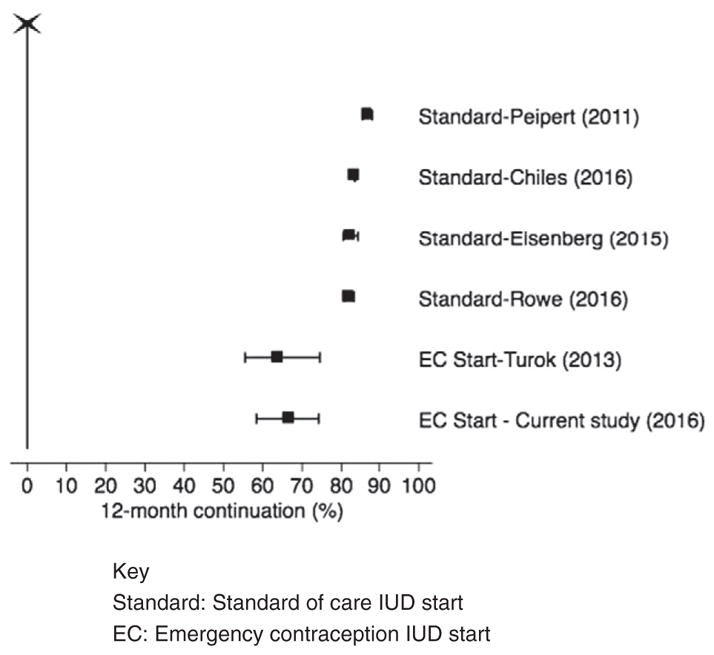
One hundred seventy-six women received IUDs; 66 (37%) chose the Cu T380A IUD and 110 (63%) chose the LNG 52 mg IUD plus oral LNG. At 1 year, we accounted for 147 (84%) participants, 33 (22%) had requested removals, 13 (9%) had an expulsion and declined reinsertion, 3 (2%) had a pregnancy with their IUD in place and 98 (67%) were still using their device. Continuation rates did not differ by IUD type; 60% of Cu T380A IUD users and 70% of LNG 52 mg IUD plus oral LNG users were still using their device at 12 months (adjusted hazard ratio 0.72, 95% confidence interval 0.40-1.3).
CONCLUSION(S): Two-thirds of women who chose IUD placement at the EC clinical encounter continued use at 1 year. Women initiating Cu T380A IUD and LNG 52 mg IUD had similar 1-year continuation rates. These findings support same-day insertion of IUDs for women who are seeking EC and would like to use a highly effective reversible method going forward.
Providing IUD options for EC users presents an opportunity to increase availability of highly effective contraception.
本研究比较了因紧急避孕(EC)前来就诊并开始使用铜(Cu T380A)宫内节育器或左炔诺孕酮(LNG)52mg宫内节育器加1.5mg口服左炔诺孕酮的女性的1年宫内节育器持续使用情况。
这项队列研究纳入了2013年6月至2014年9月期间在犹他州一家计划生育诊所就诊的188名女性,她们选择Cu T380A宫内节育器或LNG 52mg宫内节育器加口服左炔诺孕酮进行紧急避孕。训练有素的人员通过电话、短信或电子邮件对参与者进行为期12个月的随访,直至停用。我们评估了停用原因,并使用Cox比例风险模型、Kaplan-Meier估计和对数秩检验来评估不同宫内节育器持续使用率的差异。
176名女性接受了宫内节育器;66名(37%)选择了Cu T380A宫内节育器,110名(63%)选择了LNG 52mg宫内节育器加口服左炔诺孕酮。1年后,我们对147名(84%)参与者进行了随访,33名(22%)要求取出,13名(9%)发生脱落且拒绝重新插入,3名(2%)宫内节育器在位时怀孕,98名(67%)仍在使用其宫内节育器。不同类型宫内节育器的持续使用率无差异;12个月时,60%的Cu T380A宫内节育器使用者和70%的LNG 52mg宫内节育器加口服左炔诺孕酮使用者仍在使用其宫内节育器(调整后风险比0.72,95%置信区间0.40-1.3)。
在紧急避孕临床就诊时选择放置宫内节育器的女性中,三分之二在1年后仍继续使用。开始使用Cu T380A宫内节育器和LNG 52mg宫内节育器的女性1年持续使用率相似。这些发现支持为寻求紧急避孕且希望今后使用高效可逆避孕方法的女性当天插入宫内节育器。
为紧急避孕使用者提供宫内节育器选择为提高高效避孕方法的可及性提供了一个机会。