
受冲突影响人群中的创伤后应激障碍和重度抑郁症:一项流行病学模型及预测因素分析
Post-traumatic stress disorder and major depression in conflict-affected populations: an epidemiological model and predictor analysis.
作者信息
Charlson F J, Flaxman A, Ferrari A J, Vos T, Steel Z, Whiteford H A
机构信息
University of Queensland, School of Public Health, Herston, QLD, Australia.
Queensland Centre for Mental Health Research, Wacol, QLD, Australia.
出版信息
Glob Ment Health (Camb). 2016 Feb 10;3:e4. doi: 10.1017/gmh.2015.26. eCollection 2016.
BACKGROUND
Despite significant research examining mental health in conflict-affected populations we do not yet have a comprehensive epidemiological model of how mental disorders are distributed, or which factors influence the epidemiology in these populations. We aim to derive prevalence estimates specific for region, age and sex of major depression, and PTSD in the general populations of areas exposed to conflict, whilst controlling for an extensive range of covariates.
METHODS
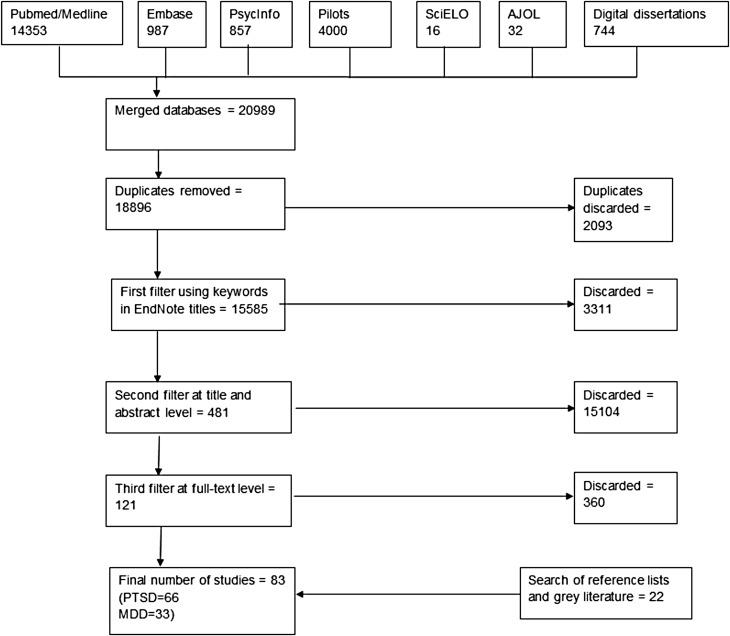
A systematic review was conducted to identify epidemiological estimates of depression and PTSD in conflict-affected populations and potential predictors. We analyse data using Bayesian meta-regression techniques.
RESULTS
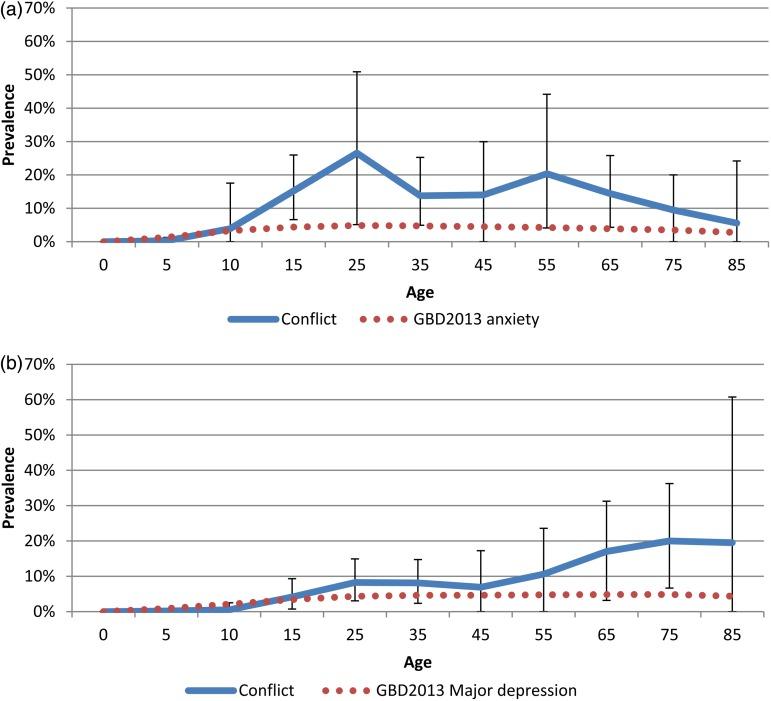
We identified 83 studies and a list of 34 potential predictors. The age-standardised pooled prevalence of PTSD was 12.9% (95% UI 6.9-22.9), and major depression 7.6% (95% UI 5.1-10.9) - markedly lower than estimated in previous research but over two-times higher than the mean prevalence estimated by the Global Burden of Disease Study [3.7% (95% UI 3.0-4.5) and 3.5% (95% UI 2.9-4.2) for anxiety disorders and MDD, respectively]. The age-patterns reveal sharp prevalence inclines in the childhood years. A number of ecological variables demonstrated associations with prevalence of both disorders. Symptom scales were shown to significantly overestimate prevalence of both disorders. Finding suggests higher prevalence of both disorders in females.
CONCLUSION
This study provides, for the first time, age-specific estimates of PTSD and depression prevalence adjusted for an extensive range of covariates and is a significant advancement on our current understanding of the epidemiology in conflict-affected populations.
背景
尽管针对受冲突影响人群的心理健康进行了大量研究,但我们尚未建立一个全面的流行病学模型来描述精神障碍的分布情况,以及哪些因素会影响这些人群的流行病学特征。我们旨在得出受冲突影响地区普通人群中重度抑郁症和创伤后应激障碍(PTSD)在地区、年龄和性别方面的患病率估计值,同时控制一系列广泛的协变量。
方法
进行了一项系统综述,以确定受冲突影响人群中抑郁症和PTSD的流行病学估计值以及潜在预测因素。我们使用贝叶斯元回归技术分析数据。
结果
我们识别出83项研究和一份包含34个潜在预测因素的清单。PTSD的年龄标准化合并患病率为12.9%(95%不确定区间6.9 - 22.9),重度抑郁症为7.6%(95%不确定区间5.1 - 10.9),明显低于先前研究的估计值,但比全球疾病负担研究估计的平均患病率高出两倍多(焦虑症和重度抑郁症分别为3.7%(95%不确定区间3.0 - 4.5)和3.5%(95%不确定区间2.9 - 4.2))。年龄模式显示儿童期患病率急剧上升。一些生态变量表明与这两种疾病的患病率有关。症状量表被证明会显著高估这两种疾病的患病率。研究结果表明这两种疾病在女性中的患病率更高。
结论
本研究首次提供了针对PTSD和抑郁症患病率的年龄特异性估计值,并对一系列广泛的协变量进行了调整,这是我们目前对受冲突影响人群流行病学理解的一个重大进展。
 Zotero 插件