Beknazarova Meruyert, Millsteed Shelby, Robertson Gemma, Whiley Harriet, Ross Kirstin
School of the Environment, Flinders University, GPO Box 2100, Adelaide 5001, Australia.
Melbourne Pathology, Collingwood and James Cook University, Collingwood, VIC 3066, Australia.
Int J Environ Res Public Health. 2017 Jun 9;14(6):624. doi: 10.3390/ijerph14060624.
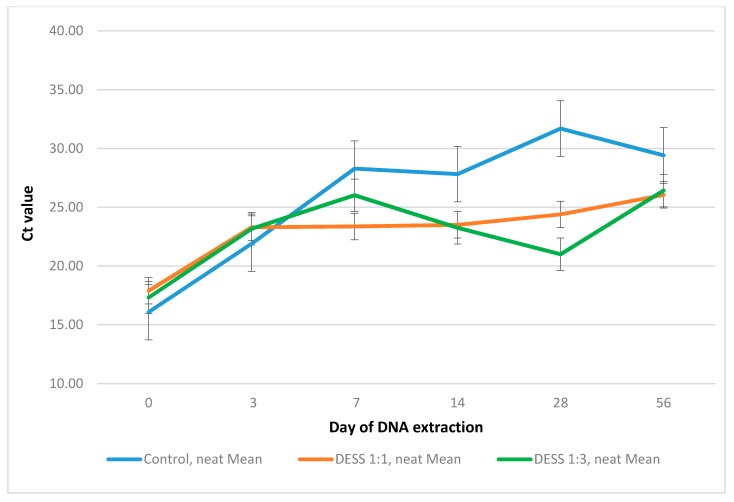
is a gastrointestinal parasitic nematode with a life cycle that includes free-living and parasitic forms. For both clinical (diagnostic) and environmental evaluation, it is important that we can detect spp. in both human and non-human fecal samples. Real-time PCR is the most feasible method for detecting the parasite in both clinical and environmental samples that have been preserved. However, one of the biggest challenges with PCR detection is DNA degradation during the postage time from rural and remote areas to the laboratory. This study included a laboratory assessment and field validation of DESS (dimethyl sulfoxide, disodium EDTA, and saturated NaCl) preservation of spp. DNA in fecal samples. The laboratory study investigated the capacity of 1:1 and 1:3 sample to DESS ratios to preserve in spike canine feces. It was found that both ratios of DESS significantly prevented DNA degradation compared to the untreated sample. This method was then validated by applying it to the field-collected canine feces and detecting DNA using PCR. A total of 37 canine feces samples were collected and preserved in the 1:3 ratio (sample: DESS) and of these, 17 were positive for spp. The study shows that both 1:1 and 1:3 sample to DESS ratios were able to preserve the spp. DNA in canine feces samples stored at room temperature for up to 56 days. This DESS preservation method presents the most applicable and feasible method for the DNA preservation in field-collected feces.
是一种胃肠道寄生线虫,其生命周期包括自由生活和寄生形式。对于临床(诊断)和环境评估而言,我们能够在人类和非人类粪便样本中检测到 属物种非常重要。实时聚合酶链反应(PCR)是在已保存的临床和环境样本中检测该寄生虫的最可行方法。然而,PCR检测面临的最大挑战之一是从农村和偏远地区邮寄到实验室的过程中DNA降解。本研究包括对二甲基亚砜(DMSO)、乙二胺四乙酸二钠(EDTA二钠)和饱和氯化钠(DESS)保存粪便样本中 属物种DNA的实验室评估和现场验证。实验室研究调查了1:1和1:3的样本与DESS比例在加标犬粪便中保存 的能力。结果发现,与未处理的样本相比,两种DESS比例均能显著防止DNA降解。然后通过将其应用于现场采集的犬粪便并用PCR检测 DNA来验证该方法。总共收集了37份犬粪便样本,并以1:3的比例(样本:DESS)保存,其中17份 属物种呈阳性。研究表明,1:1和1:3的样本与DESS比例均能够在室温下保存长达56天的犬粪便样本中的 属物种DNA。这种DESS保存方法是现场采集粪便中 DNA保存最适用且可行的方法。