Trombetta Amelia Chiara, Smith Vanessa, Gotelli Emanuele, Ghio Massimo, Paolino Sabrina, Pizzorni Carmen, Vanhaecke Amber, Ruaro Barbara, Sulli Alberto, Cutolo Maurizio
Research Laboratory And Academic Division Of Clinical Rheumatology, Department Of Internal Medicine, Irccs San Martino Aou, University Of Genoa, Genoa, Italy.
Department Of Rheumatology, Ghent University Hospital, Ghent University, Ghent, Belgium.
PLoS One. 2017 Jun 9;12(6):e0179062. doi: 10.1371/journal.pone.0179062. eCollection 2017.
Assessment of serum 25-hydroxyvitamin D (25(OH)D) correlations with clinical parameters and evaluation of the efficacy of standard oral supplementation in systemic sclerosis (SSc) patients.
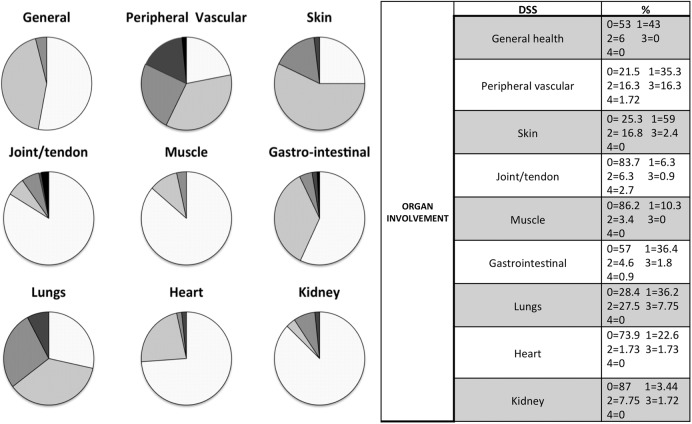
154 SSc patients were recruited, in all seasons. Serum 25(OH)D concentrations were evaluated using LIAISON 25-OH (Diasorin, Italy). Medsger disease severity scale (DSS), nailfold videocapillaroscopy (NVC) and all instrumental exam contemplated by international guidelines were performed. Drug assumption, including oral colecalciferol, was evaluated. Non-parametric tests were used for statistical analysis.
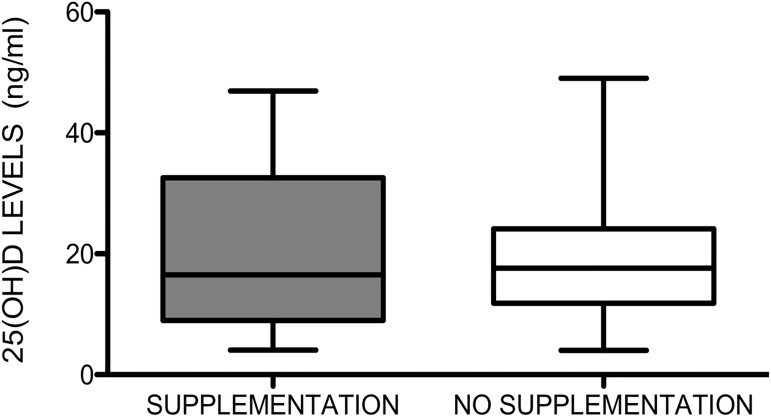
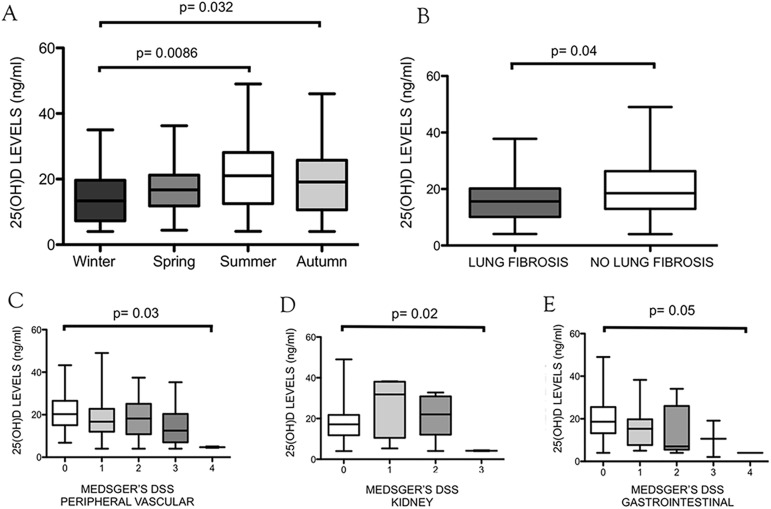
Average 25(OH)D serum concentration was 18.7 ±9 ng/ml (<20 classified as deficiency). A significant correlation was found with presence/absence of lung bi-basal fibrotic changes (16.1 ±8 ng/ml and 20 ±10 ng/ml, respectively; p = 0.04). Peripheral vascular (p = 0.03), kidney (p = 0.02), gastrointestinal (p = 0.05) Medsger's DSS parameters were found to correlate with 25(OH)D serum concentrations. No significant correlations were observed with digital ulcers incidence, strictly correlated to patterns of microangiopathy, defined at NVC analysis (p<0.0001). Interestingly, no effects of treatment with oral colecalciferol (Dibase 1,000 IU daily for at least 6 months) were found on 25(OH)D serum concentrations in treated (18.8 ±10 ng/ml) or untreated (18.7 ±9 ng/ml) SSc patients (p = 0.81). A significant difference was observed among seasonal 25(OH)D serum concentrations (winter: 14.6 ±7.8 ng/ml, spring: 17.2 ±7.9 ng/ml, summer: 21.43 ±10 ng/ml, autumn: 20.2 ±10 ng/ml; p = 0.032) in all patients.
Serum 25(OH)D deficiency was found to correlate with lung involvement, peripheral vascular, kidney and gastrointestinal Medsger's DSS parameters and with seasonality In SSc patients. Supplementation with oral colecalciferol was found not effective in increasing 25(OH)D serum concentrations. Therefore, for successful replacement, supra-physiological vitamin D3 doses or programmed UVB light exposure should be tested.
评估系统性硬化症(SSc)患者血清25-羟维生素D(25(OH)D)与临床参数的相关性,并评估标准口服补充剂的疗效。
招募了154例各个季节的SSc患者。使用LIAISON 25-OH(意大利索灵公司)评估血清25(OH)D浓度。进行梅斯杰疾病严重程度量表(DSS)、甲襞视频毛细血管镜检查(NVC)以及国际指南所考虑的所有仪器检查。评估药物服用情况,包括口服骨化三醇。采用非参数检验进行统计分析。
血清25(OH)D平均浓度为18.7±9 ng/ml(<20 ng/ml分类为缺乏)。发现其与肺部双基底部纤维化改变的有无存在显著相关性(分别为16.1±8 ng/ml和20±10 ng/ml;p = 0.04)。发现外周血管(p = 0.03)、肾脏(p = 0.02)、胃肠道(p = 0.05)的梅斯杰DSS参数与血清25(OH)D浓度相关。未观察到与数字溃疡发生率有显著相关性,数字溃疡发生率与NVC分析所定义的微血管病变模式密切相关(p<0.0001)。有趣的是,在接受治疗(18.8±10 ng/ml)或未接受治疗(18.7±9 ng/ml)的SSc患者中,未发现口服骨化三醇(每日1000 IU的骨化二醇,至少6个月)治疗对血清25(OH)D浓度有影响(p = 0.81)。在所有患者中,观察到季节性血清25(OH)D浓度存在显著差异(冬季:14.6±7.8 ng/ml,春季:17.2±7.9 ng/ml,夏季:21.43±10 ng/ml,秋季:20.2±10 ng/ml;p = 0.032)。
发现血清25(OH)D缺乏与SSc患者的肺部受累、外周血管、肾脏和胃肠道梅斯杰DSS参数以及季节性相关。发现口服骨化三醇补充剂在提高血清25(OH)D浓度方面无效。因此,为了成功替代,应测试超生理剂量的维生素D3或程序性紫外线B光照射。