Choi Tae-Young, Khaliq Mehwish, Tsurusaki Shinya, Ninov Nikolay, Stainier Didier Y R, Tanaka Minoru, Shin Donghun
Department of Developmental Biology, Pittsburgh Liver Research Center, McGowan Institute for Regenerative Medicine, University of Pittsburgh, Pittsburgh, PA.
Department of Regenerative Medicine, Research Institute, National Center for Global Health and Medicine, Tokyo, Japan.
Hepatology. 2017 Nov;66(5):1616-1630. doi: 10.1002/hep.29309. Epub 2017 Sep 29.
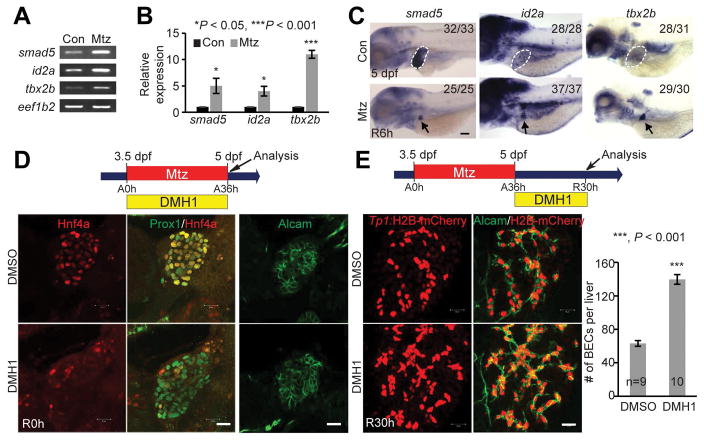
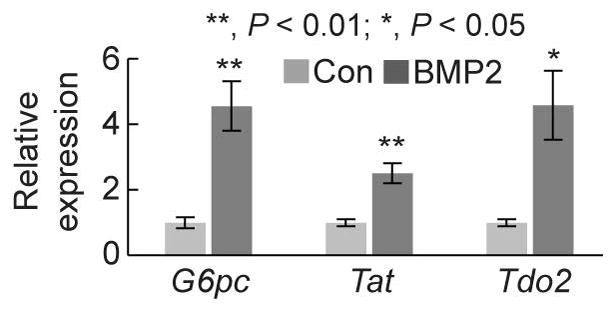
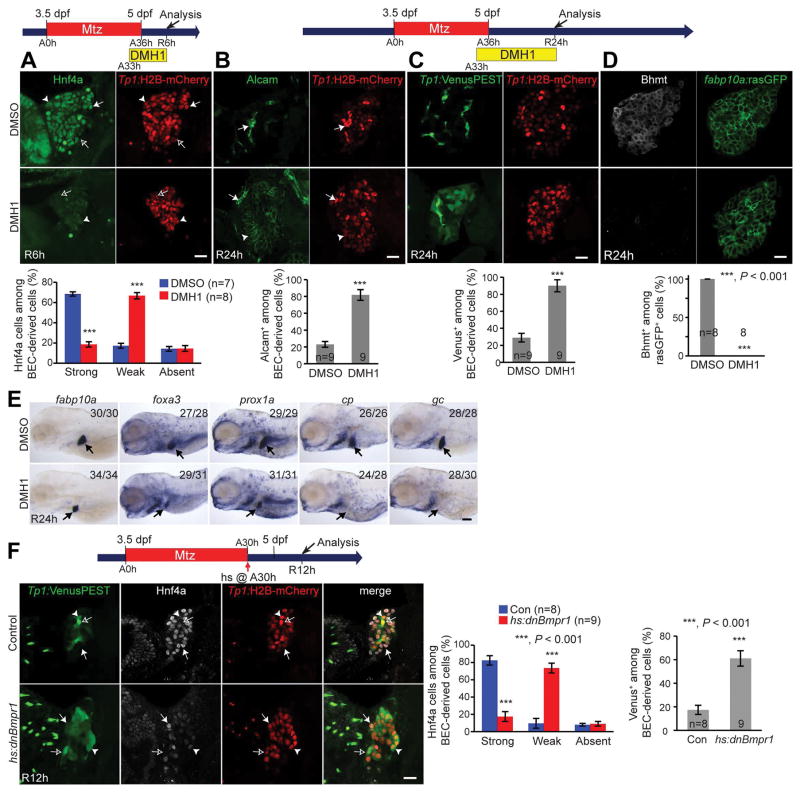
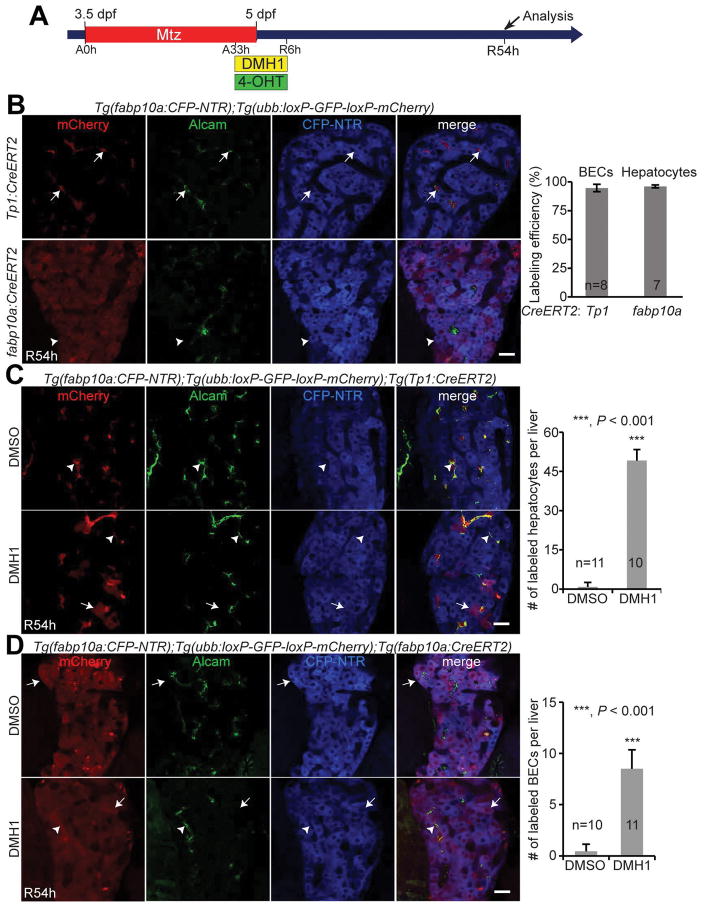
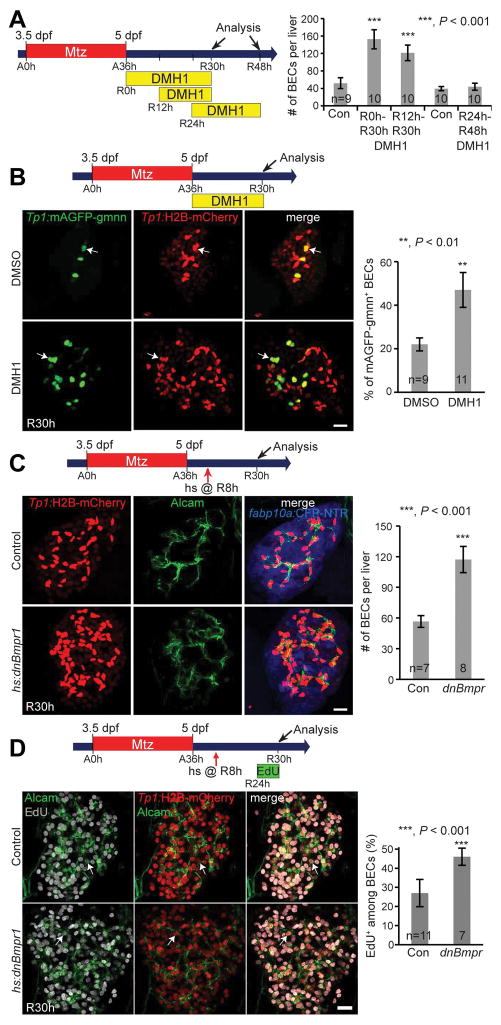
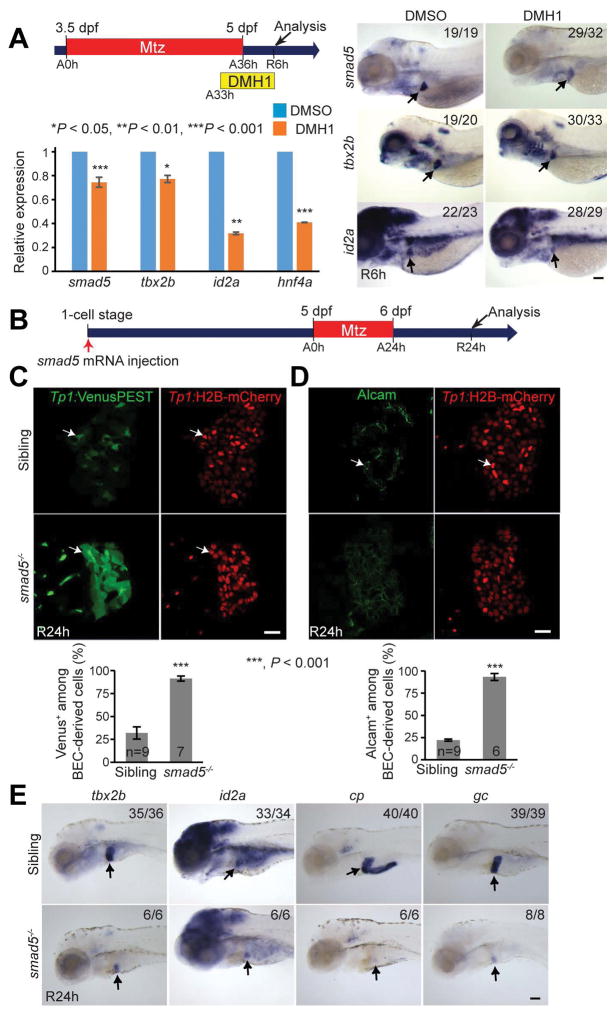
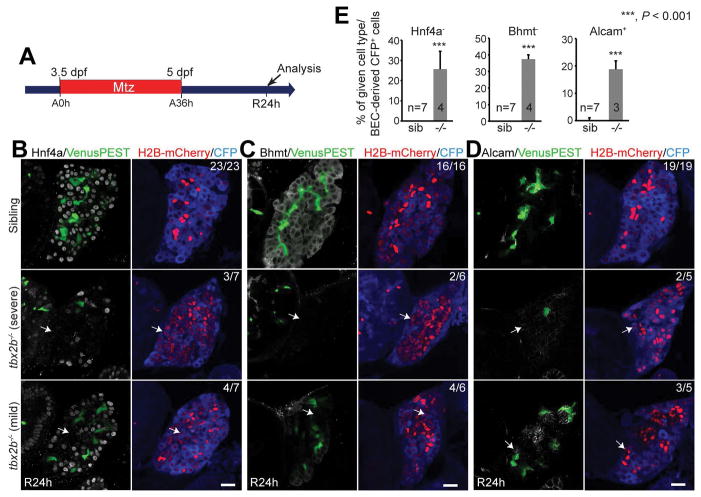
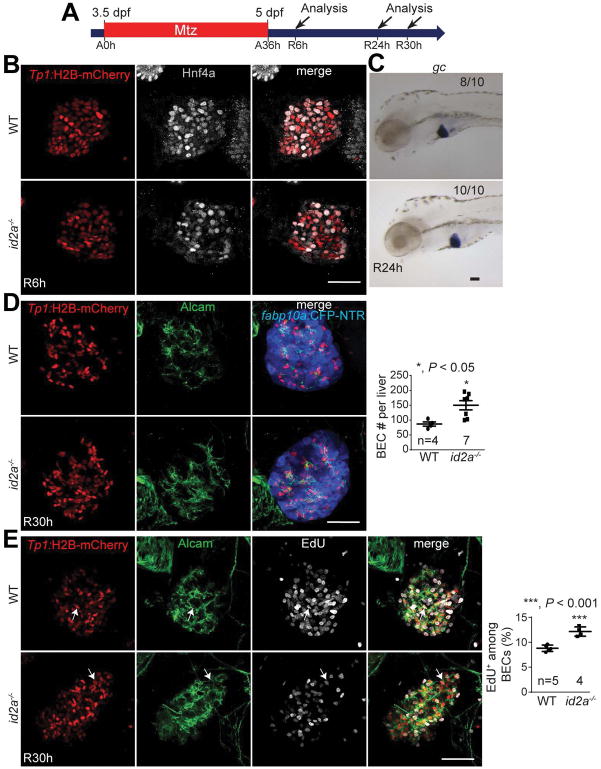
Upon mild liver injury, new hepatocytes originate from preexisting hepatocytes. However, if hepatocyte proliferation is impaired, a manifestation of severe liver injury, biliary epithelial cells (BECs) contribute to new hepatocytes through BEC dedifferentiation into liver progenitor cells (LPCs), also termed oval cells or hepatoblast-like cells (HB-LCs), and subsequent differentiation into hepatocytes. Despite the identification of several factors regulating BEC dedifferentiation and activation, little is known about factors involved in the regulation of LPC differentiation into hepatocytes during liver regeneration. Using a zebrafish model of near-complete hepatocyte ablation, we show that bone morphogenetic protein (Bmp) signaling is required for BEC conversion to hepatocytes, particularly for LPC differentiation into hepatocytes. We found that severe liver injury led to the up-regulation of genes involved in Bmp signaling, including smad5, tbx2b, and id2a, in the liver. Bmp suppression did not block BEC dedifferentiation into HB-LCs; however, the differentiation of HB-LCs into hepatocytes was impaired due to the maintenance of HB-LCs in an undifferentiated state. Later Bmp suppression did not affect HB-LC differentiation but increased BEC number through proliferation. Notably, smad5, tbx2b, and id2a mutants exhibited similar liver regeneration defects as those observed in Bmp-suppressed livers. Moreover, BMP2 addition promoted the differentiation of a murine LPC line into hepatocytes in vitro.
Bmp signaling regulates BEC-driven liver regeneration through smad5, tbx2b, and id2a: it regulates HB-LC differentiation into hepatocytes through tbx2b and BEC proliferation through id2a; our findings provide insights into promoting innate liver regeneration as a novel therapy. (Hepatology 2017;66:1616-1630).
在轻度肝损伤时,新的肝细胞源自已有的肝细胞。然而,如果肝细胞增殖受损,这是严重肝损伤的一种表现,胆管上皮细胞(BECs)会通过BEC去分化为肝祖细胞(LPCs),也称为卵圆细胞或肝母样细胞(HB-LCs),随后分化为肝细胞,从而对新肝细胞的形成做出贡献。尽管已经鉴定出了几种调节BEC去分化和激活的因子,但对于肝再生过程中LPC分化为肝细胞的调节因子知之甚少。利用斑马鱼近乎完全肝细胞消融的模型,我们表明骨形态发生蛋白(Bmp)信号通路对于BEC转化为肝细胞是必需的,特别是对于LPC分化为肝细胞。我们发现严重肝损伤导致肝脏中参与Bmp信号通路的基因上调,包括smad5、tbx2b和id2a。Bmp抑制并未阻止BEC去分化为HB-LCs;然而,由于HB-LCs维持在未分化状态,HB-LCs向肝细胞的分化受到损害。后期Bmp抑制并不影响HB-LC分化,但通过增殖增加了BEC数量。值得注意的是,smad5、tbx2b和id2a突变体表现出与Bmp抑制肝脏中观察到的类似的肝再生缺陷。此外,添加BMP2可促进小鼠LPC系在体外分化为肝细胞。
Bmp信号通路通过smad5、tbx2b和id2a调节BEC驱动的肝再生:它通过tbx2b调节HB-LC分化为肝细胞,并通过id2a调节BEC增殖;我们的发现为促进先天性肝再生作为一种新疗法提供了见解。(《肝脏病学》2017年;66:1616 - 1630)