Pan Xia, Yang Xiaoyan, Zang Jinglei, Zhang Si, Huang Nan, Guan Xinxin, Zhang Jianhua, Wang Zhihui, Li Xi, Lei Xiaoyong
Institute of Pharmacy and Pharmacology, University of South China, Hengyang, Hunan 421001, P.R. China.
Oncol Lett. 2017 Jun;13(6):4785-4793. doi: 10.3892/ol.2017.6049. Epub 2017 Apr 19.
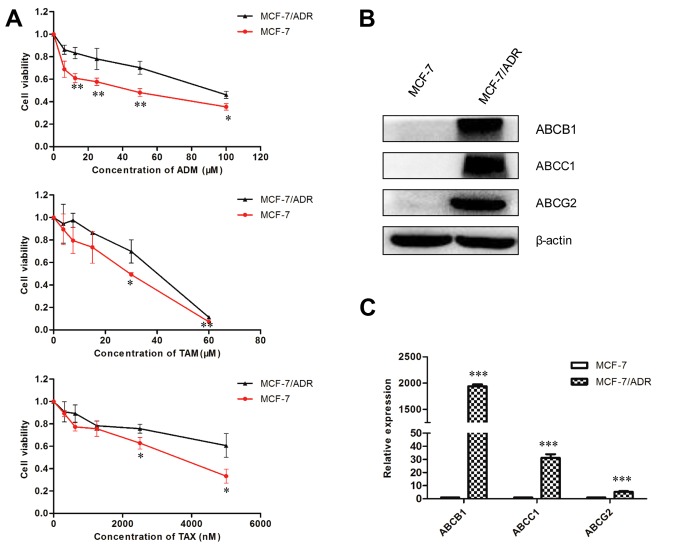
Overexpression of adenosine triphosphate-binding cassette (ABC) transport protein is emerging as a critical contributor to anticancer drug resistance. The eukaryotic translation initiation factor (eIF) 4F complex, the key modulator of mRNA translation, is regulated by the phosphoinositide 3-kinase-AKT-mammalian target of rapamycin pathway in anticancer drug-resistant tumors. The present study demonstrated the roles of ABC translation protein alterations in the acquisition of the Adriamycin (ADM)-resistant phenotype of MCF-7 human breast cells. Quantitative polymerase chain reaction and western blot analysis were applied to examine the differences in mRNA and protein levels, respectively. It was found that the expression of the ABC sub-family B member 1, ABC sub-family C member 1 and ABC sub-family G member 2 transport proteins were upregulated in MCF-7/ADR cells. An MTT assay was used to detect the cell viability, from the results MCF-7/ADR cells were less sensitive to ADM, tamoxifen (TAM) and taxol (TAX) treatment compared with MCF-7 cells. We predicted that the 3'-untranslated region of eukaryotic translation initiation factor 4-γ 1 (eIF4G) contains a potential miRNA binding site for microRNA (miR)-503 through using computational programs. These binding sites were confirmed by luciferase reporter assays. eIF4G mRNA degradation was accelerated in cells transfected with miR-503 mimics. Furthermore, it was demonstrated that eIF4G and ABC translation proteins were significantly downregulated in MCF-7/ADR cells after transfection with miR-503. It was found that miR-503 mimics could sensitize the cells to treatment with ADM, TAM and TAX. These findings demonstrated for the first time that eIF4G acted as a key factor in MCF-7/ADR cells, and may be an efficient agent for preventing and reversing multi-drug resistance in breast cancer.
三磷酸腺苷结合盒(ABC)转运蛋白的过表达正逐渐成为抗癌药物耐药性的关键促成因素。真核翻译起始因子(eIF)4F复合物是mRNA翻译的关键调节因子,在抗癌耐药肿瘤中受磷酸肌醇3激酶 - AKT - 雷帕霉素哺乳动物靶标通路调控。本研究证明了ABC转运蛋白改变在MCF - 7人乳腺癌细胞获得阿霉素(ADM)耐药表型中的作用。分别应用定量聚合酶链反应和蛋白质印迹分析来检测mRNA和蛋白质水平的差异。发现MCF - 7/ADR细胞中ABC亚家族B成员1、ABC亚家族C成员1和ABC亚家族G成员2转运蛋白的表达上调。采用MTT法检测细胞活力,结果显示与MCF - 7细胞相比,MCF - 7/ADR细胞对ADM、他莫昔芬(TAM)和紫杉醇(TAX)治疗的敏感性较低。我们通过使用计算程序预测真核翻译起始因子4 - γ 1(eIF4G)的3'非翻译区含有微小RNA(miR)-503的潜在miRNA结合位点。这些结合位点通过荧光素酶报告基因检测得到证实。在转染miR - 503模拟物的细胞中,eIF4G mRNA降解加速。此外,证明在转染miR - 503后,MCF - 7/ADR细胞中eIF4G和ABC转运蛋白显著下调。发现miR - 503模拟物可使细胞对ADM、TAM和TAX治疗敏感。这些发现首次证明eIF4G在MCF - 7/ADR细胞中起关键作用,可能是预防和逆转乳腺癌多药耐药的有效药物。