Conwell Darwin L, Banks Peter A, Sandhu Bimaljit S, Sherman Stuart, Al-Kaade Samer, Gardner Timothy B, Anderson Michelle A, Wilcox C Mel, Lewis Michele D, Muniraj Thiruvengadam, Forsmark Christopher E, Cote Gregory A, Guda Nalini M, Tian Ye, Romagnuolo Joseph, Wisniewski Stephen R, Brand Randall, Gelrud Andres, Slivka Adam, Whitcomb David C, Yadav Dhiraj
Brigham and Women's Hospital, Boston, MA, USA.
Division of Gastroenterology, Hepatology and Nutrition, Ohio State University Wexner Medical Center, Columbus, OH, 43210, USA.
Dig Dis Sci. 2017 Aug;62(8):2133-2140. doi: 10.1007/s10620-017-4621-z. Epub 2017 Jun 9.
BACKGROUND/OBJECTIVES: Our aim was to validate recent epidemiologic trends and describe the distribution of TIGAR-O risk factors in chronic pancreatitis (CP) patients.
The NAPS-2 Continuation and Validation (NAPS2-CV) study prospectively enrolled 521 CP patients from 13 US centers from 2008 to 2012. CP was defined by definitive changes in imaging, endoscopy, or histology. Data were analyzed after stratification by demographic factors, physician-defined etiology, participating center, and TIGAR-O risk factors.
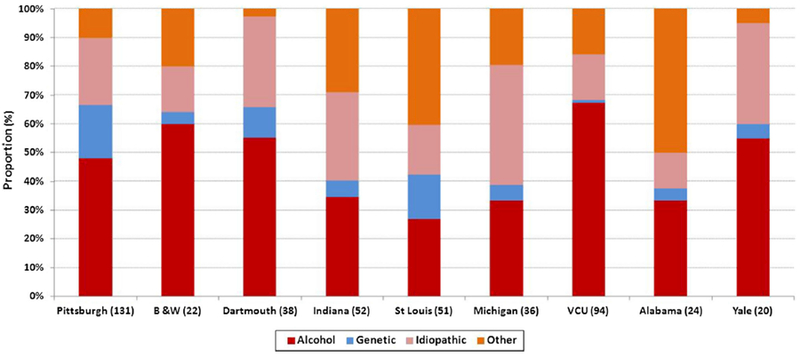
Demographics and physician-defined etiology in the NAPS2-CV study were similar to the original NAPS2 study. Mean age was 53 years (IQR 43, 62) with 55% males and 87% white. Overall, alcohol was the single most common etiology (46%) followed by idiopathic etiology (24%). Alcohol etiology was significantly more common in males, middle-aged (35-65 years), and non-whites. Females and elderly (≥65 years) were more likely to have idiopathic etiology, while younger patients (<35 years) to have genetic etiology. Variability in etiology was noted by participating centers (e.g., alcohol etiology ranged from 27 to 67% among centers enrolling ≥25 patients). Smoking was the most commonly identified (59%) risk factor followed by alcohol (53%), idiopathic (30%), obstructive (19%), and hyperlipidemia (13%). The presence of multiple TIGAR-O risk factors was common, with 1, 2, ≥3 risk factors observed in 27.6, 47.6, and 23.6% of the cohort, respectively.
Our data validate the current epidemiologic trends in CP. Alcohol remains the most common physician-defined etiology, while smoking was the most commonly identified TIGAR-O risk factor. Identification of multiple risk factors suggests CP to be a complex disease.
背景/目的:我们的目的是验证近期的流行病学趋势,并描述慢性胰腺炎(CP)患者中TIGAR - O风险因素的分布情况。
NAPS - 2延续与验证(NAPS2 - CV)研究在2008年至2012年期间前瞻性地纳入了来自美国13个中心的521例CP患者。CP由影像学、内镜检查或组织学的确定性改变定义。数据在按人口统计学因素、医生确定的病因、参与中心和TIGAR - O风险因素分层后进行分析。
NAPS2 - CV研究中的人口统计学和医生确定的病因与最初的NAPS2研究相似。平均年龄为53岁(四分位间距43, 62),男性占55%,白人占87%。总体而言,酒精是最常见的单一病因(46%),其次是特发性病因(24%)。酒精性病因在男性、中年(35 - 65岁)和非白人中明显更为常见。女性和老年人(≥65岁)更可能有特发性病因,而年轻患者(<35岁)更可能有遗传性病因。参与中心的病因存在差异(例如,在纳入≥25例患者的中心中,酒精性病因的比例从27%到67%不等)。吸烟是最常见的确定风险因素(59%),其次是酒精(53%)、特发性(30%)、梗阻性(19%)和高脂血症(13%)。多个TIGAR - O风险因素的存在很常见,该队列中分别有27.6%、47.6%和23.6%的患者观察到1个、2个、≥3个风险因素。
我们的数据验证了CP当前的流行病学趋势。酒精仍然是医生确定的最常见病因,而吸烟是最常见的确定的TIGAR - O风险因素。多个风险因素的存在表明CP是一种复杂的疾病。