Behaviour and Health Research Unit, Institute of Public Health, University of Cambridge, Cambridge, UK.
BMC Psychol. 2017 Jun 12;5(1):17. doi: 10.1186/s40359-017-0183-2.
Tableware size may influence how much food and non-alcoholic drink is consumed. Preliminary evidence of the impact of glass size on purchasing of alcoholic drinks shows an increase in wine sales of almost 10% when the same portion of wine is served in a larger glass. The primary aim of the current study is to test if micro-drinking behaviours act as a mechanism that could underlie this effect, through an increase in drinking rate, sip duration and/or number of sips from a larger glass.
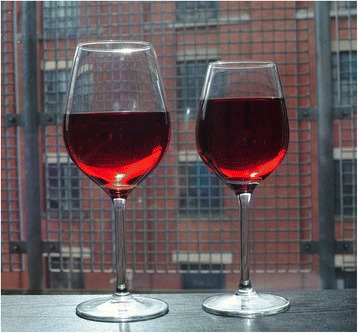
In a between-subjects experimental design, 166 young women were randomised to drink a 175 ml portion of wine from either a smaller (250 ml) or larger (370 ml) wine glass. Primary outcomes were three micro-drinking behaviours, assessed observationally using video recordings: drinking rate, sip number and sip duration. Other possible mechanisms examined were satisfaction with the perceived amount of wine served and pleasure of the drinking experience, assessed using self-report measures.
Wine drunk from the larger, compared with the smaller glass, was consumed more slowly and with shorter sip duration, counter to the hypothesised direction of effect. No differences were observed in any of the other outcome measures.
These findings provide no support for the hypothesised mechanisms by which serving wine in larger wine glasses increases consumption. While micro-drinking behaviours may still prove to be a mechanism explaining consumption from different glass sizes, cross-validation of these results in a more naturalistic setting is needed.
餐具的大小可能会影响人们食用食物和非酒精饮料的量。初步证据表明,酒杯大小会影响酒精饮料的购买量,当相同份量的葡萄酒装在更大的酒杯中时,葡萄酒的销量会增加近 10%。本研究的主要目的是测试如果微饮酒行为作为一种机制,可以通过增加饮酒速度、口数和/或从更大的酒杯中啜饮的次数,来解释这种影响。
在一项随机分组的实验设计中,166 名年轻女性被随机分配从一个较小的(250 毫升)或较大的(370 毫升)酒杯中饮用 175 毫升的葡萄酒。主要结果是三个微饮酒行为,使用视频记录进行观察评估:饮酒速度、口数和口持续时间。使用自我报告的措施评估了其他可能的机制,如对所提供的葡萄酒量的满意度和饮酒体验的愉悦感。
与较小的酒杯相比,从较大的酒杯中饮用的葡萄酒饮用速度较慢,口持续时间较短,与预期的效果方向相反。在其他任何测量指标上都没有观察到差异。
这些发现没有为通过使用更大的酒杯来增加葡萄酒消费的假设机制提供支持。虽然微饮酒行为仍可能是解释从不同酒杯大小饮酒的机制,但需要在更自然的环境中对这些结果进行交叉验证。